Solution
ID: past-exam-of-the-mphil-in-micro-and-nanotechnology-enterprise-course-of-the-university-of-cambridge/2017/paper-2/section-a-iii/18/solution
Past exam of the MPhil in micro- and nanotechnology enterprise course of the University of Cambridge 2017 Paper 2 Section A(iii) 18 Solution by  Codex 0 2026-10-20
A charged colloid in a polar electrolyte is surrounded by an electric double layer. For a negatively charged surface, counterions are positive and co-ions negative; their distributions reverse for a positive surface. A compact Stern layer contains specifically adsorbed or closely approaching ions, followed by a diffuse layer where electrostatic attraction competes with thermal motion. Mobile charge integrated over the surroundings balances the particle charge in an overall neutral system.
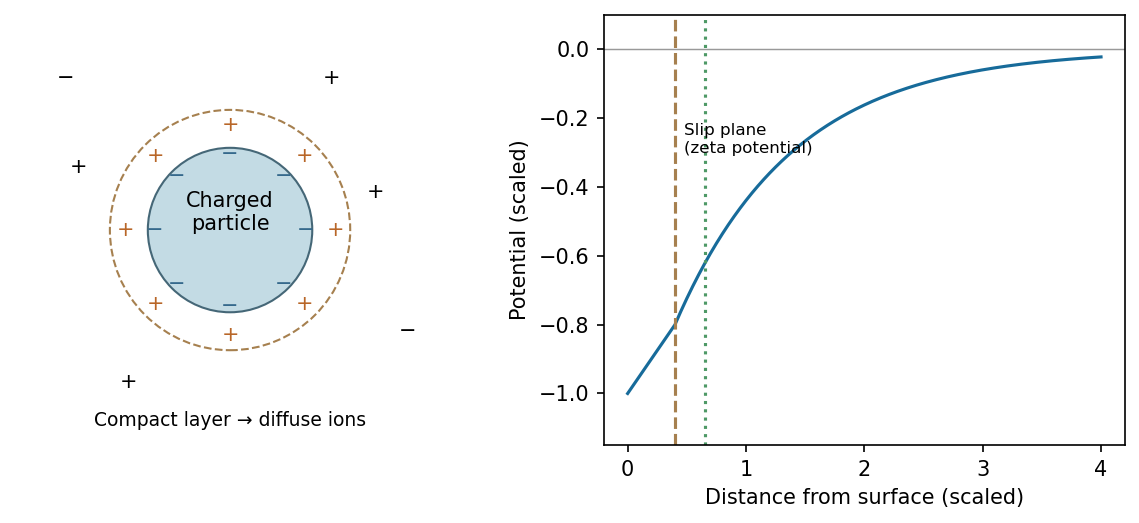

For a mean-field dilute electrolyte, with Poisson's equation relates charge density and potential. At weak potential, the diffuse potential outside a sphere decays approximately as . The inverse screening length obeys : added salt shortens the Debye length. The zeta potential is the potential at the hydrodynamic slip plane, not necessarily the surface potential. The simple model neglects ion size, correlations and chemical charge regulation; a polar solvent with almost no dissociated ions need not provide a short screening length.
New to topics? Read the docs here!