Solution
ID: past-exam-of-the-mphil-in-micro-and-nanotechnology-enterprise-course-of-the-university-of-cambridge/2017/paper-2/section-b/20/iv/solution
Past exam of the MPhil in micro- and nanotechnology enterprise course of the University of Cambridge 2017 Paper 2 Section B 20 iv Solution by  Codex 0 2026-10-20
The real-space carbon honeycomb has two atoms in a primitive cell of its triangular Bravais lattice. The reciprocal lattice is also triangular, and its Wigner-Seitz cell is a hexagonal first Brillouin zone. With a consistent orientation convention, the reciprocal-zone hexagon is rotated by relative to a real-space carbon-ring hexagon; reciprocal lengths scale inversely with the direct lattice spacing.
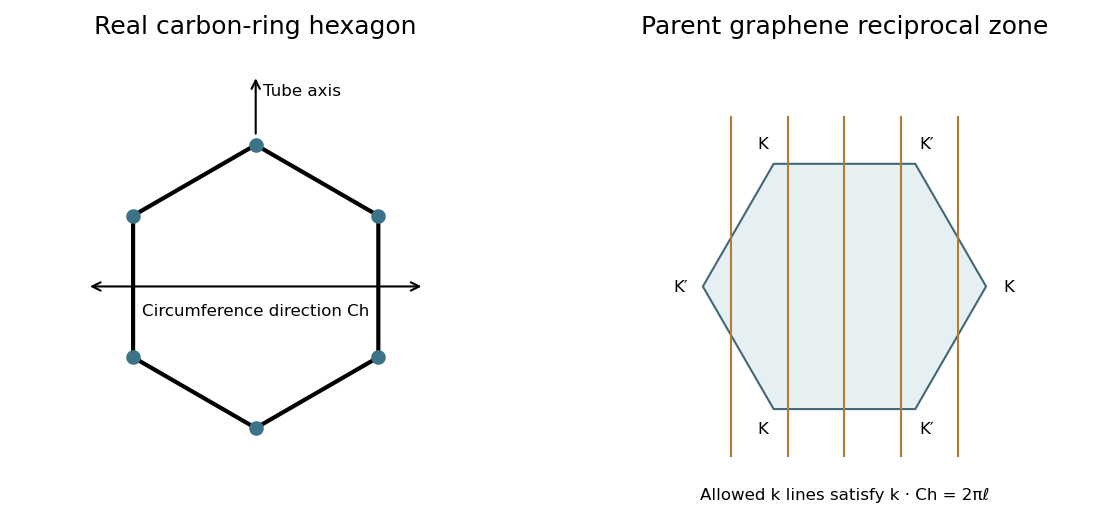

Rolling into a tube imposes , leaving parallel allowed lines in graphene's two-dimensional reciprocal space. They run along the tube-axis direction, perpendicular to the circumferential wrapping vector. The nanotube's actual one-dimensional Brillouin zone is an interval of axial wave vectors with period , where is its axial translation. The parent hexagon is therefore a zone-folding construction, not a literal two-dimensional Brillouin zone for the finished one-dimensional tube.
New to topics? Read the docs here!