Solution
ID: past-exam-of-the-mphil-in-micro-and-nanotechnology-enterprise-course-of-the-university-of-cambridge/2018/paper-2/section-a-ii/13/i/solution
Past exam of the MPhil in micro- and nanotechnology enterprise course of the University of Cambridge 2018 Paper 2 Section A(ii) 13 i Solution by  Codex 0 2026-10-20
Only the magnetic-response physics is addressed here; biological and clinical application is user-deferred.
A single-domain particle has an approximately coherent magnetic dipole moment, but single-domain does not by itself imply rapid thermal reversal. If moments equilibrate within the measurement time, a dilute, noninteracting ensemble is superparamagnetic: its quasistatic magnetization is reversible, odd in field and approaches saturation with negligible remanence or magnetic coercivity.
For freely orientable classical moments,At small field, ; at large field moments align. This Langevin form is an ideal limit, not a universal exact curve for anisotropic fixed-axis particles.
The missing timescale/magnetic anisotropy information must be stated: blocked single-domain particles can already show hysteresis. Also, a reversible quasistatic curve does not preclude a finite-frequency loss loop when relaxation lags an alternating field. The original curves illustrate an equilibrated dilute limit and possible blocked/interacting alternatives, not measured treatment performance.
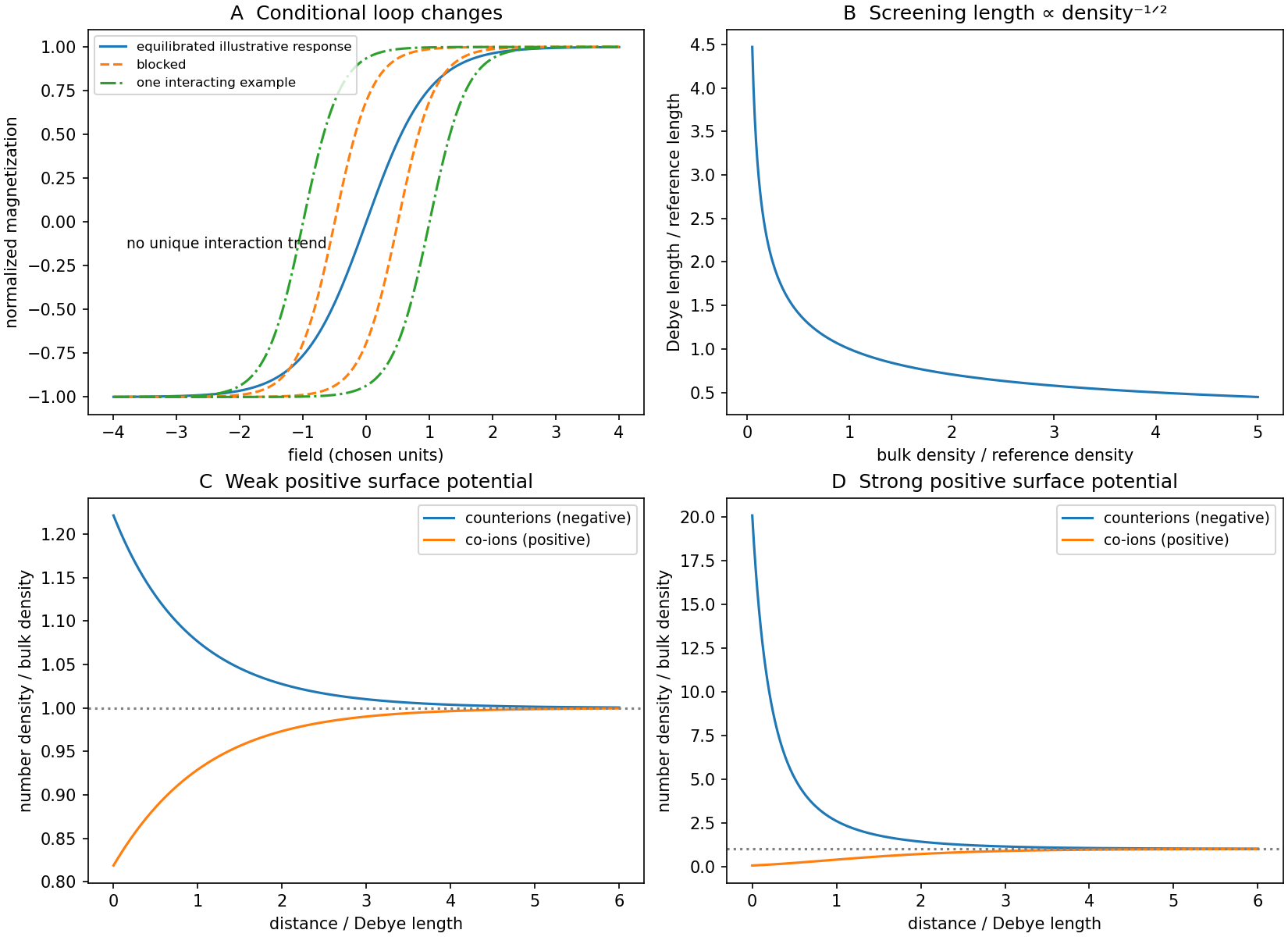
Conditional magnetic loops and electrostatic screening profiles
. Original illustrative magnetic curves and calculated planar mean-field ion profiles. Magnetic-loop broadening is one possible interaction outcome, not a concentration-dependent experimental fit or a clinical prediction. Details.
New to topics? Read the docs here!