Solution
ID: past-exam-of-the-mphil-in-micro-and-nanotechnology-enterprise-course-of-the-university-of-cambridge/2019/paper-2/section-b/20/iv/solution
Past exam of the MPhil in micro- and nanotechnology enterprise course of the University of Cambridge 2019 Paper 2 Section B 20 iv Solution by  Codex 0 2026-10-20
Let the graphene lattice constant be , and choose direct primitive vectors and . Reciprocal primitive vectors satisfying areThe first Brillouin zone is a hexagon. Its corners K and K' are inequivalent valleys; M denotes an edge midpoint. In the nearest-neighbour model, , where and are the three bond vectors. The band separation is : it vanishes at K/K' and is at M, varying continuously along each edge.
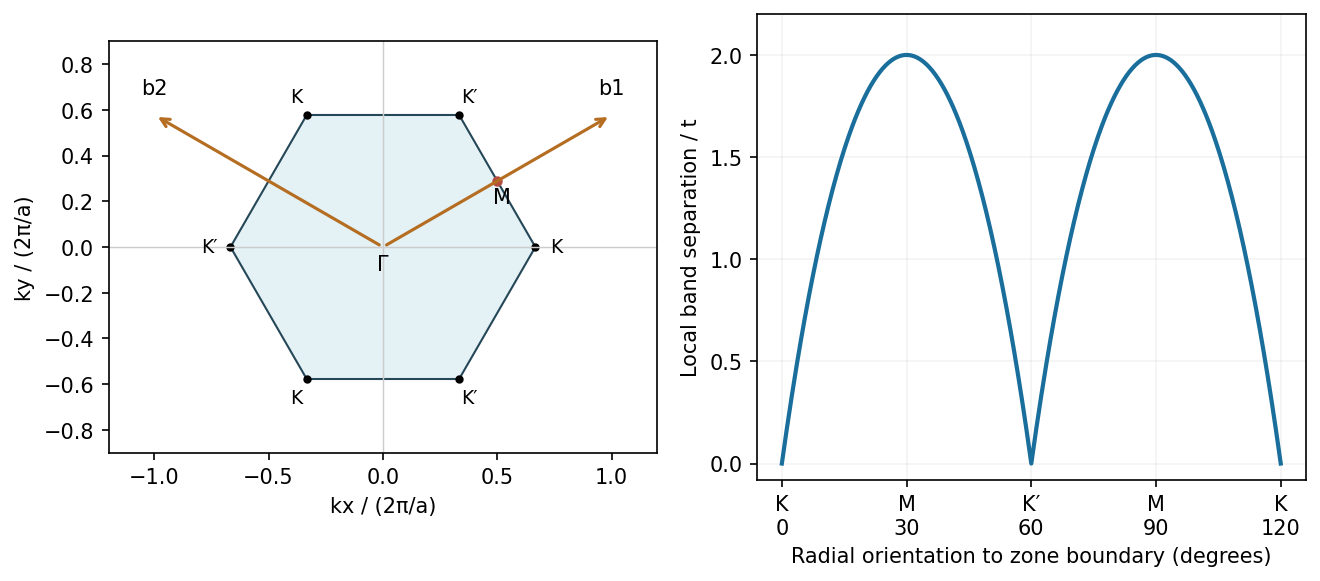
Graphene reciprocal primitive vectors and the orientation-dependent band separation on its zone boundary
. Source. Details. 
This graphene zone-boundary band separation is a local conduction-to-valence separation. Ideal graphene itself remains globally gapless because the bands touch at the corners. Circumferential quantization in a nanotube selects lines through this two-dimensional band structure; whether they pass through a valley determines the ideal metallic versus semiconducting distinction.
New to topics? Read the docs here!