Solution
ID: past-exam-of-the-mphil-in-micro-and-nanotechnology-enterprise-course-of-the-university-of-cambridge/2022/paper-1/section-a-ii/4/ii/solution
Past exam of the MPhil in micro- and nanotechnology enterprise course of the University of Cambridge 2022 Paper 1 Section A(ii) 4 ii Solution by  Codex 0 2026-10-20
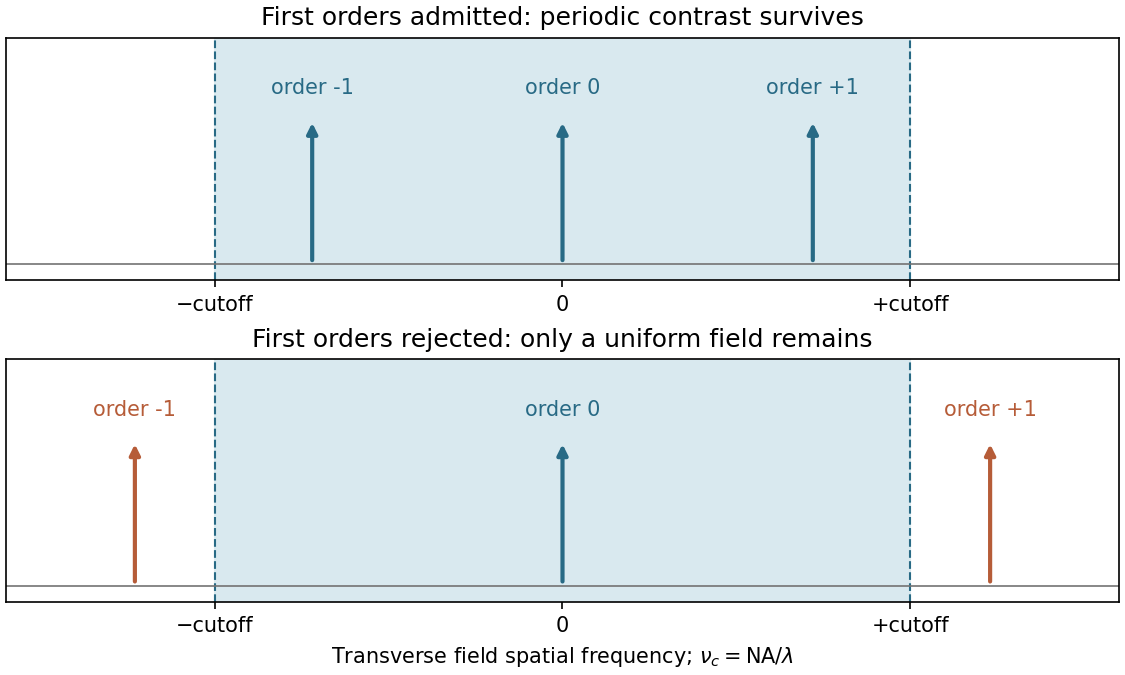
The projection lens maps the mask's angular spectrum into its back focal plane: within scalar Fourier optics this is the Fraunhofer diffraction or spatial-Fourier plane. A periodic mask produces discrete diffraction orders, separated by in object-side spatial frequency after accounting for projection magnification. The finite numerical aperture bounds the transverse wave vectors admitted by the lens, so the pupil is a spatial-frequency filter.
For an ideal on-axis coherent system,A second Fourier transformation forms the image, and the recorded intensity is . If only the zero order passes, the field is uniform and the line pattern disappears. Passing zero and first orders restores a periodic modulation; passing more orders sharpens the edges. Thus the loss of fine structure is explained by rejected diffraction orders, not by a geometrical inability to draw narrow lines. The field-transfer cutoff differs from the twice-as-large incoherent intensity-transfer cutoff.[ref]
Advanced Optical Imaging: Incoherent imaging by Delft University of Technology. coherent and incoherent transfer: pupil filtering and intensity formation

New to topics? Read the docs here!