Solution
ID: past-exam-of-the-mphil-in-micro-and-nanotechnology-enterprise-course-of-the-university-of-cambridge/2022/paper-1/section-a-iii/7/ii/solution
Past exam of the MPhil in micro- and nanotechnology enterprise course of the University of Cambridge 2022 Paper 1 Section A(iii) 7 ii Solution by  Codex 0 2026-10-20
For constant current and nearly constant capacitance,An ideal supercapacitor therefore has approximately linear charge and discharge ramps, making a triangular voltage–time trace. Series resistance adds an immediate voltage step when current starts and a step of magnitude when it reverses directly from to . Leakage and voltage-dependent capacitance introduce curvature.
A secondary battery instead follows electrode chemical potentials as its state of charge changes; many chemistries have broad plateaus or sloping plateaus, with polarization separating the charge and discharge curves. This distinction is typical rather than universal: some batteries have steeply sloping profiles, while strongly potential-dependent pseudocapacitive materials can depart substantially from a triangle.
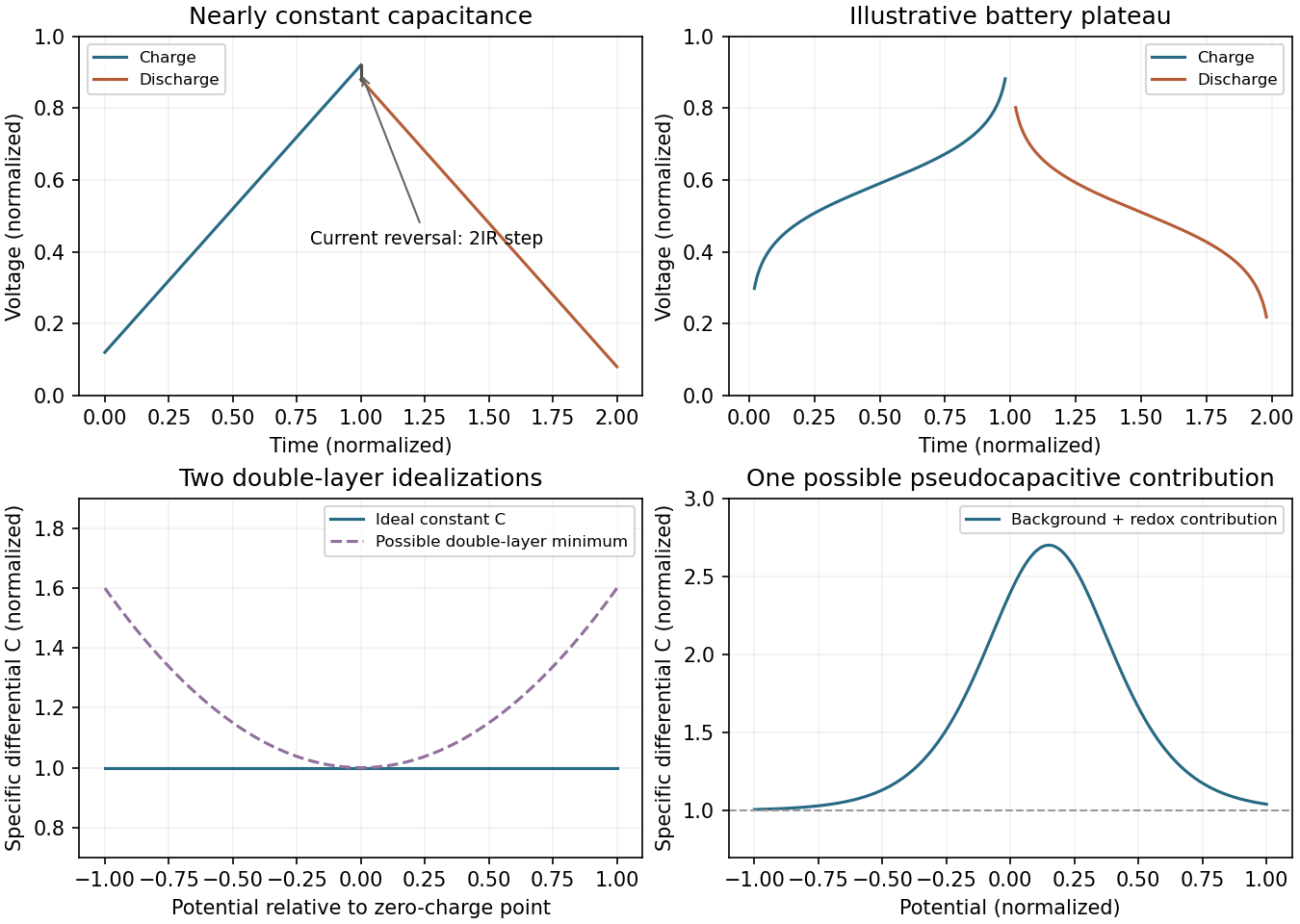
Idealized supercapacitor and battery responses, with capacitance–potential alternatives
. Original schematic curves; the lower panels distinguish a constant differential capacitance, a double-layer minimum and a localized redox contribution. They are alternative models, not a universal measured curve. Details.
New to topics? Read the docs here!