An electric battery converts the available chemical Gibbs free energy of one or more galvanic cells into electrical work delivered to an electrical load. The reacting materials are a finite reservoir: a battery can sustain a terminal electric potential difference while discharging, but cannot supply energy indefinitely. Unlike a capacitor, whose capacitor energy resides in an electric field, a battery chiefly stores its available energy in the chemical state of its materials. The detailed half-reactions and apparatus of a Daniell cell explain this conversion at the electrode level.
During discharge, electrons move through metallic wires from the negative anode, through the electrical load, to the positive cathode; external conventional current points the other way. Inside the battery, ions carry electric current through the electrolyte, and redox chemical reactions connect ionic transport to electronic transport at the electrodes. The same electron does not make a lap through both wire and electrolyte. Electric charge conservation closes the circuit; changing chemical composition supplies the energy. See galvanic cell for the two transport paths and electrolyte for how oppositely moving ions contribute to one net electric current.
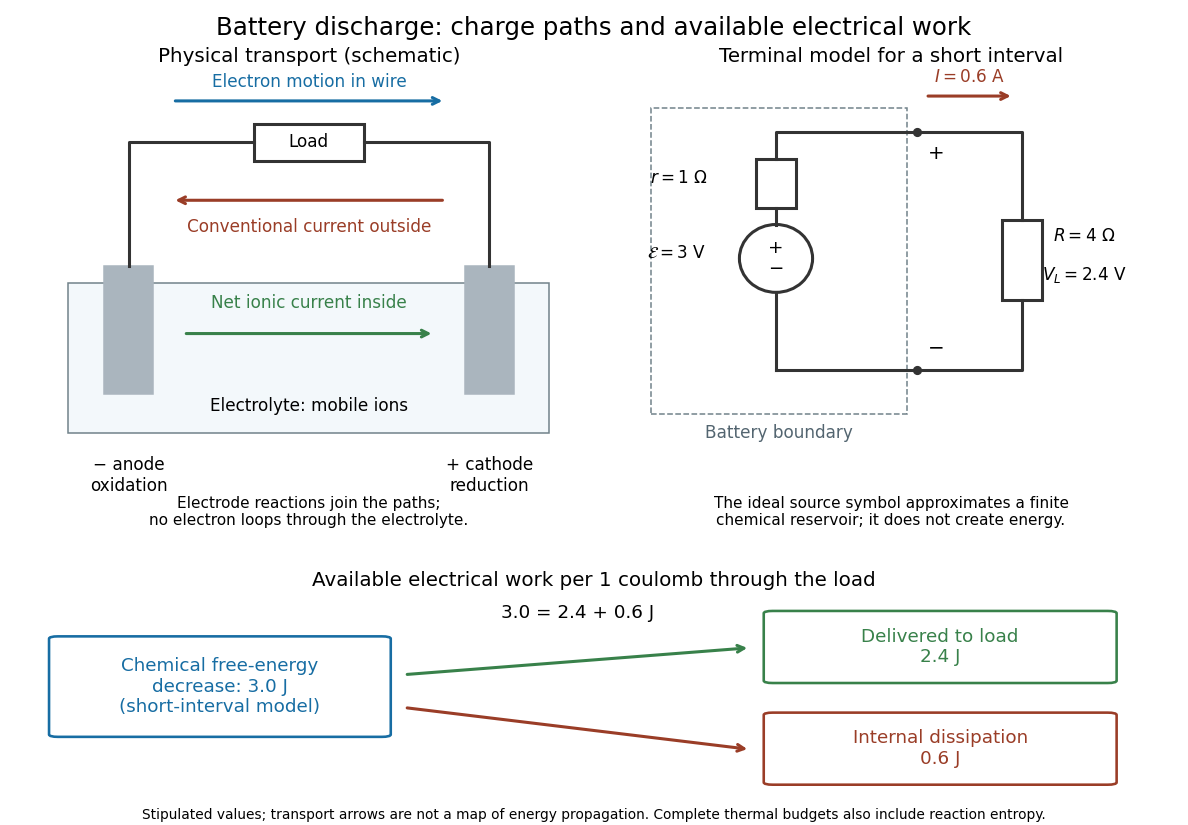
The source's electromotive force measures its driving work per unit electric charge, in volts; the loaded terminal electric potential difference measures the electrical work per unit electric charge delivered outside the battery. They agree in an ideal lossless source, or approximately near open circuit, but generally differ during discharge.[ref]
University Physics Volume 2 by Samuel J. Ling and others. §10.1, Introduction to Electromotive Force, work per charge and terminal voltage
In the ideal fixed-voltage model used in fixed-voltage capacitor energy balance, a battery maintains a prescribed terminal electric potential difference while electric charge flows to or from the capacitor. This is a constraint for that calculation, not an inexhaustible reservoir. The fixed-voltage capacitor energy balance also accounts for electrical energy returned to the source; an actual cell can accept sustained charging only if its chemistry and operating conditions permit it.
A battery using lithium oxidation and oxygen reduction, often producing lithium peroxide in a nonaqueous discharge. Specific-energy claims depend strongly on whether oxygen, electrolyte and inactive components are included in the mass.
A miniature battery, often fabricated as a thin film or patterned three-dimensional structure for small devices. The term concerns size and construction; primary or rechargeable chemistry can be used.
A battery designed to recover usable chemical energy by electrical charging that reverses its discharge reactions. Reversibility, cycle life and parasitic reactions distinguish a practical secondary cell from a merely thermodynamically reversible equation.
Electrical charge delivered per unit mass, commonly expressed in ampere-hours per gram. For an ideal active material transferring electrons per formula unit, when is in grams per mole.
A metal-air cell that oxidizes zinc while reducing oxygen at a gas-accessible positive electrode. Primary and electrically rechargeable designs exist; reversible zinc morphology and durable oxygen-evolution catalysis are major requirements for the latter.
A rechargeable aqueous sulfuric-acid cell using lead and lead dioxide electrodes. Discharge converts both active materials to lead sulfate; charging reverses that conversion subject to corrosion, gas evolution and morphology limitations.
In lead-acid batteries, development of lead-sulfate deposits that are difficult to reconvert during ordinary charging. Persistent coarse deposits reduce accessible area and capacity; sulfate formation during normal discharge is not by itself a failure.
A rechargeable cell transferring lithium ions between host electrodes during charging and discharge. Host chemical potentials determine voltage; an exposed lithium-metal electrode is a distinct design.
Charge released per specified active or composite mass under complete stoichiometric utilization. For electrons per formula unit, active-material capacity is in mAh per gram.
An electrode whose discharge transforms the active compound into different phases rather than merely reversibly inserting a small ion.
A battery designed for discharge rather than efficient repeated electrochemical regeneration of its initial state.
A primary battery using metallic lithium and iron disulfide. The overall discharge conversion consumes four lithium atoms and releases four electrons per formula unit. This is distinct from the rechargeable host-to-host transport in a conventional lithium-ion battery.
The charge a battery can deliver under specified operating conditions.
Loss of stored charge through internal processes without useful external electric current.
A primary battery coupling lithium oxidation to reduction of fluorinated carbon, producing lithium fluoride and carbon.
A useful short-interval approximation replaces a battery by an ideal electromotive force in series with a positive internal electrical resistance . This is the Thévenin terminal response with open-circuit voltage and Thévenin resistance . The model describes the terminals without asserting that there is a separate physical resistor hidden inside the cell. Both and can change with composition, temperature, electric current and history.[ref]
University Physics Volume 2 by Samuel J. Ling and others. §10.1, Internal Resistance and Terminal Voltage, current/temperature/history dependence and equation 10.1
For a resistive electrical load , take to mean discharge: conventional current leaves the positive terminal. Kirchhoff's voltage law and Ohm's law giveFor the stipulated , , ,An open-circuit voltage of therefore does not promise at this electrical load. Increasing the load electrical resistance reduces electric current and brings closer to , as in Thévenin load response.
The signed relation also explains charging within this model. If an external source drives electric current into the positive terminal, and . The terminal electric potential difference then exceeds . This algebra is not evidence that every battery is rechargeable.[ref]
University Physics Volume 2 by Samuel J. Ling and others. §10.1, paragraph accompanying Figure 10.10: reversed current and charging terminal voltage
In the constant-parameter battery internal resistance model, the source's available electrical power splits between the electrical load and internal dissipation:The stipulated , , calculation gives , , and . A resistive electrical load converts its share to Joule heating; another electrical load might convert some of it to mechanical work or light. The source term is available electrical work per time, not a complete cell heat budget: reaction entropy can also matter.
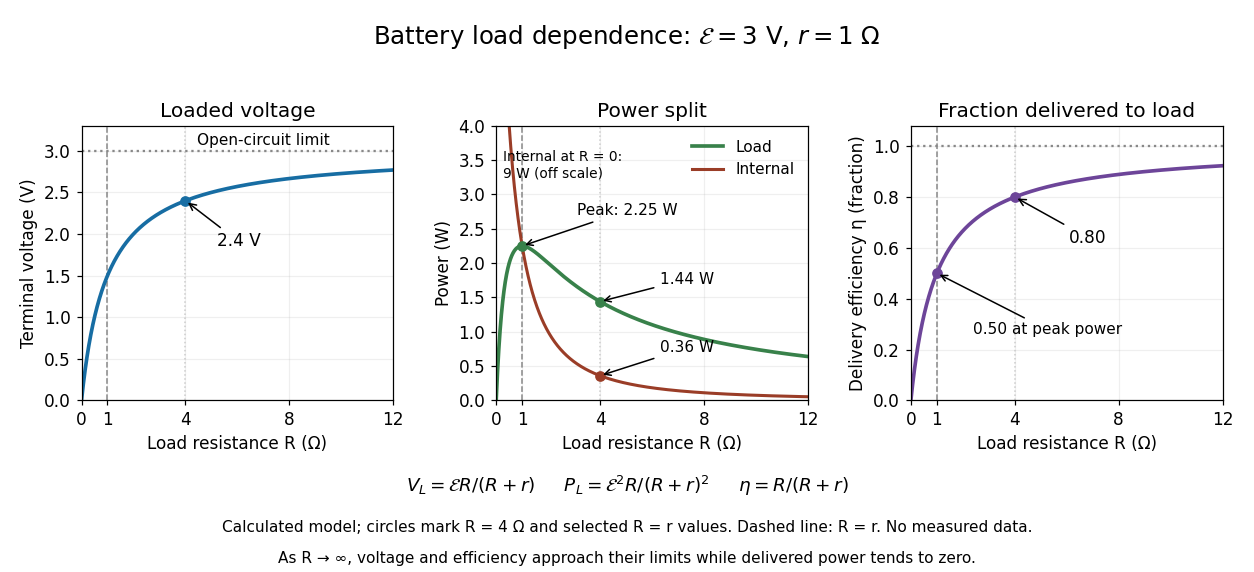
Define the delivery efficiency relative to the source's available electrical work, rather than to all chemical energy or to a complete charging cycle:Here . The largest load power occurs at : since ,Thus maximum load power and maximum delivery efficiency ask different questions. As , and , but and : a high nearly unloaded voltage supplies almost no power. As , the model gives , and internal power tending to . Real high-current operation can invalidate constant and ; the mathematical maximum does not establish a permissible operating point for an actual battery.
A battery's charge reservoir means a finite amount of electric charge can pass through the external electrical circuit before its usable chemical state is depleted. It does not mean a large net electric charge is sitting inside the casing. For one net cell chemical reaction transferring electrons per reaction event, an ideal reaction inventory obeyswhere is the Faraday constant and the extent of reaction in moles, assuming all the electric current serves that reaction. At fixed temperature and pressure, its reversible electromotive force obeys : a decrease in Gibbs free energy provides the maximum reversible electrical work per mole. The electromotive force also depends on composition; the Daniell cell illustrates this with thermodynamic activity.[ref]
17.4 Potential, Free Energy, and Equilibrium. §17.4, E° and ΔG°, and Potentials at Nonstandard Conditions: free energy, cell potential and composition
As an original finite-reservoir exercise, stipulate usable and hold the preceding , , parameters constant until an abrupt cutoff. Then , available electrical work is , load work is , and internal dissipation is . This explicitly finite idealization predicts ten minutes, not an experimentally measured runtime. Real accessible charge depends on discharge conditions and the chosen terminal-voltage cutoff. Charge alone is also not an energy: converting it to delivered work requires the terminal electric potential difference throughout discharge.
The institutional handout Measurement of Emf Using a Potentiometer, Oklahoma Christian University laboratory (Experimental Activity: calibration procedure, measuring a test cell, and measuring internal resistance of a cell) compares unloaded and loaded battery readings. Its apparatus uses a slidewire potentiometer, calibrated resistance coils, a reference cell, a galvanometer, a nominal flashlight cell, a voltmeter, and a switched variable resistor branch with an ammeter. Calibration uses the reference cell's tagged electromotive force; zero galvanometer deflection establishes a null measurement. With the load branch open, the null reading draws no test-cell electric current. The protocol compares newer and older cells using both instruments, then records simultaneous loaded terminal electric potential difference and electric current. It prescribes brief measurements, opening the load switch between readings, and periodic calibration rechecks. These are documented procedures, not run data.[ref]
Measurement of Emf Using a Potentiometer, Oklahoma Christian University laboratory. Experimental Activity, calibration procedure and measuring a test cell; measuring internal resistance, side branch K-A-R and simultaneous readings
For the battery internal resistance model, . The handout's analysis estimates electromotive force from the intercept and from the negative slope, then compares the intercept with the independent null reading.[ref]
Measurement of Emf Using a Potentiometer, Oklahoma Christian University laboratory. Measuring internal resistance of a cell, final analysis paragraphs: line intercept/slope and comparison with the earlier emf measurement
Additional replication controls are to repeat the open-load reading after the sweep, return to an earlier load setting to detect drift, and record temperature, elapsed time, instrument resolution and measurement error. Include ammeter and contact electrical resistance in the external path; allow for voltmeter loading if a voltmeter replaces the null instrument. The Thévenin measurement experiment gives the corresponding meter-loading correction. Curvature or time-dependent readings can reject the constant- approximation, but a terminal curve alone does not identify which internal transport or electrode process caused the deviation. These extra controls and interpretations are model-based extensions, not reported outcomes of the handout.


