Solution
ID: past-exam-of-the-mphil-in-micro-and-nanotechnology-enterprise-course-of-the-university-of-cambridge/2022/paper-2/section-b/20/v/solution
Past exam of the MPhil in micro- and nanotechnology enterprise course of the University of Cambridge 2022 Paper 2 Section B 20 v Solution by  Codex 0 2026-10-20
A c-axis wurtzite ZnO wire has crystallographically polar basal ends, conventionally Zn-terminated and O-terminated , and approximately nonpolar prismatic side facets such as . Crystallographic polarity is not identical to net surface charge in a growth solution: protonation, adsorbates and ionic speciation can change the latter.
For face-selective electrostatic growth inhibition, an oppositely charged additive adsorbs preferentially to a particular face and obstructs incorporation there. Blocking the axial end lowers axial growth relative to radial growth and yields a smaller aspect ratio; blocking sidewalls suppresses radial growth and favours long thin wires.
A primary hydrothermal experiment at pH 11 found negatively charged basal top surfaces and positively charged sidewalls. Positively charged Cd-containing complexes inhibited the top and favoured platelets; negatively charged Al-containing complexes inhibited sidewalls and favoured large aspect ratios. These signs are condition-specific, not fixed by the formal Zn/O termination alone.[ref]
Face-selective electrostatic control of hydrothermal zinc oxide nanowire synthesis by Jaebum Joo and others. 2011, Fig. 1 and pH-dependent complex-ion and surface-charge discussion
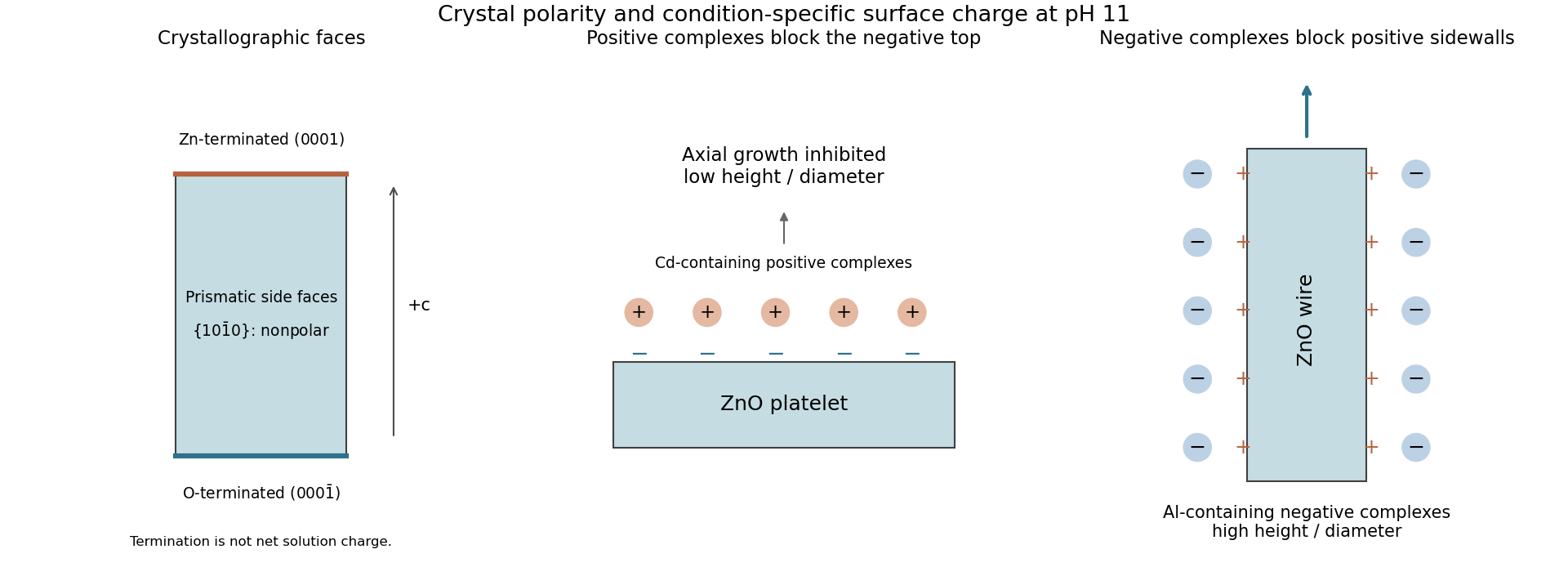
Facet-selective adsorption changes axial and radial ZnO growth
. Original facet-termination diagram and schematic of the cited pH-11 effective surface-charge example. The signs in the adsorption panels denote solution-condition-dependent surface charge, not a universal assignment of charge to crystallographic facets. Details.
New to topics? Read the docs here!