
Adsorption is accumulation of a substance at an interface. Binding a solute to a packing surface can delay its passage through a chromatography column. Ideal size-exclusion chromatography separates through SEC pore access without such binding; extra retention from adsorption requires a different interpretation.
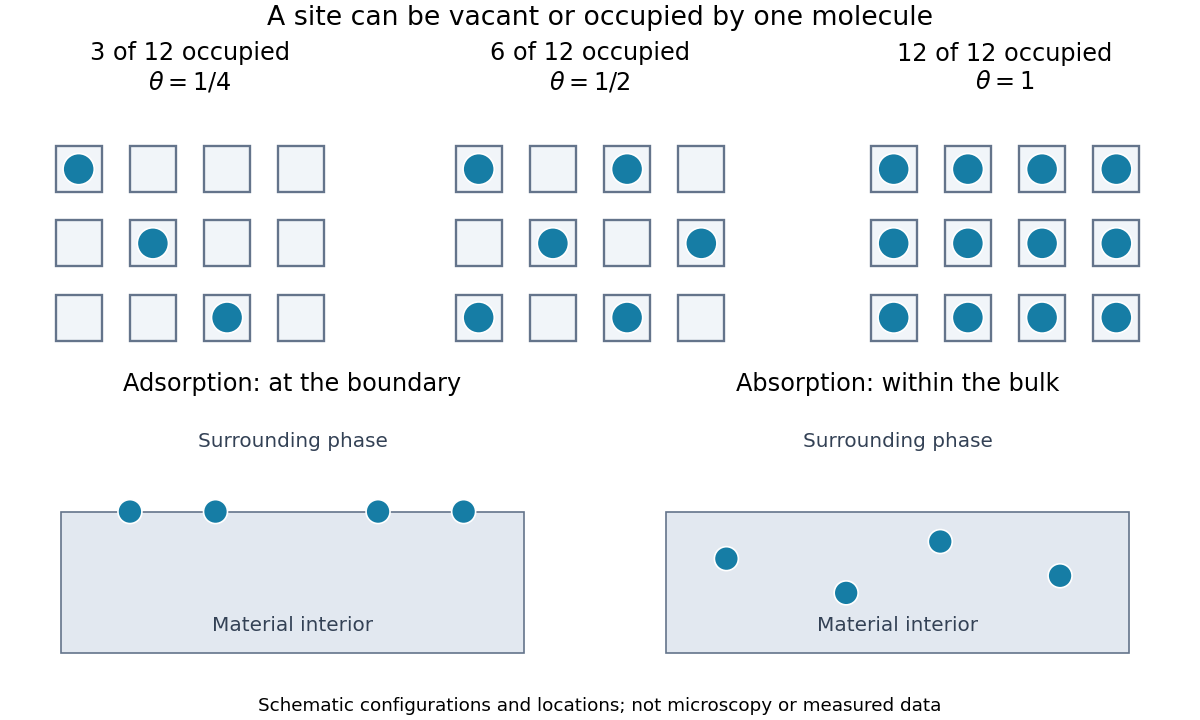
For a gas contacting a solid, adsorption concentrates molecules at the boundary; absorption takes material into the bulk. A porous solid can have a large internal surface area: binding on pore walls is still adsorption, even though those walls lie inside the particle. Both processes can occur together. Desorption returns adsorbed material to the surrounding phase. The useful question is therefore not just how much material disappeared from the gas, but where it went and whether it returns when the pressure falls.
An adsorption site model turns this spatial distinction into counting. With twelve identical adsorption sites and three bound molecules, the surface coverage is . Filling six gives ; filling twelve gives a complete monolayer. These are configurations illustrating the count, rather than measured arrangements or claims that all real surfaces have twelve sites.


Adsorption is a surface phenomenon in which molecules, ions, or atoms from a gas, liquid, or dissolved solid adhere to the surface of a solid or liquid, forming a thin film. This process involves the accumulation of these species at the surface of a material rather than changing its bulk composition. Adsorption can be classified into two main categories: 1. **Physisorption (Physical Adsorption)**: This type involves weak van der Waals forces or hydrogen bonds and is generally reversible.
New to topics? Read the docs here!