Solution
ID: past-exam-of-the-mphil-in-micro-and-nanotechnology-enterprise-course-of-the-university-of-cambridge/2023/paper-1/section-b/12/ii/solution
Past exam of the MPhil in micro- and nanotechnology enterprise course of the University of Cambridge 2023 Paper 1 Section B 12 ii Solution by  Codex 0 2026-10-20
The Shockley-Queisser limit is a radiative detailed-balance limit for a single-junction photovoltaic device under specified illumination and temperature. Its idealized absorber collects above-gap photons, thermalizes their excess energy and loses carriers only through the radiative processes required by absorptance and emission. Sub-gap photons are not harvested. A favorable gap balances current loss at large gap against voltage loss at small gap.[ref]
Detailed Balance Limit of Efficiency of p-n Junction Solar Cells by William Shockley and Hans J. Queisser. Journal of Applied Physics 32 (1961), pp. 510–519; radiative detailed balance and illumination assumptions
For a step-like absorber,The dark radiative current decreases rapidly with gap, so the qualitative ordering for the supplied absorbers isThe curve rises beneath the diagonal . The deficit reflects finite-temperature carrier statistics and the entropy associated with absorption and emission, including angular dilution of sunlight. Under ordinary unconcentrated illumination it is of order a few tenths of a volt, with a weaker gap dependence than itself. In a fixed blackbody-sun model its absolute value grows modestly with increasing gap, while its fraction of decreases. Above-gap thermalization is an efficiency loss but is not, by itself, the definition of this voltage deficit.
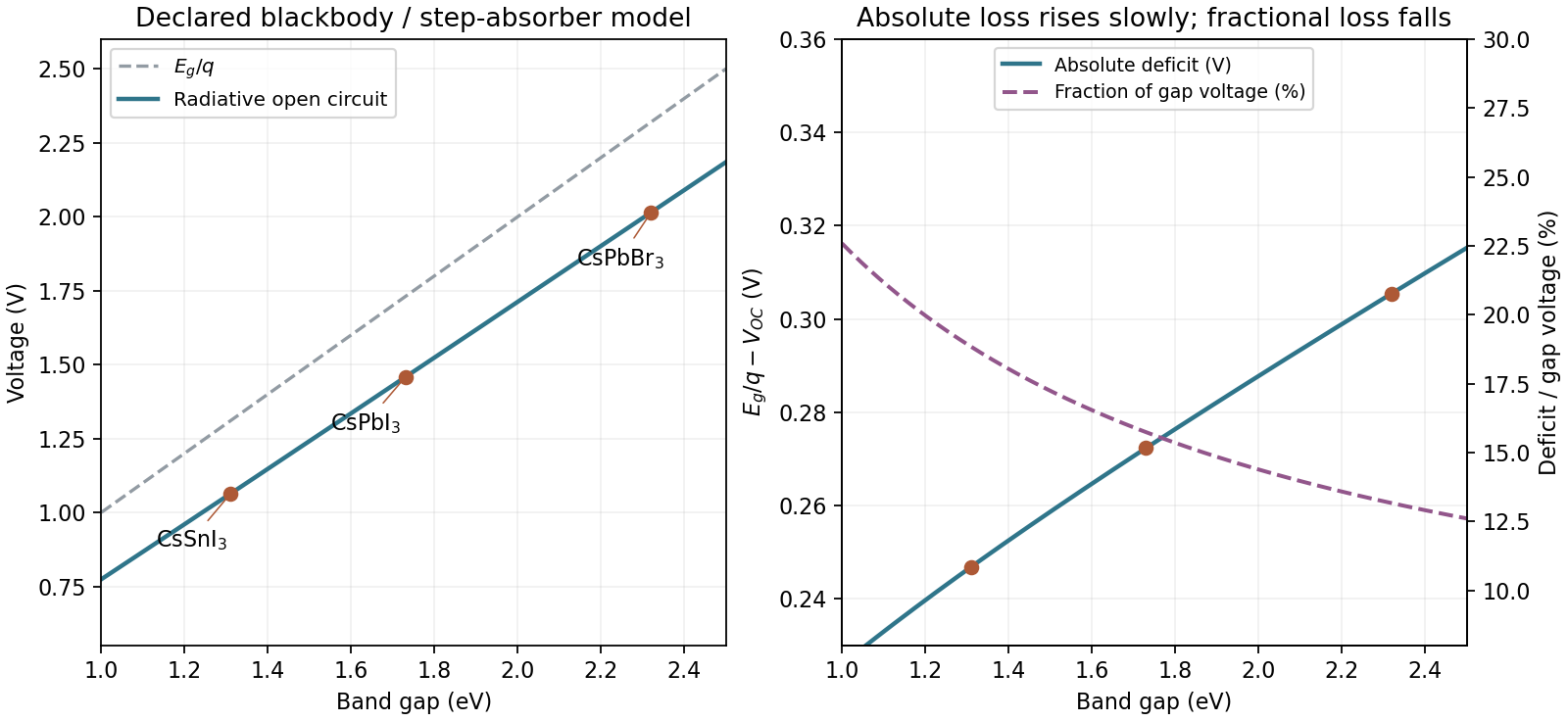

A measured perovskite device can have a larger deficit from nonradiative recombination and contact losses. The gaps alone do not determine those material-specific losses or a unique numerical voltage: solar spectrum, concentration, cell temperature and optical emission geometry must also be specified.
New to topics? Read the docs here!