
Entropy is an extensive quantity and a state function of an equilibrium system, measured in . Differences between equilibrium states are calculated along a reversible thermodynamic process:Here heat entering the system is positive and is its absolute thermodynamic temperature. The reversible path used for calculation need not be the path actually taken. Dividing the actual heat by a single temperature generally fails for an irreversible process.
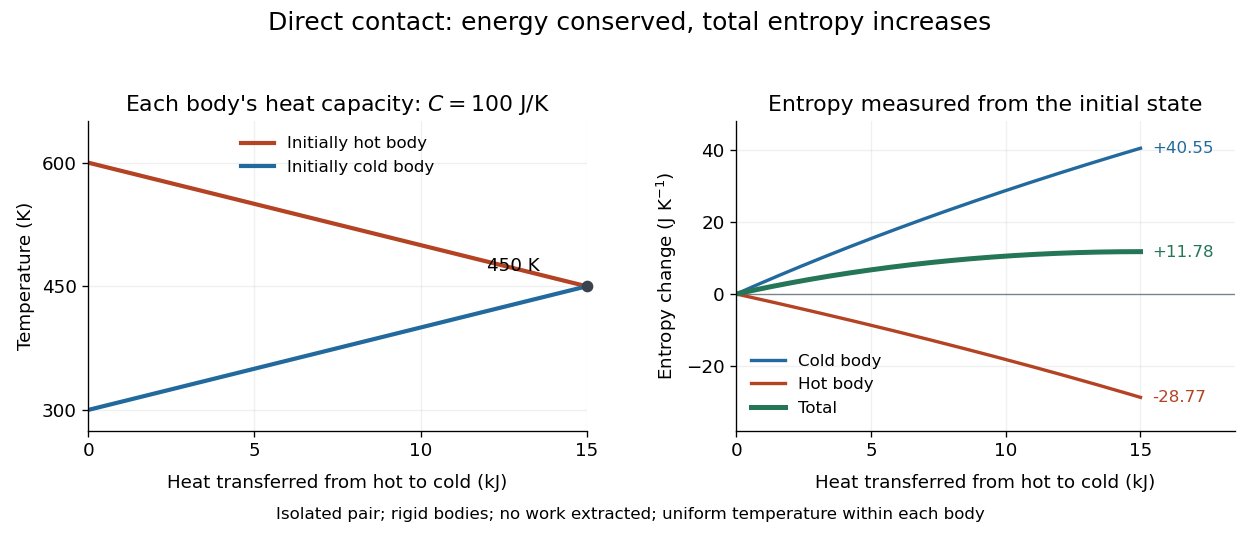
For example, put two rigid bodies, each with constant heat capacity , at and in an otherwise isolated system. Assume each body has a uniform internal temperature, no phase transition occurs, and no work is extracted. Their final thermal equilibrium is at , because the internal energy lost by one equals that gained by the other. Using entropy from heat capacity,so . One body's entropy decreases while the total increases. [ref]
https://web.mit.edu/16.unified/www/FALL/thermodynamics/notes/node41.html. MIT, Entropy changes and the hot-brick problem
In statistical mechanics, Boltzmann's entropy formula counts equally likely microstates compatible with a macrostate; Gibbs entropy handles a specified probability distribution over microstates. If the number of equally likely microstates doubles, entropy increases by . The logarithm makes multiplicative counts additive for independent systems. These are precise statements about states and probabilities, not a universal measure of visible messiness. Calling entropy merely "disorder" obscures the thermal calculation above and hides which microstates are being counted. [ref]
https://web.mit.edu/16.unified/www/FALL/thermodynamics/notes/node57.html. MIT, Statistical entropy and randomness
The usefulness of entropy is that measurable heat capacities determine its changes, and the Second law of thermodynamics turns those changes into constraints on processes. It also connects macroscopic measurements to microscopic descriptions without requiring us to track every particle.

Entropy is a concept that appears in various fields, such as thermodynamics, information theory, and statistical mechanics. Its meaning can vary slightly depending on the context, but generally, it refers to a measure of disorder, uncertainty, or randomness in a system. 1. **Thermodynamics**: In thermodynamics, entropy is a measure of the amount of energy in a physical system that is not available to do work. It is often associated with the degree of disorder or randomness in a system.


OK, can someone please just stop the philosophy and give numerical predictions of how entropy helps you predict the future?
The Unexpected Side of Entropy by Daan Frenkel
. Source. 2021.- www.quantamagazine.org/what-is-entropy-a-measure-of-just-how-little-we-really-know-20241213/ What Is Entropy? A Measure of Just How Little We Really Know. on Quanta Magazine attempts to make the point that entropy is observer dependant. TODO details on that.
New to topics? Read the docs here!