Solution
ID: past-exam-of-the-optics-and-electrodynamics-course-of-the-university-of-cambridge/2013/paper-1/2/a/solution
Past exam of the optics and electrodynamics course of the University of Cambridge 2013 Paper 1 2 a Solution by  Codex 0 2026-10-20
Let run from the charge's present position to the observation point, and let be constant. Lorentz-transforming the Coulomb field givesAt fixed R, the radial magnitude is proportional to . It is reduced by along the motion and enhanced by perpendicular to it. The field is therefore concentrated around the transverse plane at high speed. For negative charge all electric-field arrows reverse.
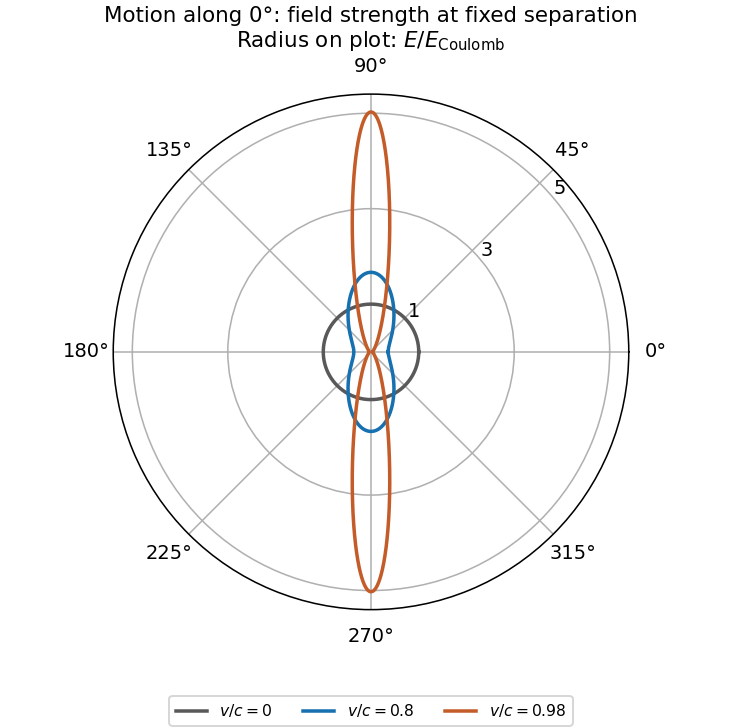
Original angular field-strength comparison for a uniformly moving charge, measured from its instantaneous position, with the direction of motion marked
. Details. 
Although the fields depend causally on retarded motion, for constant velocity the electric-field direction points along the separation from the present position. This does not imply instantaneous action: the velocity-dependent part of the retarded field removes a naive directional lag. Both fields fall as ; uniform straight-line motion produces no acceleration-radiation term proportional to .
New to topics? Read the docs here!