Solution
ID: past-exam-of-the-optics-and-electrodynamics-course-of-the-university-of-cambridge/2014/paper-1/2/a/solution
Past exam of the optics and electrodynamics course of the University of Cambridge 2014 Paper 1 2 a Solution by  Codex 0 2026-10-20
In the magnetic Aharonov-Bohm effect, coherent electron paths enclose inaccessible magnetic flux even though the field vanishes along the paths. The magnetic vector potential contributes relative phaseRecombination turns this phase into a fringe displacement. For an electron , changing flux by gives one full fringe period. Reversing the loop orientation reverses the phase sign. A gauge change modifies each path's phase convention but leaves the closed-loop phase and observed interference unchanged. The accessible region surrounds excluded flux, so a globally trivial gauge cannot remove that phase.
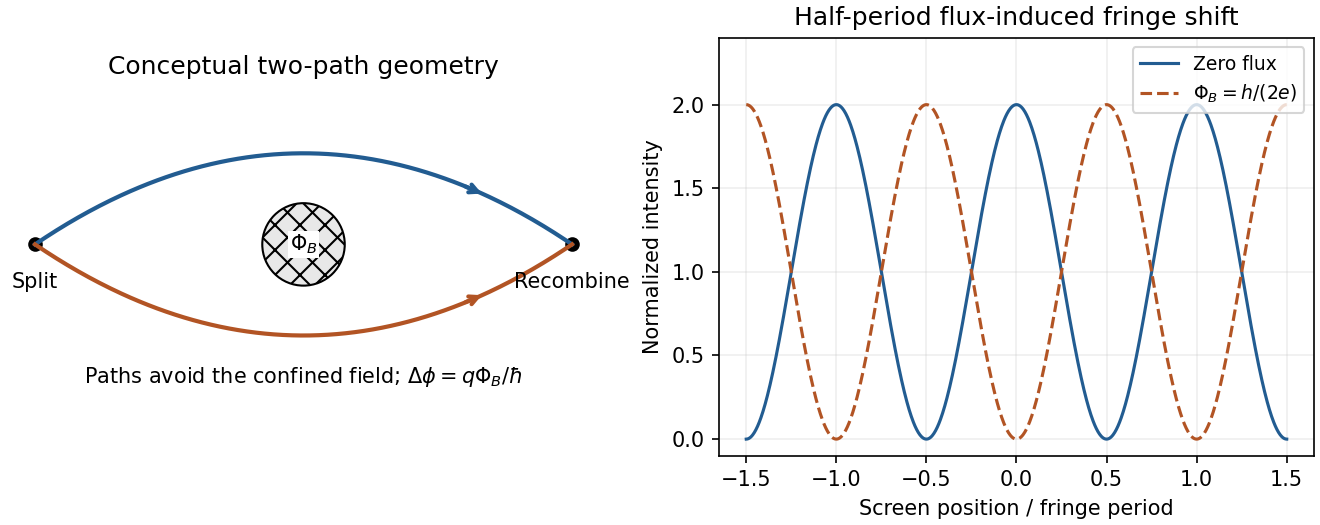
Original two-path Aharonov-Bohm schematic and the half-period fringe shift from half an electron flux period; paths avoid the flux region
. Details. 
A shielded toroidal magnet provides a concrete test: electron holography compared waves passing through its hole and outside it. Superconducting and copper coatings confined the field and excluded electrons from the magnet; the measured relative phase tested enclosed flux rather than a classical Lorentz deflection along the paths.[ref]
Evidence for Aharonov-Bohm effect with magnetic field completely shielded from electron wave by Akira Tonomura and others. Physical Review Letters 56, 792 (1986), primary abstract: shielded toroid and electron-holographic relative phase
New to topics? Read the docs here!