Solution
ID: past-exam-of-the-optics-and-electrodynamics-course-of-the-university-of-cambridge/2016/paper-1/2/c/solution
Past exam of the optics and electrodynamics course of the University of Cambridge 2016 Paper 1 2 c Solution by  Codex 0 2026-10-20
A photonic crystal has a spatially periodic dielectric response on the scale of the optical wavelength. For a nonmagnetic, lossless, nondispersive dielectric, the source-free Maxwell equations can be written as the eigenproblemThe Bloch theorem gives with periodic . The allowed frequencies form photonic band structures. Coupling of counterpropagating waves near a Brillouin zone boundary opens a stop band. A one-dimensional dielectric multilayer is a simple example; two-dimensional hole arrays and three-dimensional dielectric networks allow more extensive control.
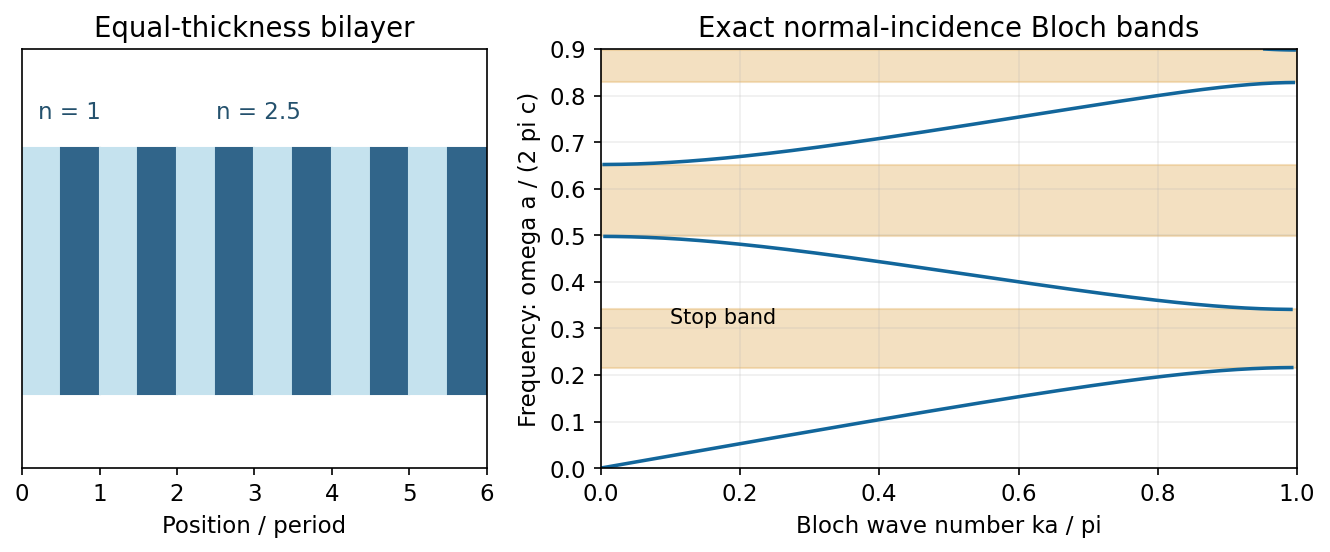

A complete photonic band gap excludes bulk propagating modes for every direction and polarization in a frequency interval. Periodicity alone does not guarantee such a gap: dimensionality, symmetry and refractive-index contrast matter. A missing or altered element can support a localized defect state in the gap, making a cavity; a line defect can guide light. Finite crystals have leakage and wavelength-dependent transmission rather than an infinitely sharp exclusion. Applications include selective mirrors, optical filters, small resonators and integrated waveguides.[ref]
Mathematical Methods in Nanophotonics, MIT 18.369, Spring 2016 by Steven G. Johnson. Lecture 2: Maxwell eigenproblem; lectures 9–14: Bloch states, one-dimensional gaps and defect localization
New to topics? Read the docs here!