A dielectric is a material in which an electric field produces electric polarization while transport of electric charge is sufficiently small for the intended use. An insulating solid in a capacitor is an example; real dielectrics can still have dielectric loss and nonzero electrical conductivity.
The important distinction is between rearranging bound electric charge and transporting mobile charge carriers through the specimen. Bound electric charges can move a little within a chemical atom or molecule, or an existing electric dipole can turn. Their averaged electric dipole moments produce electric polarization even if there is negligible steady electric current between the electrodes. A changing electric polarization does give a bound current; the absence of steady conduction does not mean that the material is electrically unresponsive.[ref]
For uniform electric polarization in a rectangular slab, polarization density gives zero bound volume charge density in the interior and opposite bound surface charge densities on the left and right faces. The electric charge has been redistributed, not created. More generally, the divergence theorem makes the cancellation explicit:Here is the outward normal vector on the material boundary. This accounts for both bound volume charge density and bound surface charge density; omitting either can falsely suggest that an initially neutral dielectric acquired net electric charge.
An electrical insulator between capacitor plates supports a useful combination: appreciable electric polarization, little leakage electric current, and tolerance of the intended electric field. This lets a small parallel-plate capacitor store separated electric charge and recoverable capacitor energy. The comparison in dielectric capacitor response explains why specifying fixed electric charge or fixed electric potential difference changes the answer. High relative permittivity alone does not establish good insulation or a large usable energy density; dielectric loss and dielectric breakdown matter as well.
For two planar homogeneous layers in series, charge conservation makes the steady normal current density the same in both layers. Combining Ohm's law with determines the fields when both conductivities are positive. The free interfacial surface charge density is , whereas total free-plus-bound charge is . The two notions of charge are distinct. This DC state can differ from the immediate response to switching the voltage; interfacial free charge accumulates during the transient.
For an infinitely long circular dielectric cylinder in a uniform transverse field in vacuum, the inside electrostatic potential is linear in the transverse coordinate. Matching the tangential electric field and normal electric displacement field to the outside dipolar solution gives the displayed uniform internal field. The result assumes no free interface charge and neglects end effects; an exterior dielectric changes the permittivity ratio.
The dimensionless quantity relating induced electric polarization to the internal electric field through in the static scalar model. It describes the material contribution; relative permittivity includes the vacuum term as well, . Zero electric susceptibility gives , not zero permittivity.
The scalar assumes a local response with linearity and isotropy, settled electric polarization, fixed material conditions, and no residual electric polarization at zero electric field. It relates to the averaged total internal electric field, which already includes the field of the bound electric charges. It does not relate to the field the external electrodes would produce in vacuum. The distinction is essential for a self-consistent calculation.[ref]
Polarization. equations (807)–(812): total field, displacement, linear susceptibility and relative dielectric constant
Substitute the scalar relation into the definition of electric displacement field:Comparison with proves and . Both and have units , so is a dimensionless quantity. In a stipulated static model with , : at a prescribed internal electric field, the material contribution is twice . This is a hypothetical response, not a measured material constant. The electric susceptibility is a convenient bridge from microscopic dielectric polarization to a macroscopic capacitance measurement, but it is not a measure of electrical conductivity.
A bound charge obeying gives a resonant electric susceptibility. For carrier density and the convention,Positive damping gives for , expressing passive absorption. Independent resonances add to the electric susceptibility. Setting gives the Drude frequency response.
For a single lossless polar optical oscillator with frequency-independent electronic background, . Setting frequency to zero yields the displayed static-to-background ratio. Multiple infrared-active branches require the corresponding product relation, rather than selecting an arbitrary pair of modes.
An optical oscillator strength is a dimensionless weight assigned to an optical resonance. In an independent-resonance Lorentz oscillator model using a reference electron mass and a specified participating number density ,Its normalization must be stated: assigning one unit of total strength per participating electron means . A one-resonance approximation with represents the whole chosen electron population, rather than asserting that the first allowed interband transition carries all optical strength. The smallest band gap therefore need not equal the fitted resonance energy.
For , the convention gives complex displacement amplitude . If the real amplitude is defined nonnegative, the phase is for but for , where . An electron's low-frequency displacement is opposite to the electric field; its high-frequency displacement is in phase. The induced electric dipole moment instead has phase for either sign of charge. A signed amplitude can absorb the extra , but that convention must be stated.
For a charge of mass bound by spring constant , the undamped equation has complex amplitude . The induced electric dipole moment is . Averaged electric dipole radiation power, divided by incident light intensity, givesThe Rayleigh scattering limit gives , proportional to . For , the charge behaves as free and the Thomson cross-section is recovered. At resonance the undamped steady-state formula is invalid; a finite damping mechanism or radiation reaction must be included. The formula describes independent weakly driven scatterers, not arbitrary coherent scattering from an extended medium.
Two routes to electric polarization are displacement and reorientation. An electric field can shift the centres of positive and negative electric charge in a neutral chemical atom or molecule, inducing an electric dipole moment. A polar molecule already has an electric dipole moment; a field biases its orientation. At finite temperature, random molecular motion opposes complete alignment, so a nonzero average need not mean that every electric dipole points the same way.[ref]
8.5 Molecular Model of a Dielectric. §8.5, Figures 8.19–8.20 and the thermal-fluctuation qualification following Figure 8.20
For a single species with number per unit volume , the electric polarization isThe brackets denote the local average electric dipole moment, rather than its magnitude. Opposite orientations can cancel while individual electric dipole moments remain nonzero.[ref] This averaging explains how an initially unpolarized material can respond strongly without acquiring net electric charge.
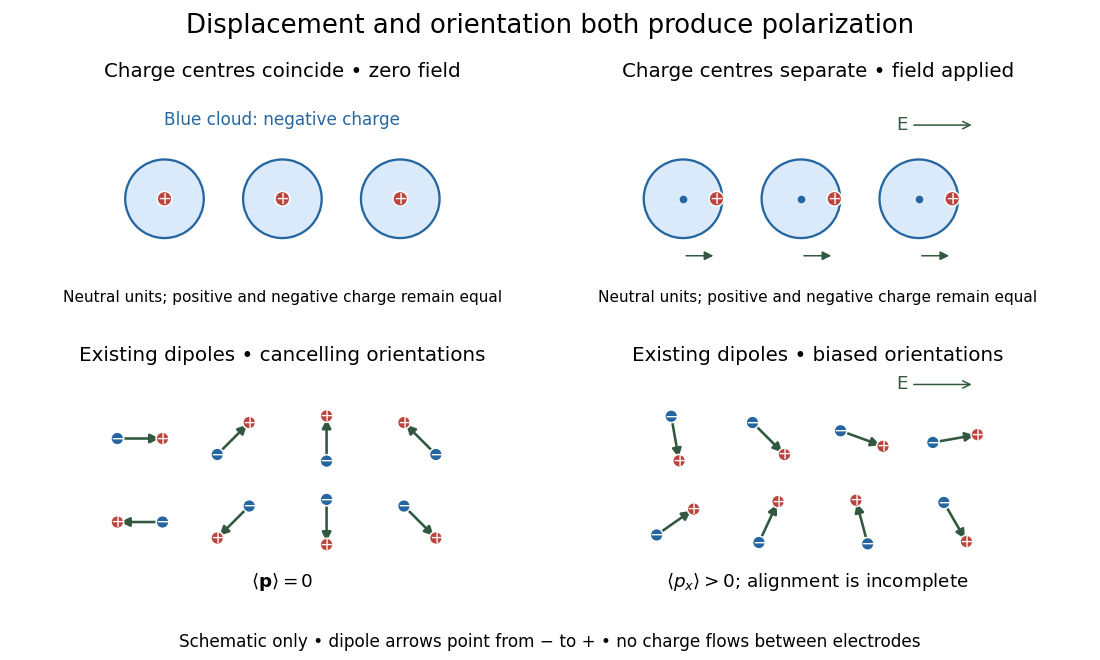
Two microscopic routes to electric polarization
. Original schematic: upper panels show coincident charge centres becoming separated; lower panels show existing electric dipoles changing from cancelling orientations to a biased distribution with incomplete alignment. Arrows run from negative to positive electric charge. Positions, displacements and orientations are illustrative, not measurements or a simulation of a particular substance. Details.Compare two initially identical parallel-plate capacitors with plate area , fixed gap , vacuum capacitance , and initial electric potential difference . Completely fill both gaps with the same uniform linear dielectric of static relative permittivity , neglecting the fringing field of a capacitor. Keep one connected to an ideal voltage source and isolate the other. The geometric capacitance becomes in both cases; the electrical constraint determines what else changes.[ref]
8.4 Capacitor with a Dielectric. §8.4, Figure 8.17 and equation (8.11): isolated capacitor, unchanged free plate charge and increased capacitance
Write , and . Applying , and the capacitor energy formula gives the complete comparison:Thus the statement that a dielectric reduces the electric field needs the fixed-free-charge condition. With fixed electric potential difference, the voltage source supplies additional free plate electric charge, maintaining despite the new bound electric charges.
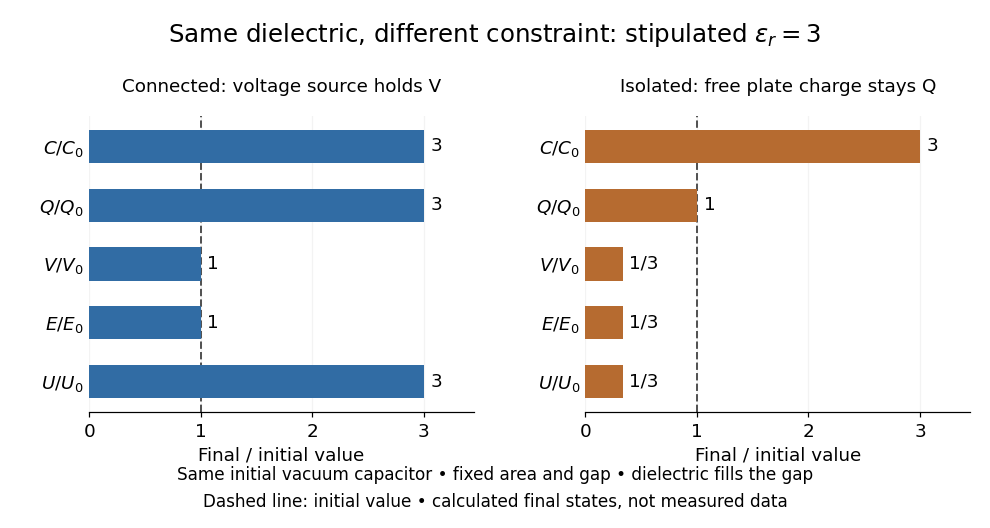
Dielectric capacitor response at fixed voltage and fixed charge
. Original normalized comparison for the stipulated model : every ratio is relative to the same initially charged vacuum capacitor. The dashed line marks the initial value. The bars show final values, not a time history or measured data. Plate geometry is unchanged and the dielectric completely fills the gap. Details.For the stipulated example, the voltage source supplies . At constant , its delivered electrical work is , whereas the increase in capacitor energy is . In an ideal reversible quasistatic insertion, the remaining is mechanical work delivered by the assembly, as accounted for in fixed-voltage capacitor energy balance. For the isolated assembly, capacitor energy falls from to , allowing of mechanical work in the same ideal limit. Actual losses reduce recoverable work; energy increases in the connected case do not arise from the dielectric supplying free energy.
An electrical insulator has sufficiently small transport of electric charge for its operating conditions. Insulation is a practical requirement involving electric potential difference, temperature, geometry and duration, rather than a universal claim of zero electrical conductivity. Electric polarization can be substantial in an electrical insulator; dielectric breakdown can end the insulating regime.
For an idealized uniform slab with small constant electrical conductivity , the Ohmic conductor model predicts leakage electrical resistance in parallel with capacitance . An isolated capacitor then hasThis is a derived model of slow discharge, not an assertion that every leakage mechanism obeys Ohm's law. Its time scale matches charge relaxation. The fixed-charge comparison in dielectric capacitor response needs an observation time short compared with , but long enough for electric polarization to settle. During a maintained voltage, leakage consumes power as Joule heating; delayed electric polarization can add dielectric loss under changing electric fields.[ref]
Materials Measurement: Dielectric Materials. Overview: real and imaginary permittivity, storage and dissipated loss
Large relative permittivity alone does not rule out either mechanism.[ref]
8.5 Molecular Model of a Dielectric. §8.5, paragraph following Table 8.1: high dielectric constant does not ensure a good insulator; mobile ions permit conduction
A correlated transition-metal compound whose lowest charge excitation primarily transfers an electron between a ligand orbital and a metal orbital. Its gap is controlled by charge-transfer and Coulomb energies rather than a weakly interacting single-band picture alone. Many cuprate parent compounds are usefully described this way. This distinguishes the orbital character of the low-energy excitation from an idealized single-band Mott insulator.
Dielectric breakdown is failure of an insulating regime under a sufficiently strong electric field, allowing substantial electric current through the material. For example, an electron freed from a chemical atom or molecule can become a mobile charge carrier. The small-field linear electric susceptibility model does not describe this conducting state.[ref]
8.5 Molecular Model of a Dielectric. §8.5, dielectric breakdown paragraph immediately before the definition of dielectric strength
For an ideal uniform dielectric between large parallel plates, . A prescribed breakdown field therefore limits charge independently of plate separation. Voltage capacity still grows with separation. This ideal result neglects field enhancement near edges and any dependence of the breakdown field on gap geometry or environmental conditions.
Dielectric strength characterizes the electric field at dielectric breakdown under specified test conditions. In an ideal uniform gap, it sets a voltage scale .[ref]
8.5 Molecular Model of a Dielectric. §8.5: dielectric strength definition and voltage limit for a specified plate separation
The parallel-plate capacitor model consequently gives the stored energy density scaleThis is a model scale, not an operating rating: fringing field of a capacitor make local electric fields differ from , while leakage and dielectric loss spend some supplied energy as heat. Comparing usable capacitor energy therefore requires insulation and breakdown performance as well as permittivity. Articles by others on the same topic



A dielectric is a specific type of insulating material that can be polarized by an electric field. Dielectrics do not conduct electricity well but can store electrical energy when subjected to an electric field. This characteristic makes them essential in various electrical and electronic applications, particularly in capacitors, where they are used to increase capacitance.