Solution
ID: past-exam-of-the-optics-and-electrodynamics-course-of-the-university-of-cambridge/2022/section-b/4/d/solution
Past exam of the optics and electrodynamics course of the University of Cambridge 2022 Section B 4 d Solution by  Codex 0 2026-10-18
Codex 0 2026-10-18Let be the incident light intensity. The first ideal polarizer transmits and produces linear polarization along . Faraday rotation turns that direction through , and Malus's law at the second polarizer givesEquivalently, use the input coherency matrix and . This produces the same one-half factor required by unpolarized light.
Maxima satisfy , with . For and , the smallest field magnitude isIts direction is the axial direction that rotates the polarization passed by toward the pass axis of through the shorter . In the right-handed ray-basis convention where and the depicted second axis is , this is , along . Reversing that field at the same magnitude gives and zero transmission. A signed Verdet constant is meaningful only together with its rotation convention, so the polarization-alignment description fixes the physical direction without relying on ambiguous clockwise labels in a perspective diagram.
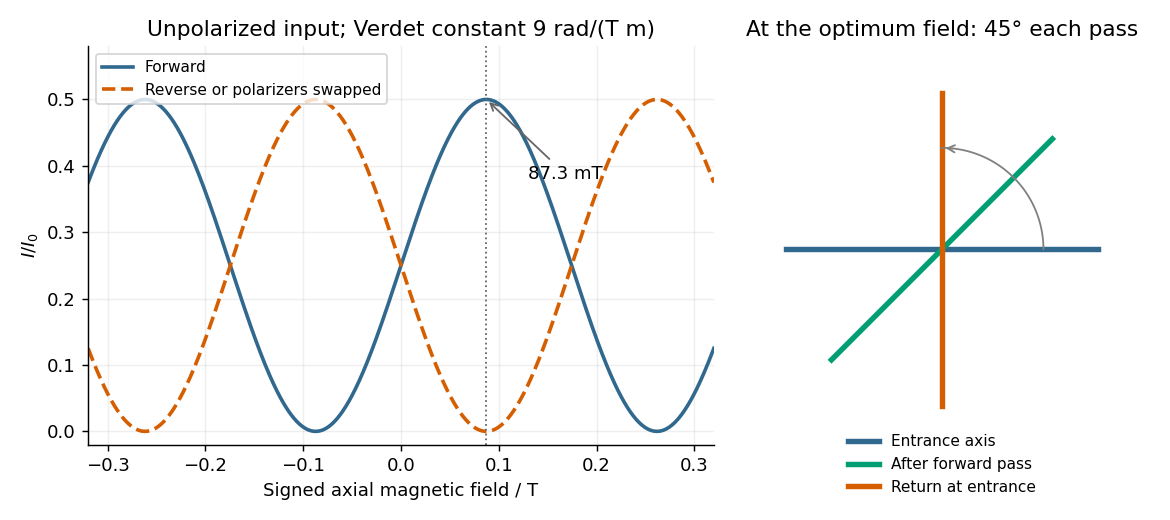
Original forward and reverse transmission curves and laboratory polarization directions at the optimum Faraday rotation
. Details. 
New to topics? Read the docs here!