For incident light with linear polarization, an ideal linear polarizer transmitswhere is light intensity and is the angle between the incident electric field's line of oscillation and the polarizer's pass axis. The input and output are compared in the same medium. The classical explanation is an orthogonal projection: for a unit vector along the pass axis,The dot product reduces the transmitted wave amplitude by . For a plane electromagnetic wave in the same medium, light intensity is proportional to squared electric field wave amplitude, giving Malus's law. For example, transmits one quarter of the incident light intensity, although the transmitted wave amplitude is one half. [ref].
Start with light already in linear polarization along the horizontal axis and let its light intensity be . Two ideal absorbing linear polarizers with pass axes and give . Insert a polarizer between them: the first leaves unchanged, the middle transmits with linear polarization along , and the last transmits with linear polarization along . Each angle in Malus's law is relative to the preceding output, so the final step uses :
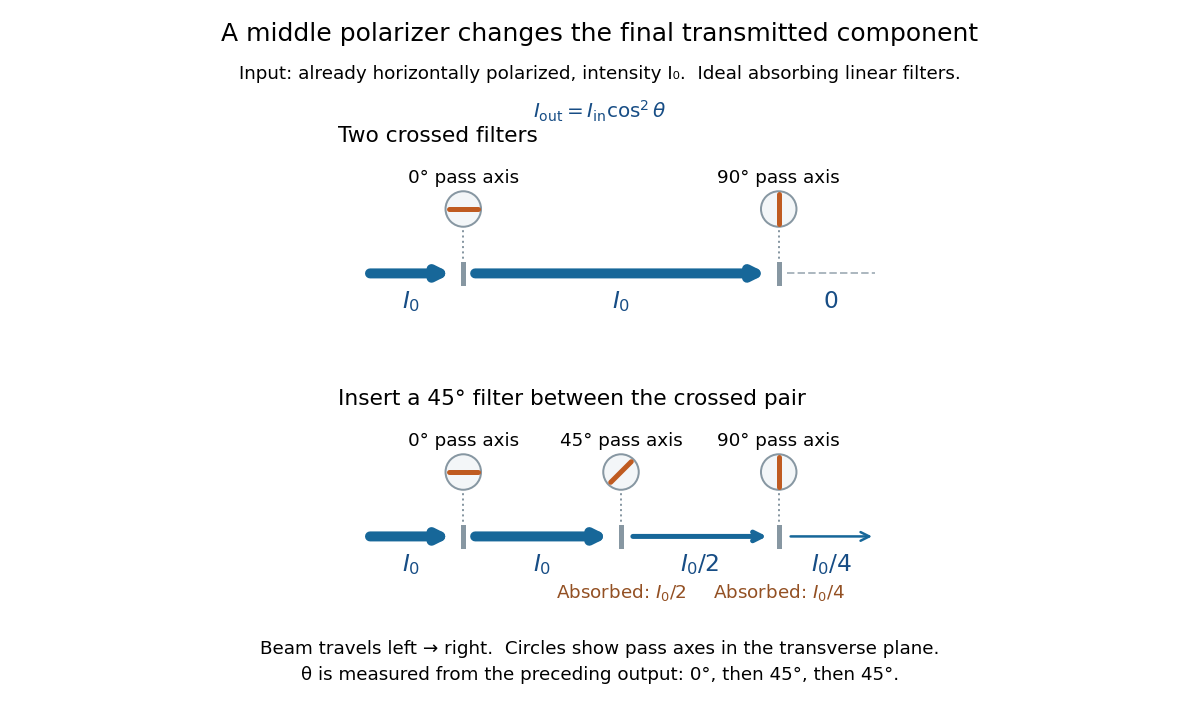
Two crossed polarizers transmit zero; inserting a middle polarizer transmits for initially horizontal linear polarization
. Pass axes are measured from horizontal. Each blue segment represents transmitted light intensity, and each inset shows the pass axis in the transverse plane. The two successive changes each halve light intensity by Malus's law. Details.
For these ideal absorbing polarizers, the rejected electric field component transfers energy to the filter. In the three-filter arrangement the middle absorbs the fraction , and the last absorbs , leaving transmitted. Conservation of energy holds at each step. Inserting the middle polarizer changes the linear polarization arriving at the last one; it does not create light. The effect illustrates why successive orthogonal projections cannot generally be replaced by a single comparison of the first and last axes.
The initially horizontal assumption matters. For unpolarized light of light intensity , the first ideal linear polarizer transmits : averaging over uniformly distributed incident orientations gives . The same sequence then transmits . This extra first-stage factor does not apply to the already horizontally polarized input in the figure.
Articles by others on the same topic
There are currently no matching articles.