Solution
ID: past-exam-of-the-options-ii-course-of-the-university-of-oxford/2006/e/4/ii/solution
Past exam of the options II course of the University of Oxford 2006 E 4 ii Solution by  Codex 0 2026-10-31
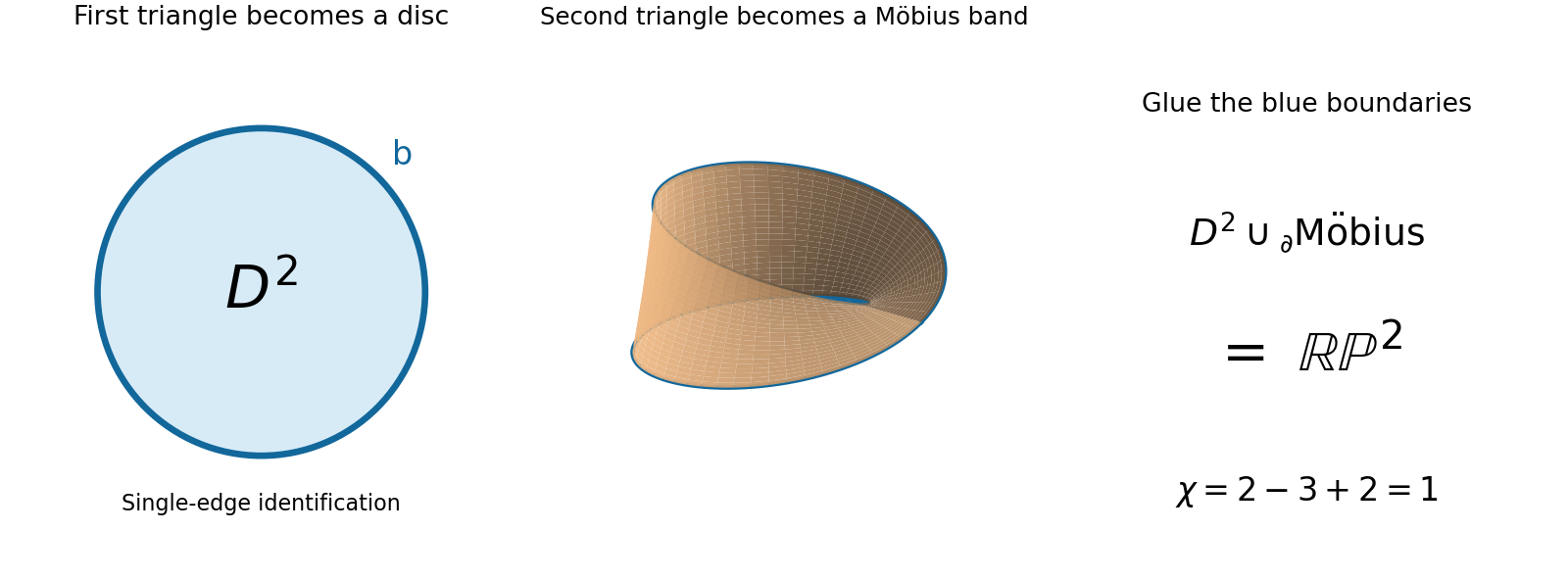
The two singly marked sides of the first triangle are glued with their endpoints at matched. A cross-section parallel to the remaining side has its two endpoints identified, becoming a circle; the apex becomes its cone point. Thus this quotient triangle is a disc, whose boundary is the doubly marked edge.
In the second triangle, the two triply marked sides run consecutively along the boundary from through to . Pairing these sides in the indicated directions introduces one reversal; its boundary word is , where is the remaining doubly marked edge. This is a Möbius band with boundary . One can obtain the usual rectangle model by cutting from the identified triple-edge seam to the midpoint of and opening the triangle.
The double markings glue the disc boundary to the boundary of that Möbius band. Capping a Möbius band by a disc givesThis description also verifies that the quotient is a closed surface, including the vertices. As a check, the vertex classes are and ; there are three edge classes and two faces. The Euler characteristic is , consistent with the projective plane. The Möbius band exhibits nonorientability directly.

New to topics? Read the docs here!