The Möbius band is the topological surface obtained by gluing the ends of a rectangle with a half-turn. Precisely, it is the quotient spaceThe twist identifies the two apparent long edges into one boundary circle. Following the core circle of a Möbius band reverses local handedness, so this surface is not orientable. An untwisted untwisted band has two boundary circles and is orientable: the distinction survives stretching and bending because orientability is a topological invariant.
To explore the construction with paper, mark the two long edges in different colours, join the short ends after a half-turn, and trace an edge. The trace passes from one marked edge to the other without ever leaving the boundary. Separately, trace the centre line and track a local transverse arrow: it comes back reversed after one circuit. The boundary closes after twice the travel around the centre, while the transverse arrow needs two circuits to return to its original direction.
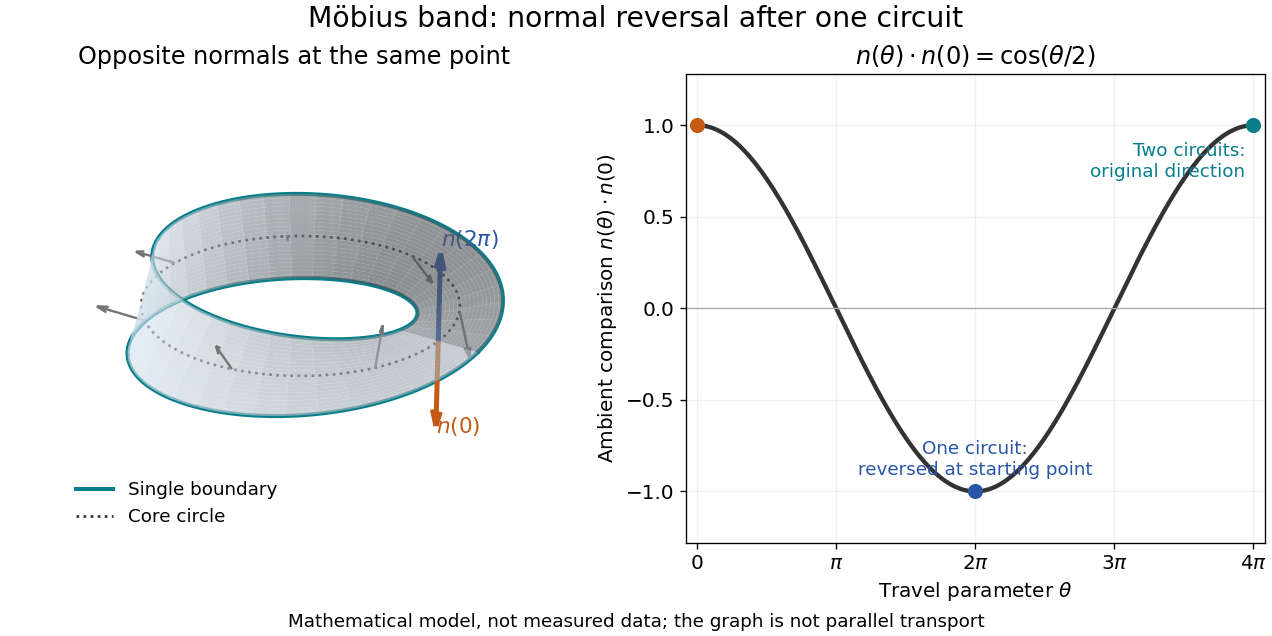

This original mathematical model has central radius and half-width :Its seam obeys . The dotted circle is the core circle of a Möbius band; the teal curve follows the single boundary through . At the same point on the core, the arrows for and are opposite. The graph compares a continuously followed unit normal with its starting value in the ambient space; the endpoint reversal, rather than any intermediate zero of the graph, establishes the obstruction. It is not a statement about parallel transport.
The Möbius band has the homotopy type of a circle: a deformation retraction shrinks each width coordinate to zero. Nevertheless its boundary represents twice a generator of its fundamental group. The boundary of a Möbius band winds twice around its core, so with compatible generator choices the boundary generator maps to in .
The historical account by Julyan H. E. Cartwright and Diego L. González places the mathematical discovery by August Möbius and Johann Listing in 1858, while investigating representations of twisted bands predating that work. A familiar-looking picture and a recognition of the underlying topological invariant are different kinds of evidence. [ref]
https://arxiv.org/abs/1609.07779. Cartwright and González, Möbius strips before Möbius, 2016
The core circle is the image of the centre line in the rectangle defining a Möbius band. Its endpoints are identified, so it is a circle. The formuladefines a deformation retraction onto that circle: it respects , starts at the identity map, and fixes the core throughout. Consequently the Möbius band has fundamental group isomorphic to , just like a circle; this alone cannot distinguish it from an annulus.
For the model of the Möbius band, the tangent vectors along its core circle of a Möbius band areTheir cross product, divided by its norm , gives the continuous unit normalAlthough , we have . Any other continuous choice of unit normal along this parametrized interval is either everywhere or everywhere: its relative sign is a continuous map into the discrete space , and the interval is connected. Thus no choice can agree at the identified endpoints. This short calculation proves that the Möbius band has no global continuous unit normal and is not an orientable surface.
The plotted quantity is . It compares ambient vectors at generally different points; after one circuit it is at the starting point, and after two circuits it is there. Only these endpoint comparisons are needed for the orientability argument.
In the quotient space description of the Möbius band, follow once along the rectangle. The seam sends its endpoint to the start of , which must also be traversed before returning to the original point. Under the deformation retraction onto the core circle of a Möbius band, these two stretches each travel once around the same circle. Orienting both circles by increasing longitudinal parameter gives a map of topological degree two. Equivalently, the group homomorphism on fundamental groups induced by inclusion of the boundary sends a chosen generator to twice the core generator, or to in multiplicative notation. Reversing the chosen boundary generator changes the sign, not the fact that it winds twice.
Articles by others on the same topic
There are currently no matching articles.