Solution
ID: past-exam-of-the-particle-and-nuclear-physics-course-of-the-university-of-cambridge/2014/paper-1/4/a/solution
Past exam of the particle and nuclear physics course of the University of Cambridge 2014 Paper 1 4 a Solution by  Codex 0 2026-10-20
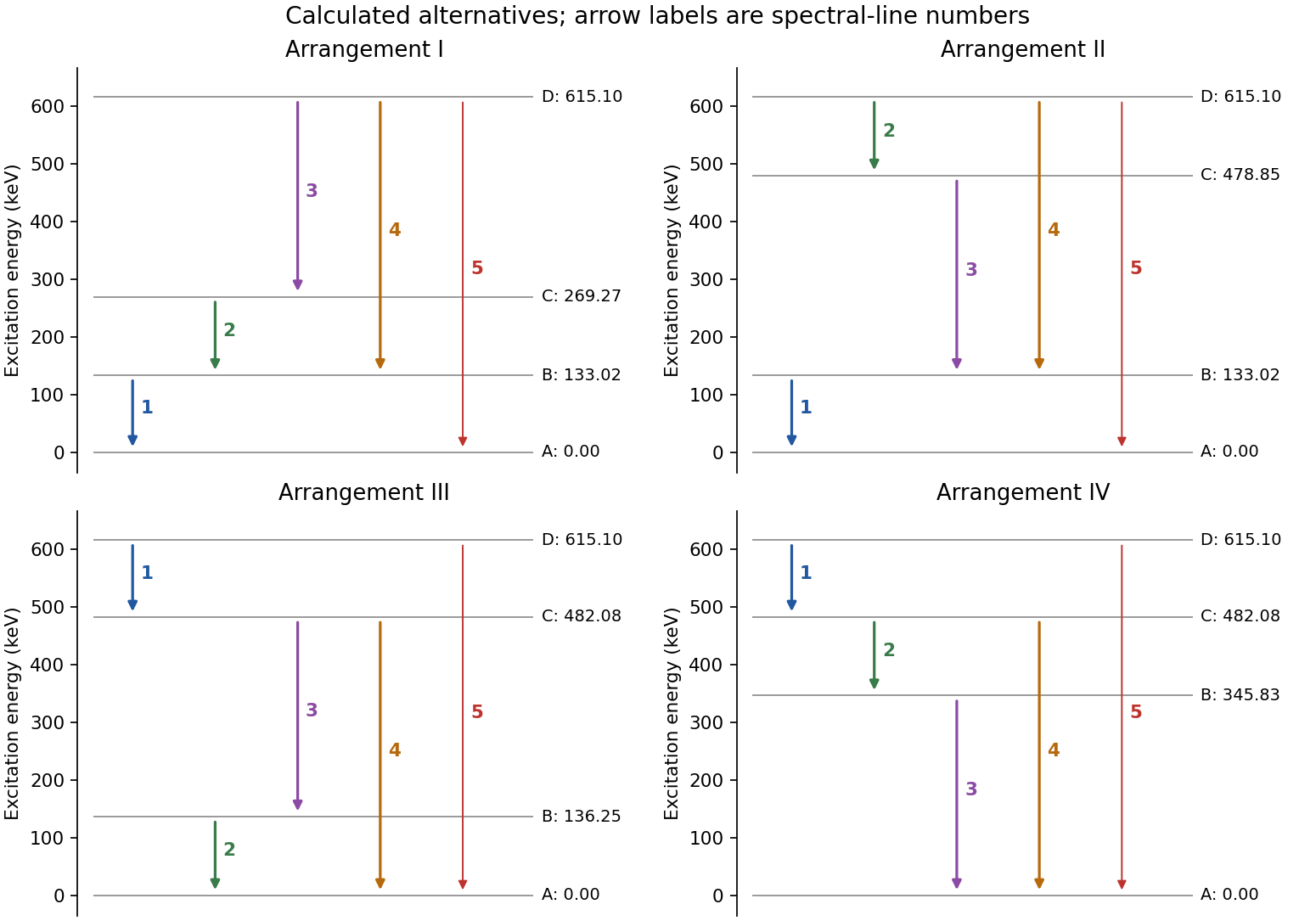
Assume the quoted intensities represent relative emitted photon numbers, with efficiency corrections implicit, as required for population-flow bookkeeping. The prominent branch obeys , and identifies a serial two-photon branch. The energies obey and within their uncertainties. The weak fifth line directly spans D to A. Reversing which end contains the line-1 step and interchanging the serial line-2/line-3 order produces the four possibilities.
Take A as zero. A gamma-ray energy-network fit to the five energy differences gives the following approximate excitation energies in keV:The line connections, in the order , are respectively: I: ; II: ; III: ; IV: .
For I and II, the B population entering through lines 2 or 3 and line 4 exits through line 1. For III and IV, line 1 feeds C and its intensity splits into the direct line 4 and serial lines 2/3. The small direct D-to-A branch bypasses these intermediate balances. The central measured energies do not obey every sum exactly; all four fitted arrangements have for two energy constraints. Assigning the weakest line's central energy as an exact excitation energy would discard the more precise cascade measurements.

New to topics? Read the docs here!