Solution
ID: past-exam-of-the-particle-and-nuclear-physics-course-of-the-university-of-cambridge/2021/section-b/4/c/solution
Past exam of the particle and nuclear physics course of the University of Cambridge 2021 Section B 4 c Solution by  Codex 0 2026-10-18
Codex 0 2026-10-18For both modes, a leading weak quark transition in is , followed by , with the original acting as a spectator quark. This produces the four quarks needed for , using the component of . Producing three pions additionally requires a pair from strong hadronization. A representative quark-line diagram draws it as gluon emission and splitting.
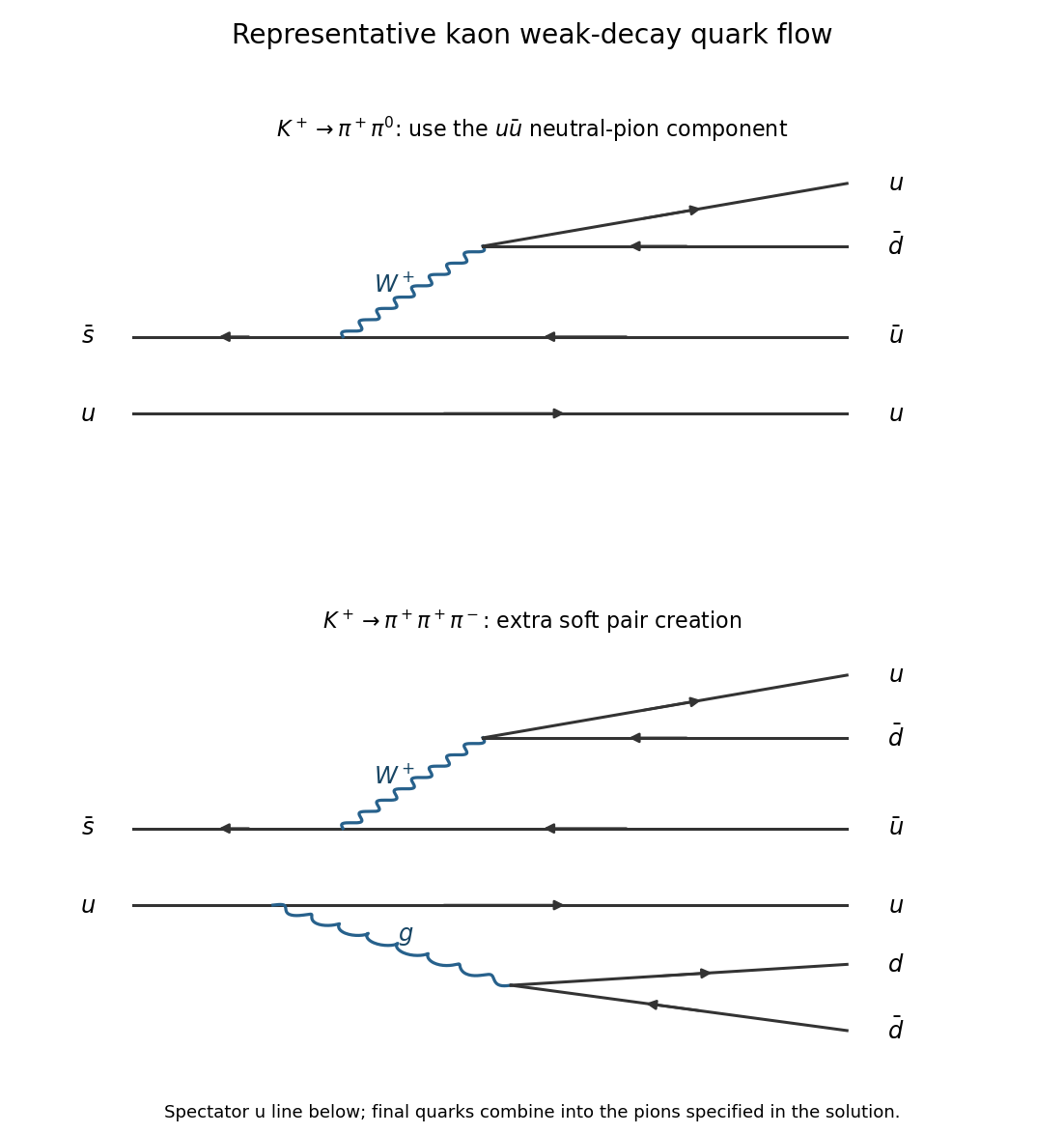

The three-pion assignment is , , and , matching . The extra soft pair creation is a schematic representation of hadronization, not a controlled perturbative prediction of the relative decay rates. Both processes are first order in the effective weak interaction.
There is an explicit error or hypothetical assumption to address: the original PDF assigns to all these mesons. Taken literally, the two-pion final state has , because all particles have zero spin and the initial is zero. Its parity is . For three spinless particles, use two Jacobi orbital angular momentum quantum numbers . Coupling to total zero requires , so the orbital parity is and the three-particle parity is also . Thus under the printed assignment, both channels conserve parity.
The named physical pions and kaons are instead pseudoscalar mesons with . With those physical assignments,ThereforeThese two opposite-parity final states from the same physical kaon are a classic illustration of parity violation in a weak decay. The physical conclusion requires correcting the printed parity assignment explicitly.
New to topics? Read the docs here!