Solution
ID: past-exam-of-the-particle-physics-course-of-the-university-of-oxford/2016/2/4/solution
Past exam of the particle physics course of the University of Oxford 2016 2 4 Solution by  Codex 0 2026-10-25
The functional arrangement below separates the polarization analysis from the resonance selection. The shield prevents the direct source beam from overwhelming the detector; the off-axis detector accepts gamma rays re-emitted by the samarium scatterer.
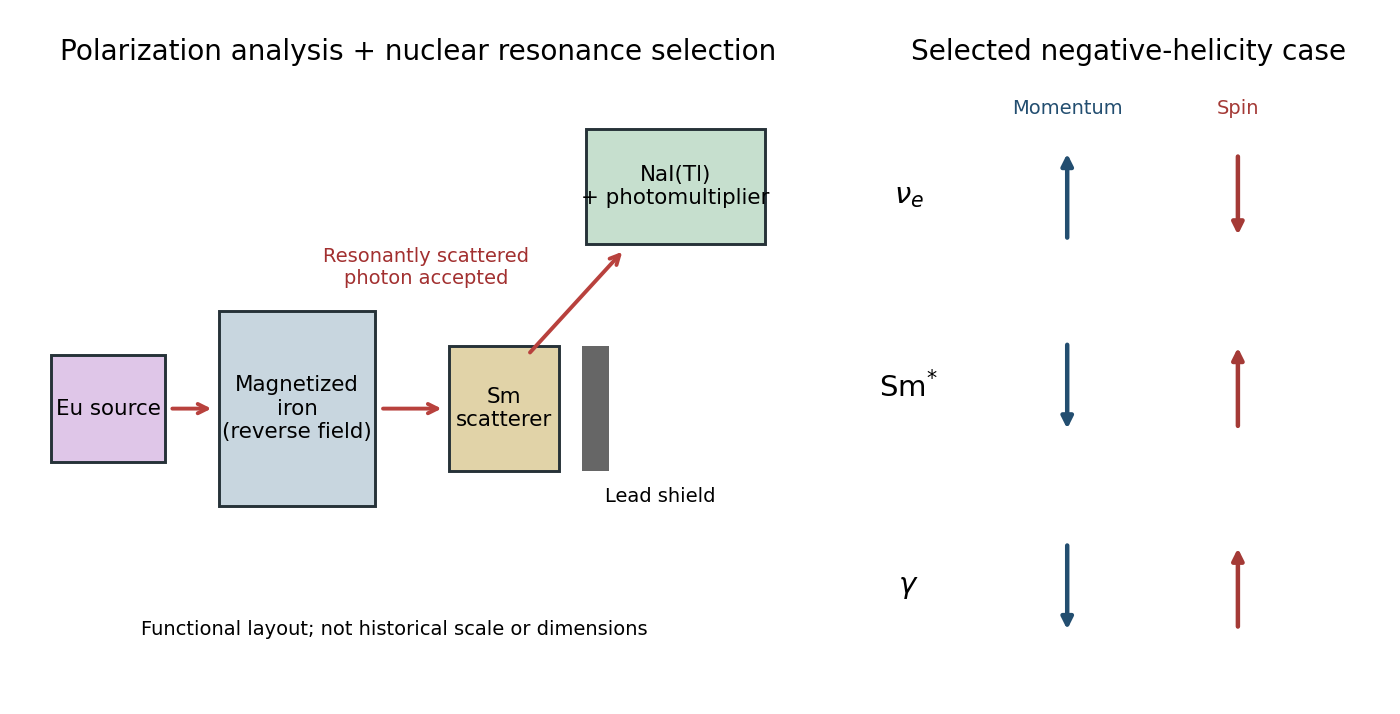

The europium source emits into magnetized iron, whose magnetization is alternated. A samarium scatterer selects nuclear nuclear resonance fluorescence, favouring photons emitted along the daughter recoil. A shielded NaI(Tl) scintillation counter records the scattered nuclear line. Compare the background-subtracted line rates for the two iron magnetizations, and use the calibrated sign of the analysing power to identify the photon helicity.
The measured circular polarization was negative, compatible after angular acceptance corrections with negative neutrino helicity. By the angular momentum conservation argument, the selected photon helicity and neutrino helicity have the same sign. Thus the experiment concludesfor the emitted relativistic electron neutrino. Finite acceptance dilutes the measured polarization; it does not justify equating the raw count asymmetry to .[ref]
Helicity of Neutrinos by Maurice Goldhaber and others. Pages 1016–1017, apparatus, reversal calibration and negative circular polarization
New to topics? Read the docs here!