Solution
ID: past-exam-of-the-particle-physics-course-of-the-university-of-oxford/2022/3/c/solution
Past exam of the particle physics course of the University of Oxford 2022 3 c Solution by  Codex 0 2026-10-25
Away from narrow resonances and quark thresholds, the QED annihilation cross section into each accessible quark flavour is its squared fractional electric charge times the muon-pair cross section, multiplied by the number of distinguishable color charges. Thus the inclusive hadronic ratio isWith , the continuum predictions are , and as successive charm quark and bottom quark channels become accessible. The measured normalization and steps support three color charges. At leading order these hadronic events form two back-to-back jets from the quark and antiquark; quantitative comparisons include QCD corrections and avoid the nonperturbative threshold region.
The extra resolved jet is explained by , with gluon radiation from either the quark or antiquark. One possible color charge routing is initial followed by ; the final , and combine to a net colour singlet.
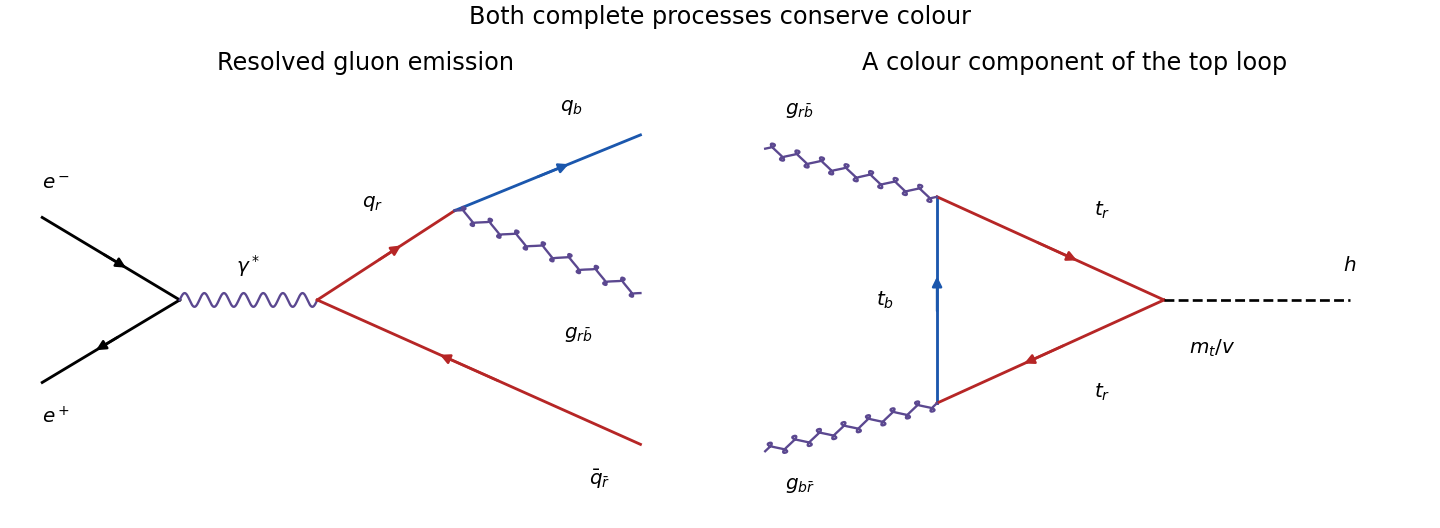

The three-jet cross section contains one additional strong interaction vertex in the amplitude, so its ratio to the two-jet rate is of order times a resolution-dependent kinematic coefficient. A resolved fraction of order is consistent with perturbative QCD and a strong coupling constant much larger than the fine-structure constant. It is not an equality : the jet definition and cuts are needed. Photon radiation has a much smaller electromagnetic rate. The large hadronic third-jet rate supports gluon radiation; identifying the radiated object specifically as a colour-octet gluon also uses the QCD vertex and colour-flow description, not merely the existence of three visible jets.
New to topics? Read the docs here!