Solution
ID: past-exam-of-the-physics-2-paper-of-the-university-of-oxford/2018/5/solution
Past exam of the physics 2 paper of the University of Oxford 2018 5 Solution by  Codex 0 2026-10-25
A grating spectrometer places an illuminated narrow slit at the front focal plane of a collimator. The resulting parallel beam reaches the diffraction grating at known incidence, here taken normal. A rotatable telescope focuses each outgoing diffracted parallel beam onto its crosshair or detector. Align the slit with the grating rulings, focus the collimator at infinity, and illuminate many grooves across a suitable aperture. A narrow slit supplies sufficient spatial coherence and prevents slit width from blurring the angular separation; the telescope must also resolve the two images.
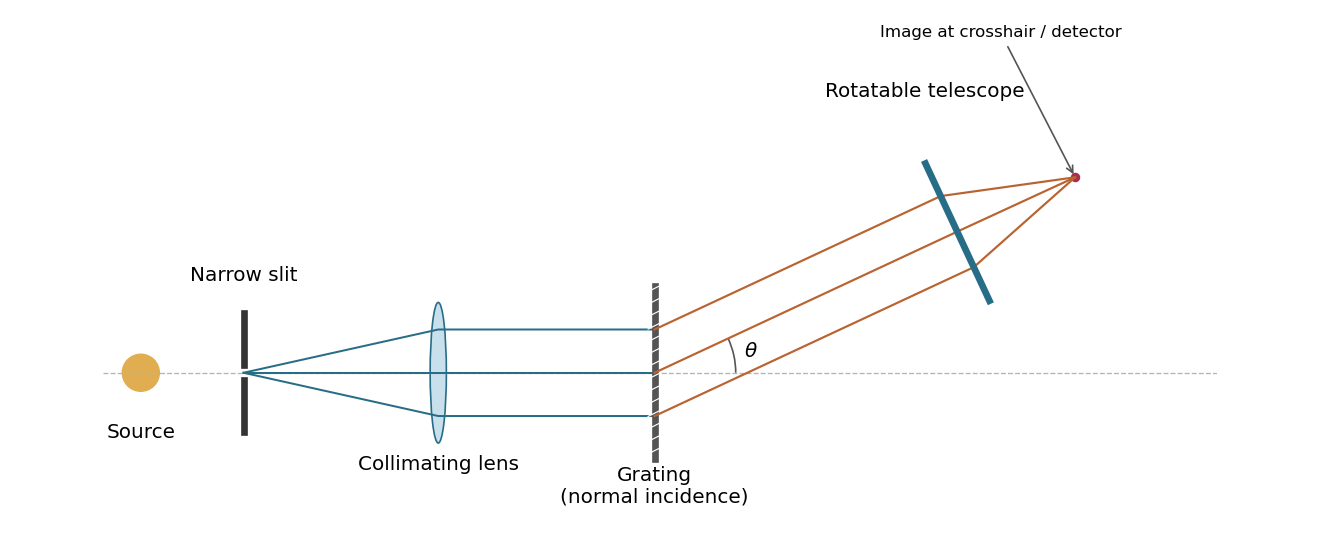
A grating spectrometer with a narrow source slit, collimator, normally illuminated diffraction grating and rotatable observing telescope
. Details. 
The groove spacing is . The grating equation at normal incidence is . For diffraction order ,ThereforeThe ideal resolving power of a diffraction grating is , so the Rayleigh criterion for this doublet requires about illuminated grooves, spanning roughly . This is an ideal lower bound; finite slit width, aberrations and detector resolution can require a larger usable aperture.
New to topics? Read the docs here!