A diffraction grating is a periodic optical structure whose repeated slits or grooves direct light into diffraction orders through wave interference. Its beauty is that many individually broad contributions cooperate to select narrow directions: the spacing determines where the principal peaks occur, while the number of illuminated elements determines how sharply they are selected. This makes a diffraction grating useful in a spectrometer, where separating wavelengths spatially lets us examine an optical spectrum. [ref]
https://ocw.mit.edu/courses/6-007-electromagnetic-energy-from-motors-to-lasers-spring-2011/4835d62777f42e82a40c319defcc80a6_MIT6_007S11_lec28.pdf. MIT 6.007: Multiple-slit diffraction and spectrometer application, slides 5-6
.Consider a transmission diffraction grating in air, illuminated at normal incidence by a plane wave. Let be the centre-to-centre slit spacing, the wavelength in the surrounding medium, and the signed outgoing angle from the forward normal. In Fraunhofer diffraction, where observation directions specify the far-field pattern, adjacent contributions have path difference and phase difference . Their wave amplitudes reinforce whenever , giving . This normal-incidence geometry should be kept distinct from the incident and reflected angle convention in the grating equation below. [ref].
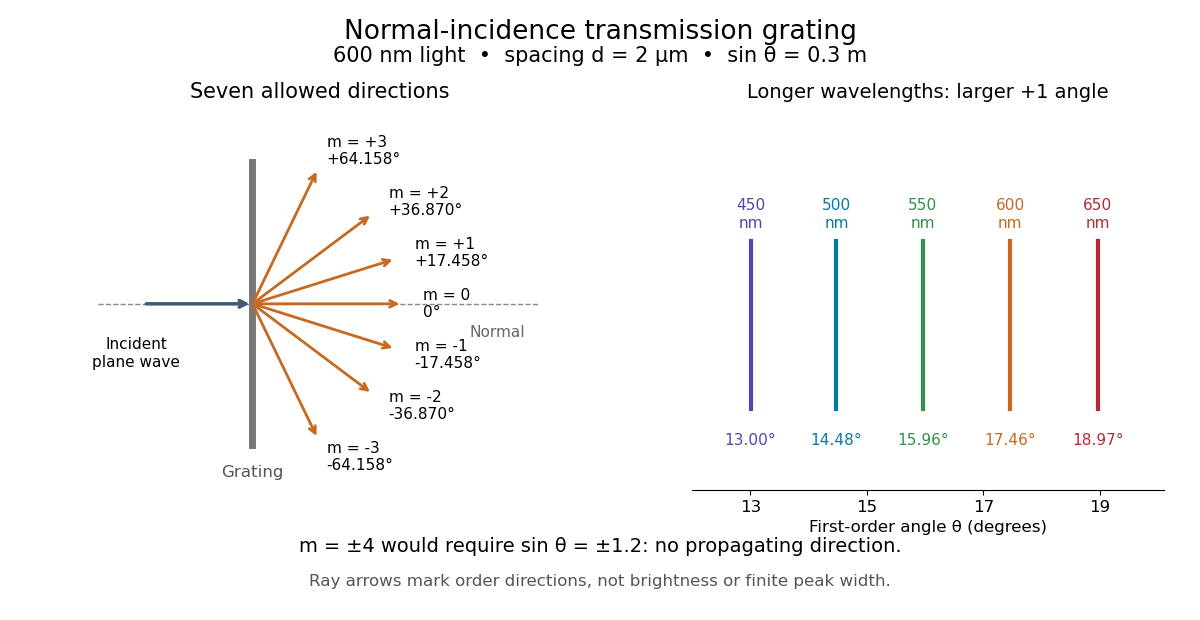
Angular colour separation follows immediately. At fixed nonzero diffraction order, increasing the wavelength moves the peak farther from the normal. With , first-order light at leaves at , whereas leaves at : a separation of . The zero diffraction order stays at for both wavelengths. Thus grating dispersion comes from an orderly dependence of wave interference on wavelength, rather than an arbitrary assignment of colours to directions.
For identical slits with uniform coherent illumination, meaning stable relative wave phases across the array, the normalized wave interference factor isThe apparent at a principal peak has limiting value one. A short explanation uses the geometric series: equal wave phases add equal complex amplitudes; a small directional change distributes those contributions around the complex plane and allows cancellation. With each slit's contribution held fixed, peak scalar wave intensity scales as . The normalized plots remove that height change to make the narrowing visible. Stable relative wave phases, or optical coherence, are essential; a sum of independent intensities would lose this array structure. [ref]
https://farside.ph.utexas.edu/teaching/315/Waveshtml/node93.html. Richard Fitzpatrick, University of Texas: Multi-slit interference, equations 10.38-10.40
.For finite slit width , the ideal rectangular-slit model multiplies by a broad single-slit diffraction envelope:The sinc function factor, extended continuously at , controls the brightness available to the narrow peaks. For example, gives envelope values about , , and at diffraction orders , , and in the example. If an envelope zero coincides with an allowed diffraction order, that peak disappears. A permitted direction therefore need not produce a visible bright spot. [ref]
https://www.mit.edu/course/other/viz/EM/visualizations/notes/modules/guide14.pdf. MIT: Single-slit envelope and absent interference maxima, sections 14.6-14.7
.Historically, Joseph von Fraunhofer used fine parallel wires stretched between threaded rods to make diffraction gratings. Kenyon's historical apparatus account describes both this construction and a later reconstruction with visible light. The example makes the governing idea tangible: regular spacing can turn a simple array of obstacles into an instrument for distinguishing wavelengths. [ref]
https://physics.kenyon.edu/EarlyApparatus/Optics/Diffraction_Grating/Diffraction_Grating.html. Thomas B. Greenslade Jr., Kenyon College: Diffraction grating
.A spectrometer that resolves spectral lines using the angular dispersion of a diffraction grating. A narrow slit at a collimator focal plane supplies nearly parallel illumination; a telescope or focusing lens forms separate images for different outgoing angles. At normal incidence, the grating equation is . The slit width, illuminated groove count, aberrations and detector sampling jointly determine whether a calculated angular separation is actually resolved.
For a uniformly illuminated grating of identical slits, width and pitch , the amplitude is a single-slit diffraction factor times the coherent array sum. At integer order , the array amplitude is , giving the displayed peak intensity at fixed incoming intensity. Changing can increase the central intensity while suppressing a higher order through its envelope. Renormalizing both patterns to unit central intensity removes the information needed for that comparison.
For equal narrow slits, adjacent phase increment gives amplitude relative to one slit. Near a principal maximum, set ; for large the normalized intensity approaches . Approximating the first subsidiary maximum by gives principal-to-subsidiary intensity ratio . The exact large-array extremum satisfies in and gives a slightly different ratio, about . The slit envelope can further modify observed peak heights.
For equally spaced, coherently illuminated narrow slits at normal incidence, the phasor sum is proportional to , where . The first zero around the central maximum has . Principal maxima are removable zero-over-zero limits, not intensity zeros.
A normal-incidence diffraction grating of pitch has order at and angular separation . A lens whose axis follows the selected order maps a small angular interval to . Detector pixels substantially smaller than this separation are needed; two pixels per resolution interval correspond to . If instead detector coordinates obey relative to the original axis, the scale is . A numerical pixel limit therefore requires an optical layout and a sampling criterion as well as the resolving power of a diffraction grating.
For coherently illuminated grating lines used in diffraction order , the Rayleigh criterion yields the displayed ideal resolving power of a diffraction grating. The angular maximum-to-first-zero separation is , while nearby wavelengths are separated by . The order must exist, carry appreciable light intensity and remain free from dominant instrumental broadening. Line count alone therefore does not determine whether a particular instrument resolves a specified doublet.
For narrow slits and equally bright mutually incoherent spectral lines, and the intensities add as displayed. The Rayleigh criterion uses a main-peak-to-first-zero separation . A slightly sub-Rayleigh doublet can still have two local maxima: the criterion is not a theorem of statistical non-identifiability. photon counts, background, unequal strengths and uncertainty in the instrumental profile govern actual inference.
At normal incidence, an ideal grating of lines and period resolves a small wavelength separation in order by the Rayleigh condition . Combining this with yields . The final expression is a limiting lower bound as diffraction approaches grazing. Finite usable diffraction angle, unequal line strengths, aberrations and intrinsic linewidth can all demand a larger instrument or a more detailed criterion.
A diffraction order is the integer labeling a principal constructive interference direction of a diffraction grating: adjacent elements differ in path length by wavelengths. In the normal-incidence transmission geometry described above,Positive and negative diffraction orders lie on opposite sides of the forward normal. The condition expresses the range of the sine of a real angle, so it also limits the propagating diffraction orders.
For and , . Taking the inverse sine givesThese are seven allowed propagating diffraction orders. Order would require , and would require , so neither has a propagating far-field direction. The allowed diffraction orders are equally spaced in , while their actual angles become farther apart toward grazing propagation.
Each principal peak has finite width. For the ideal uniform coherent array, the nearest zeros around order obeyThus the one-sided distance from the order direction to the first zero is . Near the first diffraction order in our example, puts the zeros at and , while puts them at and . The respective one-sided widths are and ; the full zero-to-zero widths are and . These are calculated coherent peak widths, with the slit envelope omitted, and do not describe a measured instrument response. [ref]
https://farside.ph.utexas.edu/teaching/315/Waveshtml/node93.html. Richard Fitzpatrick: Principal maxima and their neighbouring zeros, equations 10.39-10.42
.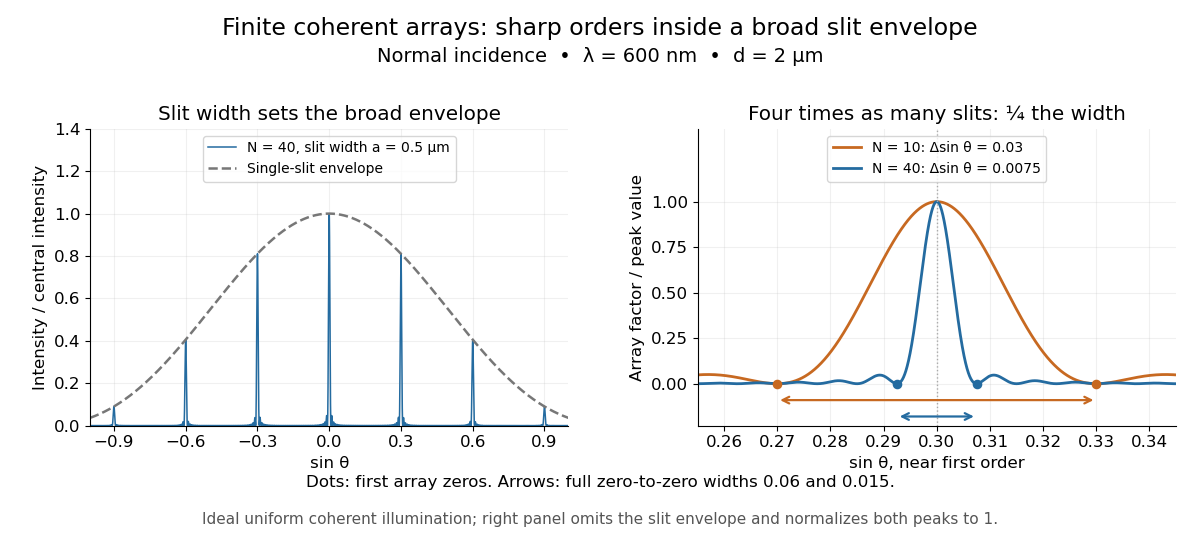
Four times as many illuminated slits therefore give a fourfold narrowing in this coordinate without moving the diffraction order. That sharper directional selection helps distinguish nearby wavelengths in a spectrograph. Actual performance also depends on illumination, optical coherence, and source width; the separate slit-limited resolving power of a grating describes the contribution of the entrance slit.
A missing diffraction order occurs when a principal maximum of an array factor coincides with a zero of the individual aperture's diffraction envelope. For identical slits of width and centre spacing , order has . It is missing if is a nonzero integer. This is cancellation of field contributions, not loss of the incident wavelength or a failure of the grating equation.
For a reflection diffraction grating with both ray directions measured on the same side of its normal, adjacent grooves have path difference . Constructive interference requires this to be an integer multiple . Signed-angle conventions can turn the sum into a difference; the physical path difference is unchanged.
A formal grating order must have a real outgoing angle. For normal incidence, is necessary. Oblique incidence can access orders outside that normal-incidence range; reflection Littrow geometry has . The ideal resolving power of a diffraction grating applies only to an order that exists and has sufficient signal.
At fixed incidence angle, differentiating the grating equation gives . A camera with focal length therefore has local focal-plane dispersion near its optical axis. With coordinate , the full derivative is .
At fixed wavelength, the grating equation gives . Thus an incident angular width is magnified by in the dispersion direction. Including the ratio of camera and collimator focal lengths gives the projected slit width. The ESO B&C operating manual, Appendix A explicitly includes this anamorphic factor.
A slit of width at the focus of a collimator subtends . Its projected width is . Dividing this width by the grating dispersion gives . Thus the spectral resolving power is . Omitting the anamorphic factor gives a denominator instead; these agree in the Littrow configuration.
In the Littrow configuration the selected diffracted ray retraces the incident ray, so and the grating equation becomes .
An echelle grating works in high diffraction orders. A separate cross-disperser separates their overlapping optical spectra on a two-dimensional detector.
Articles by others on the same topic

A diffraction grating is an optical component with a periodic structure that diffracts light into several beams. The grating consists of multiple closely spaced slits or grooves, which can be either reflective or transmissive. When light waves encounter the grating, they are scattered at specific angles according to the principles of wave interference, producing a spectrum of colors.


