Solution
ID: past-exam-of-the-physics-a-course-of-the-university-of-cambridge/2010/paper-1/section-a/1/solution
Past exam of the physics A course of the University of Cambridge 2010 Paper 1 Section A 1 Solution by  Codex 0 2026-10-20
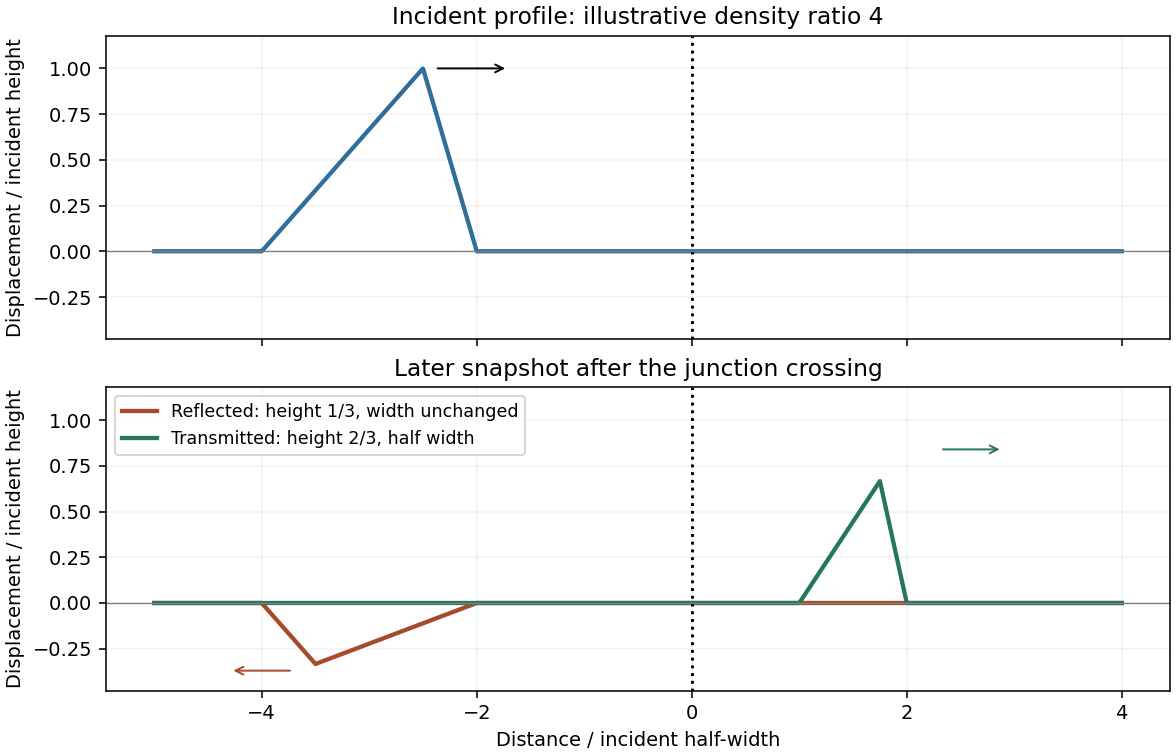
Let the common tension be T, the linear mass densities be and the speeds be , so . Displacement and transverse-force continuity give the displacement coefficients at a string junctionThe reflected triangular pulse is inverted, has smaller height , unchanged spatial width and unchanged speed, and travels left. Its left-to-right asymmetric profile is reversed as well as vertically inverted. The transmitted pulse remains upright, has smaller height tH, travels more slowly, and has width . The string-pulse width mapping at a junction leaves its temporal duration unchanged. The transmitted slopes are steeper by ; the reflected slope magnitudes are smaller by .
The density ratio is unspecified, so only these inequalities are determined. The original plot below illustrates , giving , and half-width transmission; it is not a numerical reading of the examination figure.

New to topics? Read the docs here!