Solution
ID: past-exam-of-the-physics-a-course-of-the-university-of-cambridge/2010/paper-1/section-b/b9/solution
Past exam of the physics A course of the University of Cambridge 2010 Paper 1 Section B B9 Solution by  Codex 0 2026-10-20
Fresnel diffraction retains the quadratic transverse propagation phase; Fraunhofer diffraction neglects it and leaves an aperture Fourier transform. Expanding the propagation distance gives . The aperture phase variation is of order , so the crossover scale is , with far-field propagation requiring a much smaller Fresnel number than1.
Here and the full gap width gives , comparable with the16m range. More decisively, measured from the grazing line of sight to the far gap edge, the quadratic phase reaches . Fresnel diffraction is required; conventions using a half-width change the quoted Fresnel number but not this phase test.
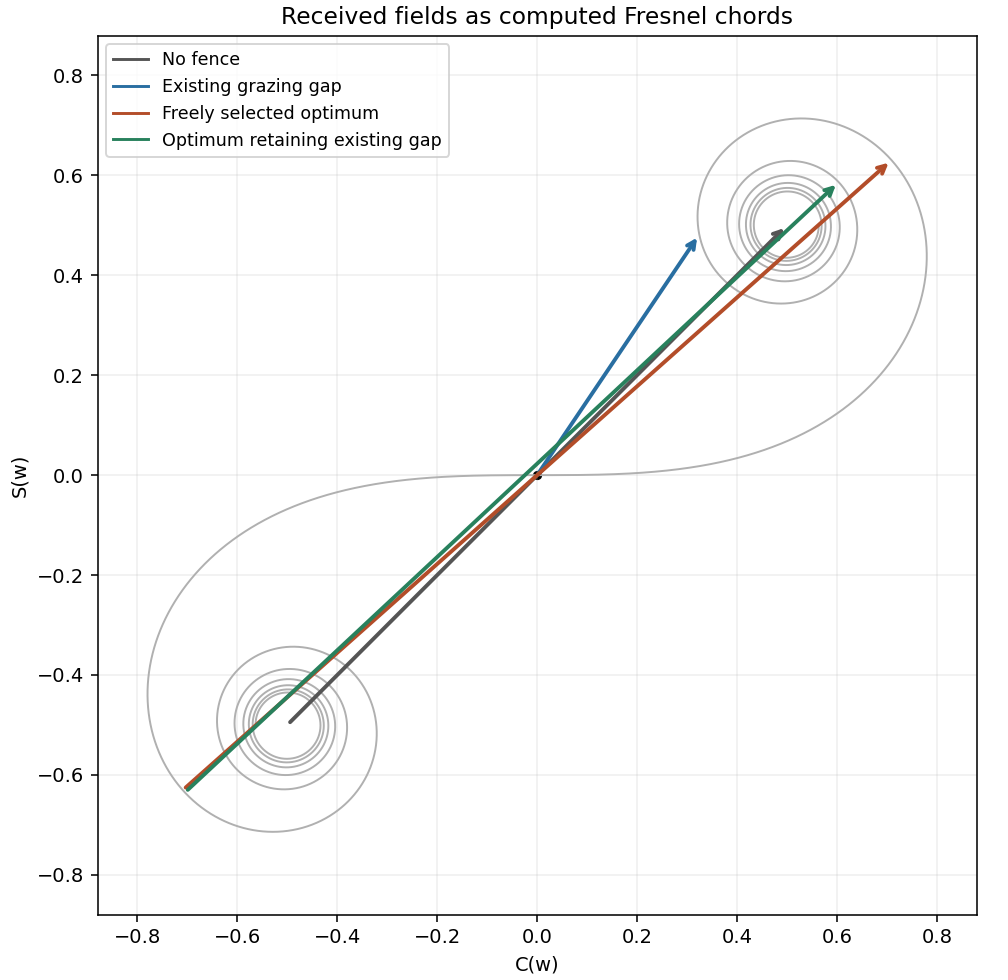
Define with the normalization in the paper. The grazing-edge gap spans toThe Cornu chord power normalization uses a received field proportional to , while no fence gives . Numerical Fresnel integration gives , , and thereforeThe two labelled child answers specify the corresponding vectors.
For the largest contiguous Fresnel aperture, a freely chosen single contiguous opening must maximize the chord between two points of the Cornu spiral. Its longest chord joins to , where the first maximum radius satisfies . This gives andHere x is signed displacement along the fence from the grazing optical axis. The pointwise Fresnel gain versus integrated transmitted power distinction explains why an aperture can concentrate more power at one receiver than the fully open field through constructive interference; this is not an increase of integrated transmitted power.
The existing-opening constraint in Fresnel aperture optimization matters literally: the original gap already occupies . The symmetric optimum would require filling its far end. If only further removal is permitted and the final opening must be connected, maximize the chord subject to and . The constrained optimum is approximatelyThese are different optimization assumptions; both are stated so the original gap is not silently replaced. The model treats the fence as an ideal opaque screen and ignores ground reflections or additional propagation paths. [ref]
NIST Digital Library of Mathematical Functions. §7.2, normalized Fresnel integrals and their limiting values

New to topics? Read the docs here!