Solution
ID: past-exam-of-the-physics-a-course-of-the-university-of-cambridge/2010/paper-1/section-d/d12/b/solution
Past exam of the physics A course of the University of Cambridge 2010 Paper 1 Section D D12 b Solution by  Codex 0 2026-10-20
The transient is the homogeneous part of a damped harmonic oscillator, . Define and . Its characteristic roots are .
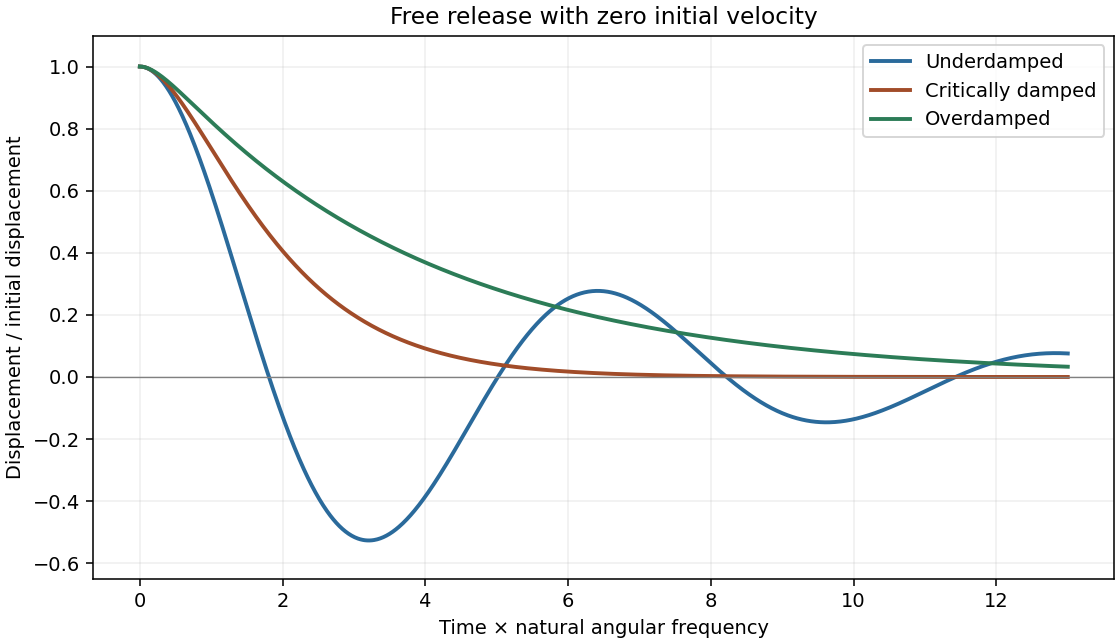
- For , the underdamped response is , with . The displacement oscillates with a decaying envelope.
- At critical damping, . It has a repeated root, so two identical exponentials are not an independent pair of solutions.
- For , two real negative exponentials produce an overdamped return without sustained oscillation. In the strong-damping limit the slow decay rate is approximately , not .
Initial position and velocity determine A,B. For an imposed force or support motion, the full solution is a particular response plus this transient, which decays for b>0 and k>0. The mechanical energy obeys . In light damping its cycle-averaged envelope decays as , with . Initial conditions can still produce an overshoot in a nonoscillatory regime; the damping category describes the roots rather than every possible trajectory.
Oscillator transients
. Dimensionless release from unit displacement and zero velocity for three damping regimes. Source. Details.
New to topics? Read the docs here!