Solution
ID: past-exam-of-the-physics-a-course-of-the-university-of-cambridge/2010/paper-2/section-a/3/solution
Past exam of the physics A course of the University of Cambridge 2010 Paper 2 Section A 3 Solution by  Codex 0 2026-10-20
The Sturm oscillation theorem requires respectively zero, one and two nodes of a wavefunction. Treating the vertical outer boundaries as hard walls, all three wavefunctions vanish there. The potential energy is asymmetric, so no even/odd parity should be imposed. At internal finite steps, both the wavefunction and its first derivative are continuous.
For and , only the left well is classically allowed. Their wavefunctions oscillate there and continue as evanescent combinations through the barrier and right region, reaching zero at the far wall. The first is nodeless; the second has one node in the left well. For both wells are allowed, while the central barrier remains forbidden: the wavefunction oscillates in both wells, with an evanescent bridge and two nodes of a wavefunction overall. A node may lie inside a finite forbidden barrier when the matching coefficients have opposite signs. Precise node positions and relative amplitudes require dimensions and heights not specified by the qualitative drawing.
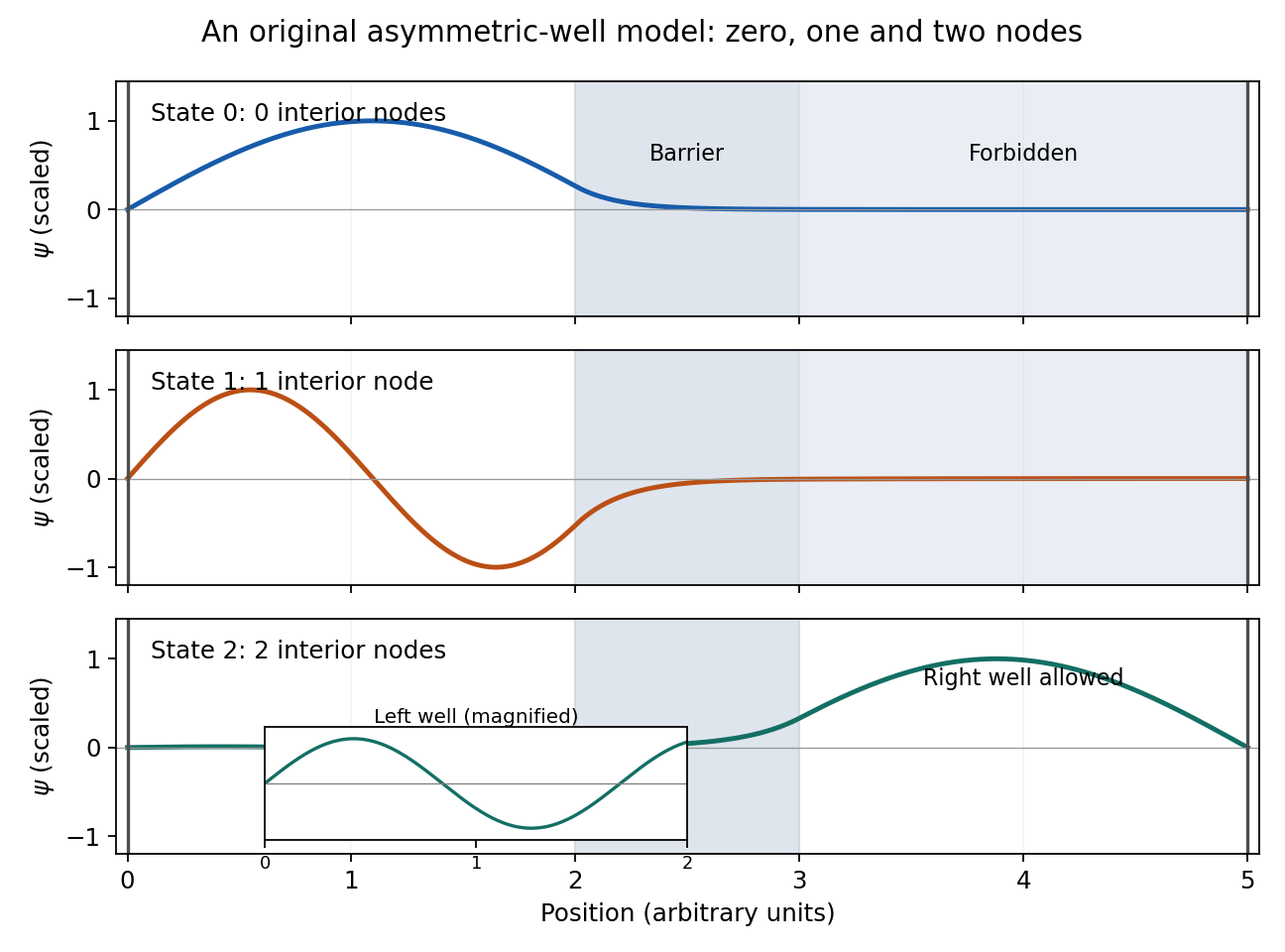

The original illustration solves an explicitly chosen model with the same ordering of allowed and forbidden regions. Its numerical parameters and detailed node positions are illustrative.
New to topics? Read the docs here!