Solution
ID: past-exam-of-the-physics-a-course-of-the-university-of-cambridge/2016/paper-1/section-d/d13/a/solution
Past exam of the physics A course of the University of Cambridge 2016 Paper 1 Section D D13 a Solution by  Codex 0 2026-10-20
The ideal voltage-feedback Operational amplifier has zero input currents and, while stable negative feedback holds it in its linear operating range, equal input voltages: and . The first rule follows from infinite input impedance; the second is the large-open-loop-gain limit of . Equal input electric potential is a virtual short, not an electrically conducting connection.
For an inverting amplifier with the noninverting input grounded, and node-current balance gives , hence . For a noninverting amplifier, the feedback divider gives , hence .
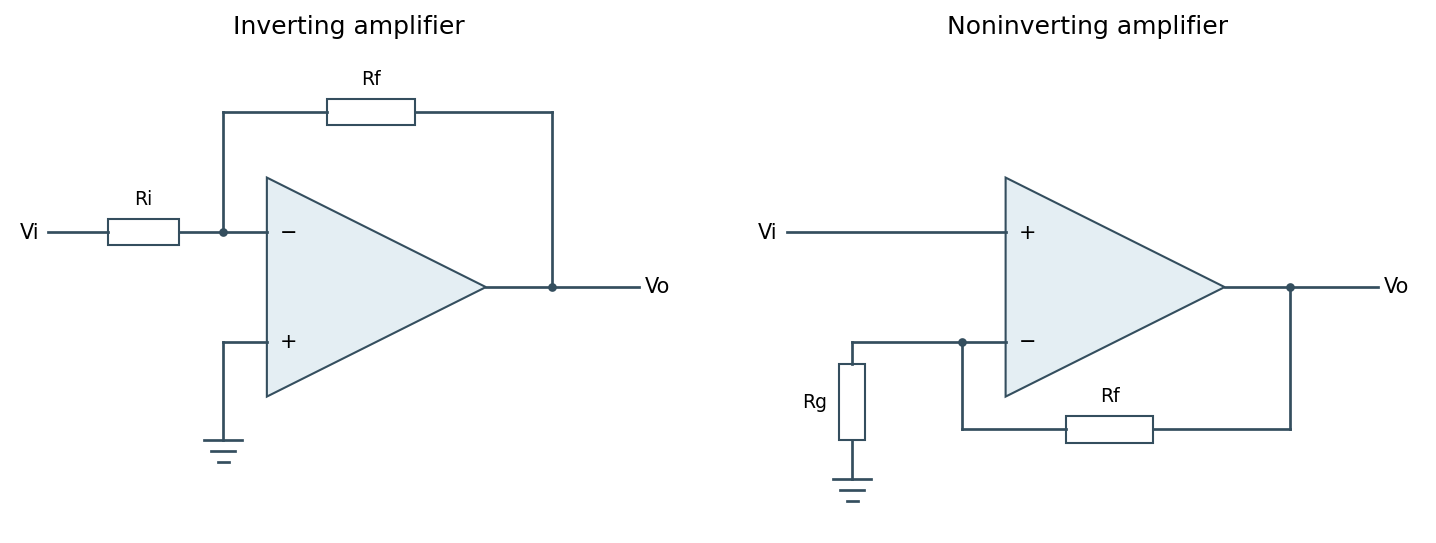
Ideal inverting and noninverting negative-feedback configurations
. Source. Details. 
One should check output swing, input common-mode range, slew rate, Gain-bandwidth product and stability before using these limits in a real circuit. Saturation, positive feedback or operation beyond bandwidth invalidates the equal-voltage rule; finite input bias currents and offset voltage can also matter.[ref]
Operational-amplifier negative feedback by Analog Devices. University electronics course, Chapter 3: high-gain feedback assumptions and practical limits
New to topics? Read the docs here!