Negative feedback closes a causal loop whose net effect opposes an initiating change. In signal transduction, activation followed by a downstream inhibition of the earlier activating stage is one example of negative feedback. Loop sign alone does not establish asymptotic stability or complete signaling adaptation; see the worked signaling feedback example.
A useful biological example is chemotaxis feedback regulation: an Escherichia coli biological cell adjusts its response to a sustained attractant instead of remaining at its immediate response. Increased CheA activity promotes CheB phosphorylation; CheB reverses receptor methylation, opposing their activation. After attractant addition, reduced activity instead favors receptor methylation by CheR, restoring activity. This is a return from receptor activity to the machinery regulating that activity. The response need not return exactly at every dose. [ref]
A motivating measurement is the chemotaxis FRET assay. CheY and CheZ carrying yellow and cyan fluorescent tags were observed in immobilized Escherichia coli biological cells on a coverslip in a flow chamber. Adding and removing attractant changed the yellow-to-cyan emission ratio, reporting the association of phosphorylated CheY with CheZ. This measures a molecular readout upstream of motor behavior. Comparisons with biological cells lacking CheR, CheB, or both tested the dependence on receptor modification; these perturbations also change starting activity and sensitivity, so they are not pure changes of one feedback gain. [ref]
The later chemotaxis feedback regulation experiment used only the Tar receptor and nonmetabolizable methylaspartate, supplied and removed by flow. Long recordings separated slow recovery from incomplete signaling adaptation; correction for bleaching addressed drift in the optical readout. Activity recovered incompletely after sufficiently large additions, with detectable imprecision already at in that preparation. Restricting the receptor type and preventing consumption of the stimulus help interpret the perturbation, but limit transfer to other receptors and conditions. The readout infers CheA activity through CheY-CheZ association, rather than directly measuring every molecular step. [ref]
Negative feedback can also overshoot or sustain oscillations if its return arrives too late. The worked signaling feedback example gives the contrasting instantaneous case; the delayed negative feedback model below isolates the effect of timing. Loop sign describes causation, while asymptotic stability describes what happens to displacements over time.
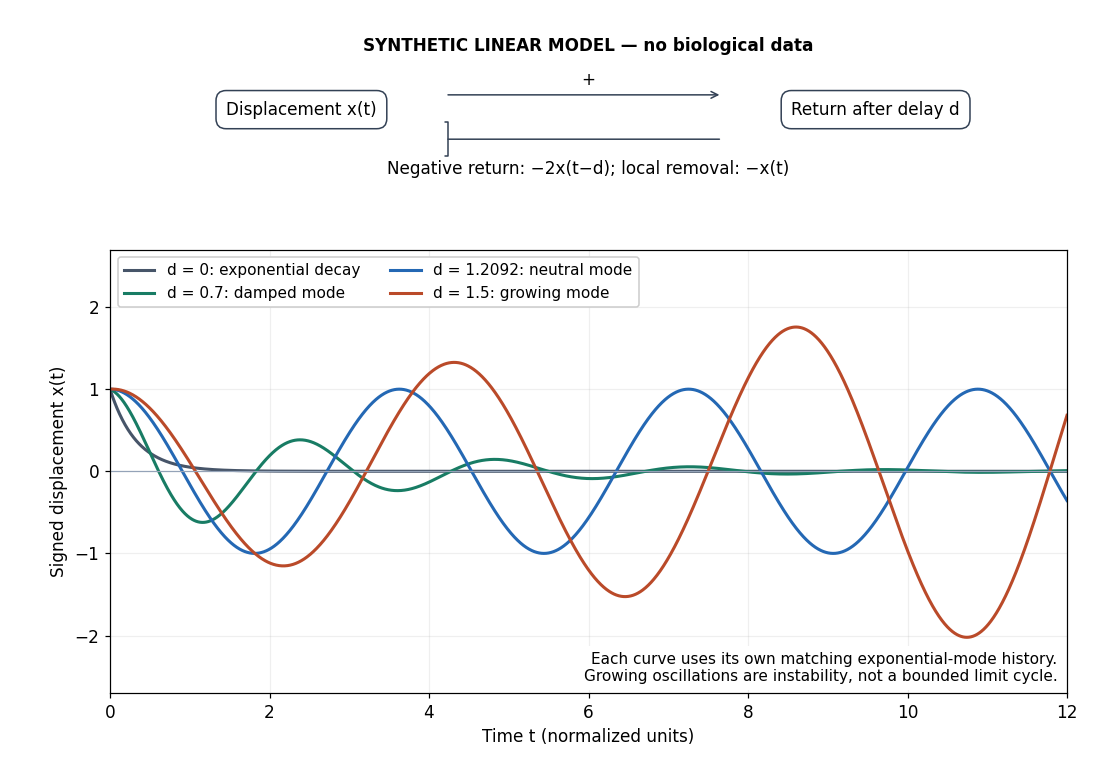
Negative feedback with an instantaneous or delayed return
. Original synthetic delay differential equation modes, not measured chemotaxis responses. All variables and time are normalized. The same negative return coefficient is used throughout; only its delay changes. Each curve has its own matching history. A growing oscillation signals instability of this linear mathematical model, not a bounded biological rhythm. Details.A feedback delay is a time interval between an event and its returning influence. Multiple biochemical steps can introduce an effective lag; a fixed delay is an idealization, not a universal description of signal transduction. To isolate timing, let be a signed displacement from an equilibrium point and use normalized dimensionless variables:The local removal is and the returning influence is negative at every delay. At the ordinary differential equation reduces to the decay already illustrated under signaling feedback. For a delay differential equation requires a history on , not just an initial condition at one instant. Negative values of are displacements, not negative chemical concentrations.
An exponential function gives the characteristic equation of a delay differential equationPutting and equating real and imaginary parts gives and . The first crossing with therefore occurs atFor this particular mathematical model, the equilibrium point is asymptotically stable for . No nonnegative real delayed feedback characteristic root can satisfy the equation; the first loss of asymptotic stability is the indicated pair of imaginary delayed feedback characteristic roots. Differentiating the characteristic equation of a delay differential equation along a root yieldsThus the pair moves into growth as the delay increases through . The neutral mode at is a periodic function, but its amplitude depends on history: this linear mathematical model does not select an attracting limit cycle.
The figure plots using a delayed feedback characteristic root and that same formula on the history interval. At the displayed mode decays; at it grows. These are exact modes up to numerical root accuracy, not step responses with identical histories. Molecular bounds and a changed return law would be needed to interpret what happens after an unstable biological response becomes large.
A delayed feedback characteristic root solves the characteristic equation of a delay differential equation and supplies an exponential function mode. Its real part determines decay or growth of that mode.
In Escherichia coli, chemotaxis feedback regulation couples receptor activity to modification of the receptors by CheR and CheB. It is a molecular example of negative feedback supporting signaling adaptation, with precision and kinetics assessed by the chemotaxis FRET assay above.
Removal of methyl groups from a modified receptor. In chemotaxis feedback regulation, this reverses the chemical modification introduced by receptor methylation; the two processes have different enzyme-dependent rates. Whether the demethylation rate depends on total receptor modification or on active receptors matters for perfect adaptation.
A conceptual chemotaxis adaptation model in which saturated CheR action supplies receptor methylation while CheB preferentially demethylates active receptors. If , the steady state output is , independent of ligand whenever a physically accessible stable steady state exists. Changing enzyme abundance can change this baseline without destroying adaptation to a subsequent ligand step.[ref]
If the forward receptor-modification flux depends on remaining unmethylated substrate, it generally depends indirectly on ligand through the modified receptor pool. The steady output then need not be ligand independent. Near-perfect adaptation may remain in a saturation limit; finite modification capacity and completely inactive receptor populations also bound the ideal perfect-adaptation result.
Return of an output to its original steady value after a persistent input change, with the adaptation property persisting over a range of model parameters. integral action can implement this property under stability and operating-range assumptions.
CheW is a coupling protein linking chemotaxis receptor arrays to CheA-associated signalling complexes. Removing it from a reconstituted system can test its functional requirement, while a physical-interface assay addresses direct contacts.
CheA is the signaling enzyme that promotes phosphorylation of CheY and CheB in the chemotaxis feedback regulation pathway.
CheB is an enzyme that reverses receptor methylation in chemotaxis; its regulation contributes to negative feedback.
CheR is an enzyme that catalyzes receptor methylation in chemotaxis, contributing to signaling adaptation.
The phosphorylation state of the protein CheY connects receptor signaling to motor behavior in Escherichia coli.
The chemotaxis FRET assay uses Förster resonance energy transfer between fluorescent tags on CheY and CheZ to report their association. Interpreting this emission ratio as CheA activity requires the coupling between CheY phosphorylation and CheZ binding described in the experimental sources above.
Articles by others on the same topic


Negative feedback is a regulatory mechanism in which a system responds to a change by initiating processes that counteract that change, ultimately bringing the system back to its desired state or equilibrium. This concept is commonly found in various fields, including biology, engineering, and systems theory. In biological systems, for example, negative feedback helps maintain homeostasis. An example is the regulation of blood sugar levels: when blood sugar rises after eating, the pancreas releases insulin, which helps lower blood sugar levels.