Solution
ID: past-exam-of-the-physics-a-course-of-the-university-of-cambridge/2016/paper-2/section-b/b8/solution
Past exam of the physics A course of the University of Cambridge 2016 Paper 2 Section B B8 Solution by  Codex 0 2026-10-20
The Fourier expression is the scalar Fraunhofer diffraction approximation for coherent, effectively monochromatic illumination with a uniform incident plane wave over the aperture. At a distant screen the aperture-dependent quadratic propagation phase must be negligible, roughly for transverse size . Alternatively, a thin lens forms the angular Fourier transform in its back focal plane. That focal-plane construction is the appropriate one here; the aperture-to-lens distance need not itself be an enormous free-propagation distance. aperture features should be large compared with wavelength for this simple scalar transmission-mask model.
If complementary transmissions are and , linearity gives . Away from the undiffracted forward beam, the uniform plane-wave contribution vanishes in angular space, so and their intensities agree. This is Babinet's principle. It equates the off-forward diffracted intensities, not the transmitted power or the on-axis intensity including the direct beam.
Let be screen coordinates conjugate to aperture coordinates , so , . With width along and height along , define . The complementary rectangle has transformThus the obstruction's off-forward scattered component hasIts dark lines occur atThe central-lobe zero-to-zero size is by ; it is wider in the direction conjugate to the narrower obstruction. The central forward image of the illuminating beam must be distinguished from this scattered envelope in a real screen observation.
The source figure gives centre-to-centre separation . Choose the three rectangle centres at ; an overall translation changes only the transform phase. Their scattered amplitude is proportional toThereforeAlong the screen's direction, the three-element interference factor has principal maxima separated by , under the single-rectangle envelope. Its zeros lie at and . It also has weaker secondary maxima between principal orders. Every fifth principal order coincides with a single-rectangle zero and is missing; multiplication by the envelope slightly shifts maxima away from the nominal interference-factor positions. The figure plots the calculated scattered component and marks the separate direct-beam limitation.
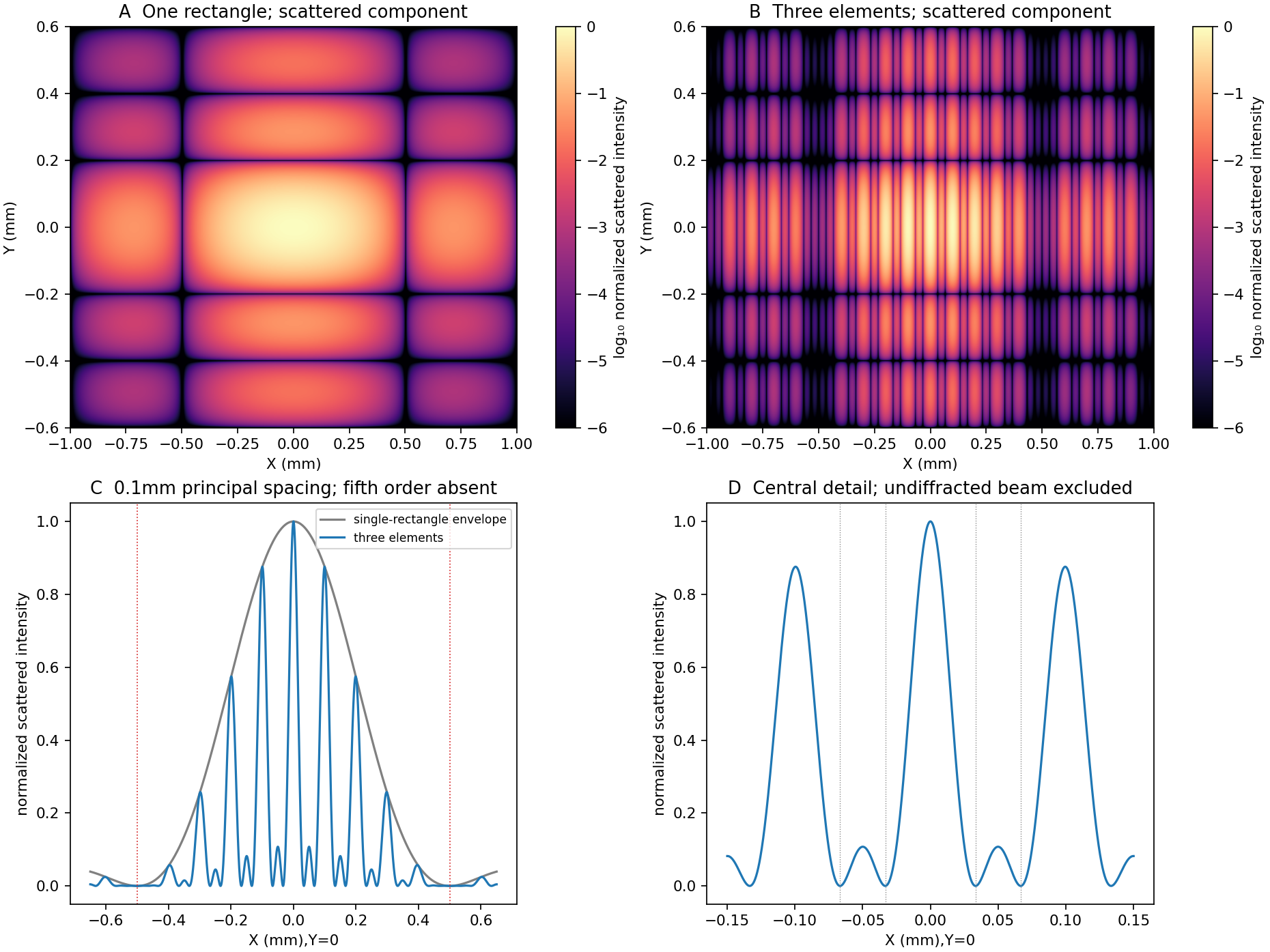
Original calculated rectangular-obstruction and three-element Fraunhofer scattered intensities
. Screen coordinates are physical conjugates of the obstruction coordinates. All plotted values describe the scattered component; the unresolved undiffracted illumination at the origin is excluded. Intensities are normalized, and no source figure is reproduced. Details.
New to topics? Read the docs here!