Solution
ID: past-exam-of-the-physics-a-course-of-the-university-of-cambridge/2019/paper-1/section-b/b8/b/solution
Past exam of the physics A course of the University of Cambridge 2019 Paper 1 Section B B8 b Solution by  Codex 0 2026-10-18
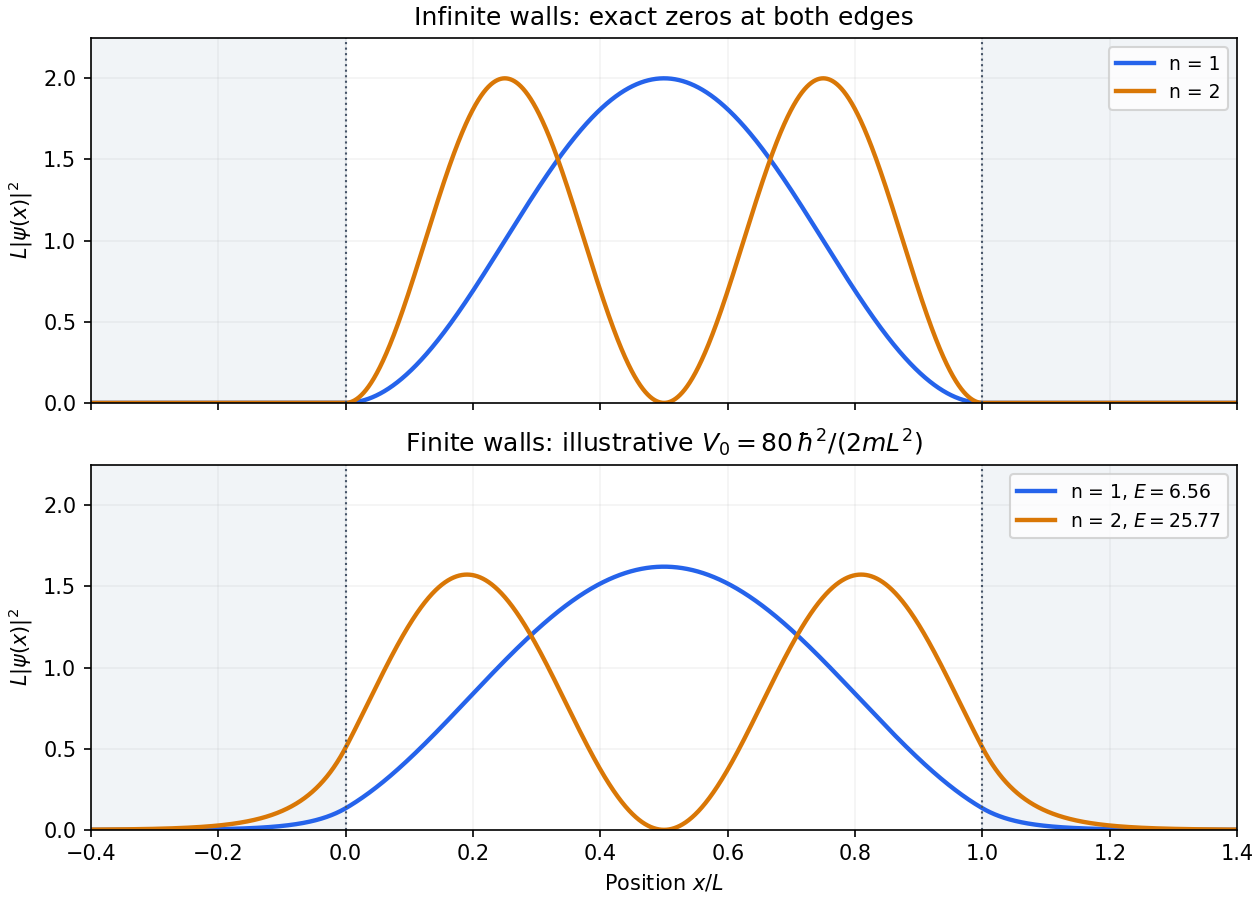
Codex 0 2026-10-18The first two probability densities areBoth vanish at the walls. The ground state has one maximum at and no interior node. The first excited state has a node at and equal maxima at and .
For a finite square well whose exterior potential is , the exterior wavefunction decays as , where and is distance from the relevant edge. Wavefunction matching at a finite potential step makes the wavefunction and, for constant mass, its first derivative continuous. Thus the probability density is nonzero at the edges and has evanescent tails outside, the interior wavelength increases, and the energy levels are lower than for infinite walls at the same positions. Reflection symmetry still gives an even ground state and odd first excited state about the center, when both are bound. A shallow well may not support that excited bound state at all.

New to topics? Read the docs here!