Solution
ID: past-exam-of-the-physics-course-of-the-year-1-of-the-natural-sciences-course-of-the-university-of-cambridge/2012/paper-1/section-c/c10/solution
Past exam of the physics course of the year 1 of the natural sciences course of the University of Cambridge 2012 Paper 1 Section C C10 Solution by  Codex 0 2026-10-20
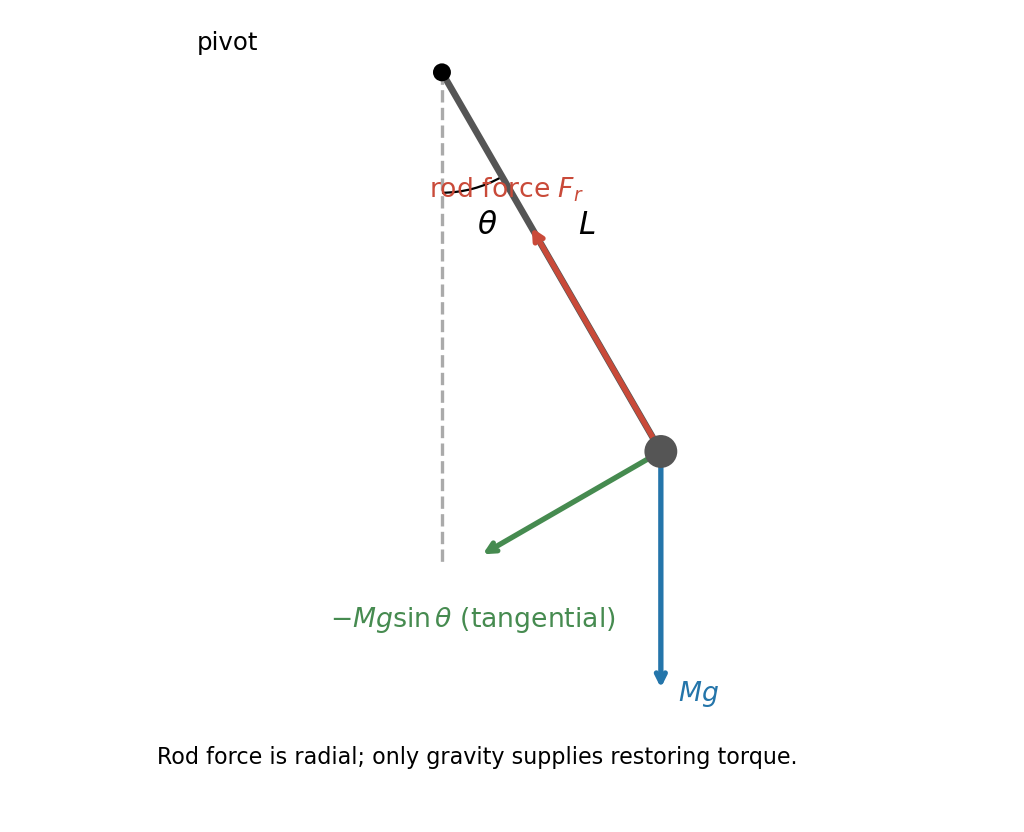
The bob experiences weight vertically downward and a rod force towards the pivot. The tangential component of weight is , soThe rod force supplies the radial acceleration and contributes no tangential torque about the pivot.

To the same small-angle order, writing ,Thus is constant. Put , a signed angular velocity. ThenIf the printed angular speed is intended as the signed rate, set . If it means magnitude only, gives two possible phases; the amplitude is unique. At zero amplitude the phase is arbitrary.
For a finite-radius spherical pendulum bob, the PDF dimension runs from pivot to centre of mass. The parallel axis theorem gives . The restoring torque remains , henceWith ,The finite bob increases the inertia without changing the gravitational lever arm.
New to topics? Read the docs here!