Solution
ID: past-exam-of-the-physics-course-of-the-year-1-of-the-natural-sciences-course-of-the-university-of-cambridge/2012/paper-1/section-d/d13/solution
Past exam of the physics course of the year 1 of the natural sciences course of the University of Cambridge 2012 Paper 1 Section D D13 Solution by  Codex 0 2026-10-20
Here is potential energy, is the stationary-state total energy eigenvalue, and is its spatial wavefunction. Wavefunction normalization gives , and is the probability of finding the particle in .
A bound state requires . Inside the well the equation is , whereas outside it is , withThe ground state is even and has no node, selecting inside. Normalizability selects decaying, not growing, exterior exponentials. Continuity of and givesThe first excited state, if present, is odd: a sine inside and opposite-sign decaying tails outside. Matching gives . On its first odd branch, , hence . Since , existence requiresThis is the first odd bound-state threshold of a square well. There is no excited bound state below that threshold; equality gives a non-normalizable zero-energy limiting state, not an extra bound state.
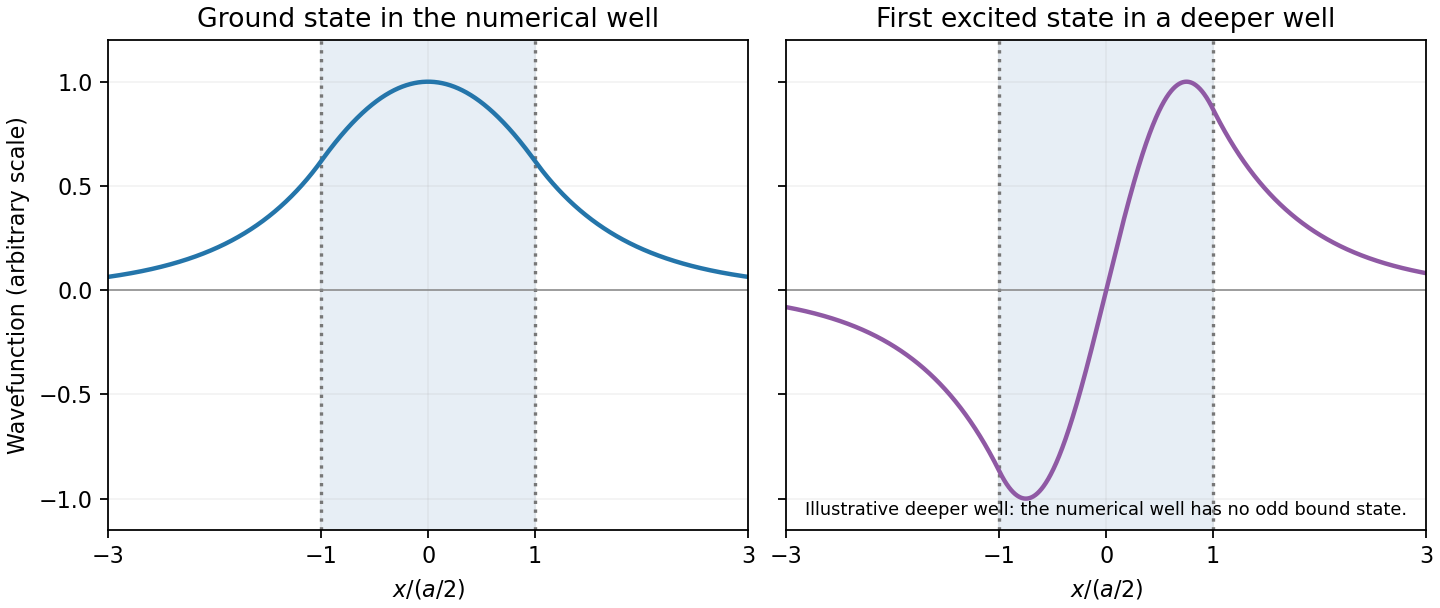
Original finite-well wavefunctions: an even nodeless ground state and an odd excited state in a deeper illustrative well
. Details. 
For the numerical well,The exterior probability of a symmetric finite-well state includes both tails:The threshold is , exceeding the well depth, so there is no excited bound state. The rounded supplied coefficients integrate to rather than exactly one; this rounding does not change the quoted probability precision materially.
New to topics? Read the docs here!