Solution
ID: past-exam-of-the-physics-course-of-the-year-1-of-the-natural-sciences-course-of-the-university-of-cambridge/2014/paper-1/d13/solution
Past exam of the physics course of the year 1 of the natural sciences course of the University of Cambridge 2014 Paper 1 D13 Solution by  Codex 0 2026-10-20
Represent each wave by a complex phasor. Add phasors before squaring: two amplitudes give . For equally illuminated narrow slits, adjacent phasors differ by , soAll phasors align when , giving the grating equationThe nearest zero has adjacent-phase increment : the phasor polygon closes once. Thus , givingThe angular linearization is valid away from grazing directions; the underlying exact first-zero condition is .
For the first subsidiary maximum of a large slit array, use the stipulated phasor wraps: relative to a principal maximum. Its amplitude is approximately times one slit's amplitude. ThereforeThis uses the question's approximate maximum position, not the exact extremum of the slit-array intensity.
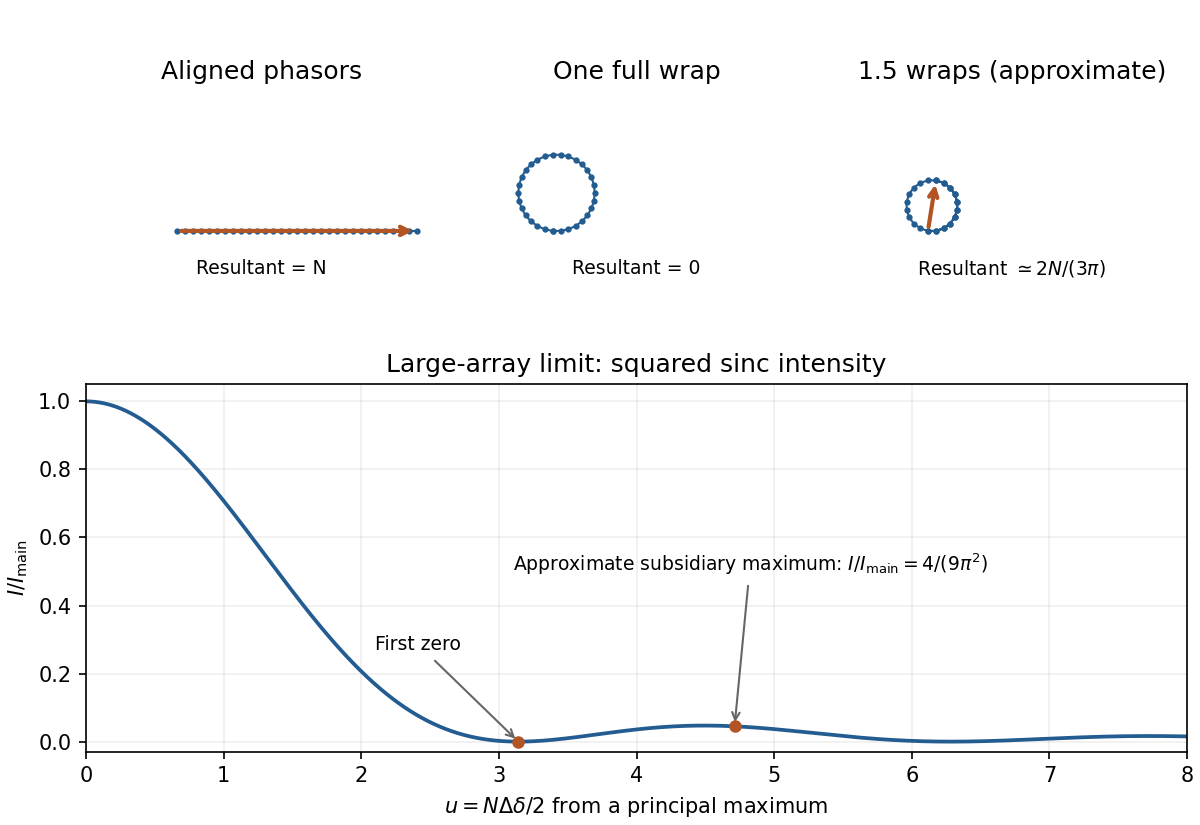
Original phasor sums for a principal maximum, the adjacent zero and the approximate first subsidiary maximum; calculated large-array intensity shown below
. Details. 
The Rayleigh criterion places one line's principal maximum at the other's first minimum. Grating dispersion then gives . Combining with normal incidence, , gives the normal-incidence grating width bound:The value is an ideal lower bound approached near grazing diffraction. A usable finite angle needs greater width; for example requires about . The exact sine first-zero relation still gives the lower bound when the local angular approximation fails near grazing.
Such a coherently illuminated grating is very large and needs accurate groove placement and suitable collection optics; an unaided far-field screen would require distances much greater than . Focusing optics avoid that screen distance but not the required resolving power of a diffraction grating. Real linewidth, slit width and aberrations can require more resolution. The unequal isotope abundances also make this ideal Rayleigh estimate less decisive than for equally bright lines.
New to topics? Read the docs here!