Isotopes of a chemical element have the same atomic number , hence the same number of protons, but different neutron numbers and therefore different mass numbers . For example, every neon atomic nucleus contains ten protons: neon-20, neon-21, and neon-22 contain ten, eleven, and twelve neutrons, respectively. They occupy one chemical element box in the periodic table, rather than three boxes.
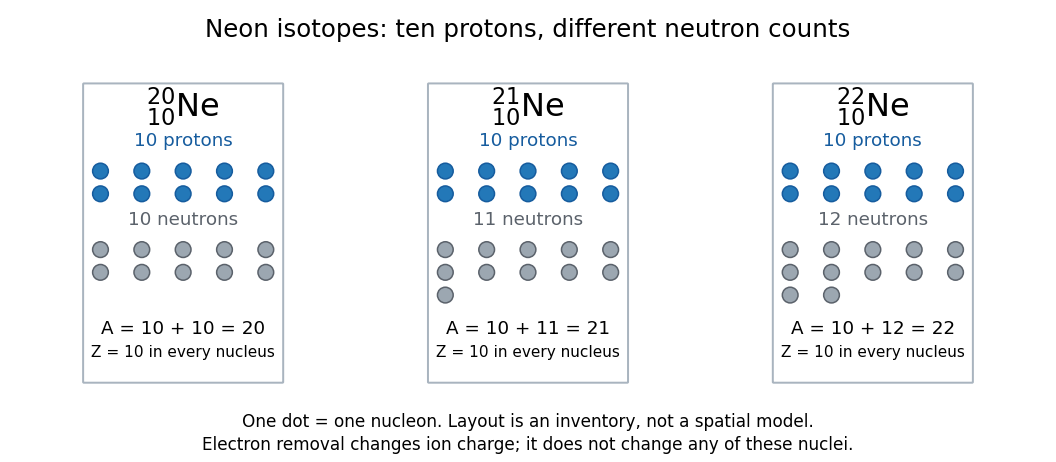
Three labels answer different questions. The chemical element fixes ; the isotope specifies which neutron number accompanies that ; the ion label specifies the net electric charge. Neutral and the ion both contain ten protons and twelve neutrons; they contain ten and nine Electrons, respectively. Ordinary ionization changes the Electron count, leaving the isotope unchanged. Changing the neutron number can change nuclear binding energy and the possibility of radioactive decay. Isotopic abundances can help distinguish material sources, while radioactive decay can additionally supply chronological information.
A mass spectrum makes the distinction experimentally visible: a single chemical element can give separate ion peaks at different mass-to-charge ratios. Its bulk atomic weight is a weighted mean governed by isotopic abundances, rather than the location of one compulsory peak. The historical mass spectrograph experiment and the synthetic neon mass spectrum below illustrate these complementary observations.
Articles by others on the same topic




There can, therefore, I think, be little doubt that what has been called neon is not a simple gas but a mixture of two gases, one of which has an atomic weight about 20 and the other about 22. The parabola due to the heavier gas is always much fainter than that due to the lighter, so that probably the heavier gas forms only a small percentage of the mixture.