Solution
ID: past-exam-of-the-physics-course-of-the-year-4-of-the-natural-sciences-course-of-the-university-of-cambridge/2015/paper-1/section-a/a2/solution
Past exam of the physics course of the year 4 of the natural sciences course of the University of Cambridge 2015 Paper 1 Section A A2 Solution by  Codex 0 2026-10-20
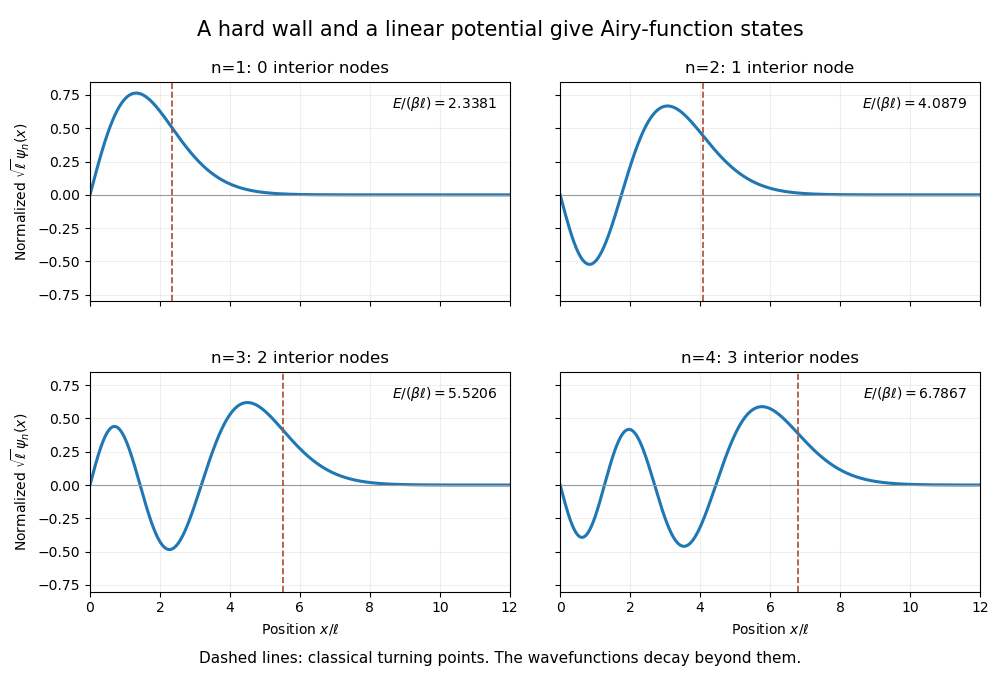
The hard wall imposes , while the increasing linear potential requires decay as . SetThe stationary Schrödinger equation becomes . The growing Airy function solution is excluded, leavingThis is the quantum bouncer. For the first four states, . Their interior node counts are respectively zero, one, two and three. Each wavefunction starts at zero at the wall, oscillates in the classically allowed interval, and crosses smoothly into an exponentially decaying tail beyond the turning point . The turning point is not an extra hard wall: the wavefunction generally remains nonzero there and beyond it.

New to topics? Read the docs here!