Solution
ID: past-exam-of-the-physics-course-of-the-year-4-of-the-natural-sciences-course-of-the-university-of-cambridge/2016/paper-1/section-b/b8/solution
Past exam of the physics course of the year 4 of the natural sciences course of the University of Cambridge 2016 Paper 1 Section B B8 Solution by  Codex 0 2026-10-20
In the position representation, the momentum operators are and . Thereforesince at fixed radius. Solving the eigenvalue equation on the circle and imposing periodicity givesTheir normalization uses the angular measure on .
For the half-ring sine-squared angular state, write . The stated wavefunction is normalized because . It and its first derivative match continuously to zero at the boundaries, so the integrations by parts have no boundary contributions. The angular momentum expectation and second moment areHence . The jumps in the second derivative do not invalidate this result: the periodic wavefunction has a square-integrable second derivative and a continuous first derivative.
The probability of is the squared projection onto :The odd sine term gives the imaginary overlap; a real wavefunction need not have zero probability of nonzero angular momentum. Its positive and negative angular-momentum probabilities are equal.[ref]
Quantum Mechanics by David Tong. Chapters 3–4: operator expectation values, angular momentum and eigenstate projections
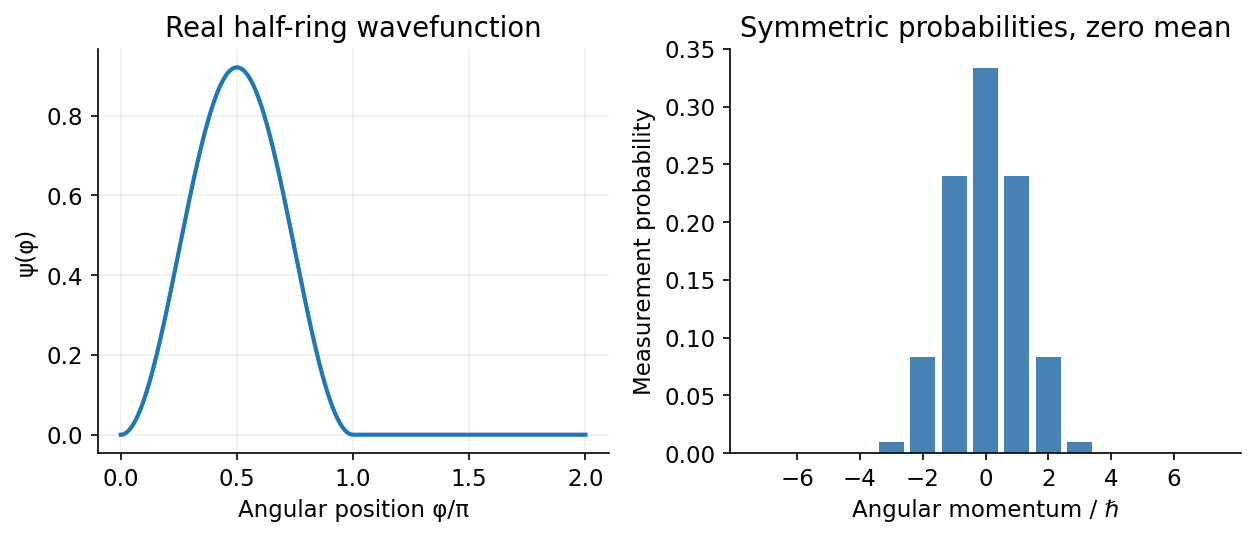
A real state confined to half a ring has zero mean angular momentum and symmetric nonzero measurement probabilities
. Source. Details. 
New to topics? Read the docs here!