Solution
ID: past-exam-of-the-physics-of-nanoelectronic-systems-course-of-the-university-of-cambridge/2016/paper-1/3/b/solution
Past exam of the physics of Nanoelectronic Systems course of the University of Cambridge 2016 Paper 1 3 b Solution by  Codex 0 2026-10-20
A quantum point contact is made by using negative surface split gates to leave a short narrow channel in a clean two-dimensional electron gas. Its length should be smaller than the transport mean free path; transverse confinement should be strong enough that subband spacing exceeds thermal and lifetime broadening. Low-resistance Ohmic contacts connect large reservoirs. Apply a small source–drain bias, measure current and differential conductance, and sweep the gate to change the channel width or barrier height. Contact and wiring series resistance must be accounted for when comparing plateau values.
The Landauer formula explains the conductance without treating the short channel as a diffusive wire. For each propagating one-dimensional mode, the density of states and group velocity cancel in the incident flux, leaving per spin per energy interval. The reservoir occupation difference supplies the net current:The factor two assumes unresolved spin degeneracy. In zero-temperature linear response,A well-transmitted channel has , giving steps as modes open. A finite two-terminal resistance persists even for a perfectly ballistic channel because reservoirs inject only a finite number of modes; it is not evidence of resistive scattering inside the channel. Gate-controlled point-contact conductance quantization was demonstrated in a two-dimensional electron gas.[ref]
Quantized conductance of point contacts by B. J. van Wees and others. 1988, primary publication: gate-controlled quantized conductance of ballistic point contacts
The saddle-point model of a quantum point contact resolves how modes open. Near the bottleneck, choose the channel direction as and writeTransverse harmonic confinement gives barrier tops . Scattering through the inverted longitudinal harmonic barrier givesSmall longitudinal curvature makes a sharp transmission threshold compared with the transverse subband spacing; finite curvature rounds each conductance step. This is the explicit smooth-barrier model developed for a saddle constriction.[ref]
Quantized transmission of a saddle-point constriction by M. Büttiker. 1990, saddle potential and mode-resolved transmission
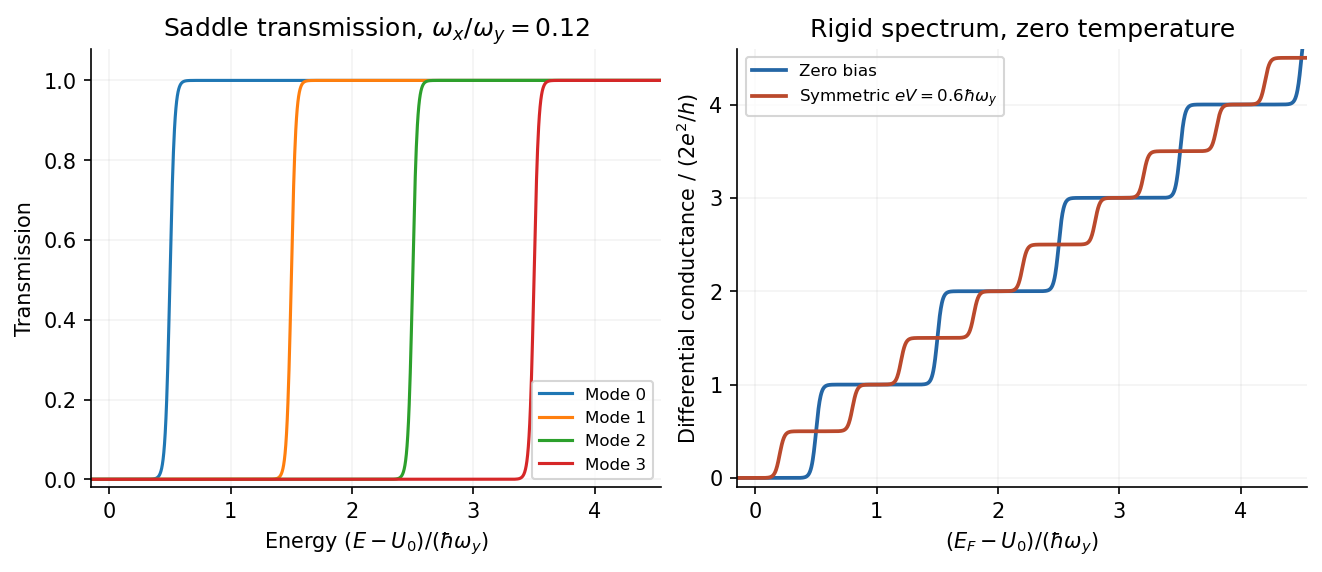

At larger source–drain bias, the current samples a finite energy window. For a rigid transmission spectrum at zero temperature,With symmetric bias, , the nonlinear conductance of a quantum point contact isIf both window edges sample open modes, the usual plateau remains. If one edge samples and the other , differential conductance approaches : a half-integer plateau relative to the zero-bias step. It is a bias-window effect, not half an electron spin degeneracy. Ridges in gate–bias transconductance occur when a reservoir chemical potential crosses a subband threshold; their separations can measure subband energies.
The half-plateau expression assumes symmetric bias and an approximately bias-independent barrier. An asymmetric voltage drop or self-consistent shift of changes the numerical relation. At still larger biases, heating and inelastic scattering can invalidate a rigid elastic saddle model. Thus the zero-bias quantization counts transmitted modes, while nonlinear spectroscopy compares mode counts at the two ends of the bias window.
New to topics? Read the docs here!