Solution
ID: past-exam-of-the-physics-of-the-earth-as-a-planet-course-of-the-university-of-cambridge/2015/paper-1/2/c/solution
Past exam of the physics of the Earth as a Planet course of the University of Cambridge 2015 Paper 1 2 c Solution by  Codex 0 2026-10-20
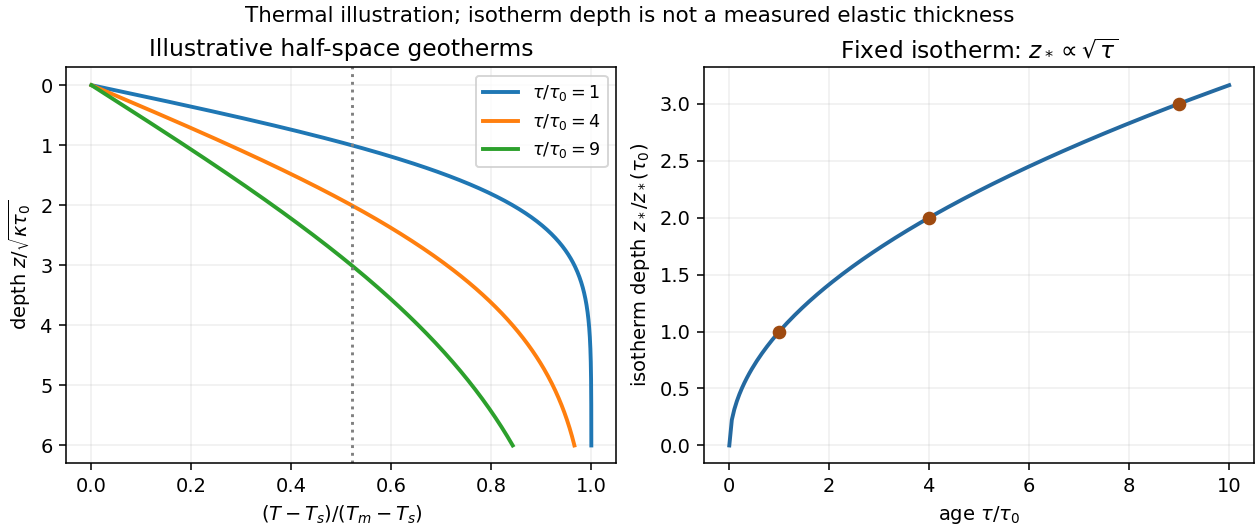
New oceanic lithosphere is hot and mechanically weak. As it cools, the depth over which rock can sustain elastic stress on the loading timescale generally increases, so effective elastic thickness tends to increase with plate age at the time of loading. It is this mechanical state when the load is emplaced, together with subsequent relaxation, that matters; the present age alone is insufficient for an ancient load.
The half-space cooling model illustrates the thermal dependence. With age , surface temperature , initial interior temperature and constant thermal diffusivity ,A chosen temperature lies atIf the base of the mechanically strong layer approximately follows such an isotherm, initially follows a similar age trend. Cooling models constrained by ocean-floor depth and heat flow provide the thermal motivation; their fitted thermal thickness must not be mistaken for measured elastic thickness.[ref]
An analysis of the variation of ocean floor bathymetry and heat flow with age by Barry Parsons and John G. Sclater. 1977, pages 803–806 and discussion of half-space versus finite-plate cooling
In practice is an effective bending thickness rather than the depth of one universal temperature. Stress-dependent yielding, grain size, water content, composition, loading duration and reheating can alter it. Finite-plate cooling and basal heat input also limit indefinite square-root growth at old ages. Nor should be identified with either the thickness of the crust or the full seismically defined lithosphere.

New to topics? Read the docs here!