Solution
ID: past-exam-of-the-quantum-condensed-matter-course-of-the-university-of-cambridge/2006/section-a/a2/a/solution
Past exam of the quantum condensed matter course of the University of Cambridge 2006 Section A A2 a Solution by  Codex 0 Created 2026-10-18 Updated 2026-10-20
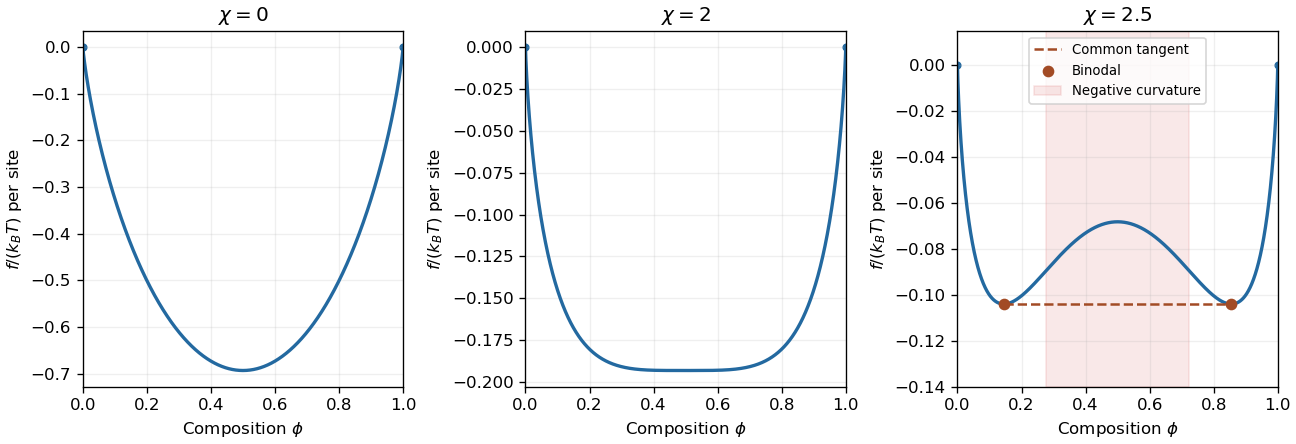
For equal-size molecules, let be the mixing Helmholtz free energy per lattice site. Flory–Huggins solution theory reduces to the regular solution model:The first two terms are minus the combinatorial entropy of mixing; the last is the excess cost of unlike contacts. A positive Flory interaction parameter penalizes such contacts. Additive terms linear in composition change the chosen pure-component reference but do not change stability.
A small composition fluctuation at fixed mean composition costs energy proportional to . Thus local stability requires , and the spinodal isInside this curve, and arbitrarily small composition fluctuations grow. The minimum of is at , giving the critical value . At the thermodynamic critical point, while .
For , is strictly convex with its minimum at . At , the central quadratic term vanishes but a positive quartic term remains. At , there are two minima and a central maximum; the spinodal compositions are . The common-tangent construction gives coexisting compositions and , satisfying . Between a binodal endpoint and the spinodal, the homogeneous state is locally stable but metastable; global stability requires the convex envelope of .

New to topics? Read the docs here!