
A critical point of a smooth map is an input; a critical value is an output reached from at least one such input. For the fold , all inputs are critical points of a smooth map, and all outputs are critical values. The identical coordinate pairs live in different copies of . To classify an output , inspect its entire fiber of a function:For both inputs have matrix rank two, so the output is a regular value. For its input has matrix rank one, so the output is a critical value. For the fiber of a function is the empty set, and the output is a regular value despite being outside the image of a function.
In general, for a smooth map , write for its set of critical points of a smooth map. Its set of critical values is . Equivalently, is a critical value if some has a differential that is not surjective. A regular value requires a surjective differential at every input in that fiber of a function. The universal condition holds vacuously for an empty fiber of a function: every output outside is a regular value. These quantifiers are explicit in Loring W. Tu, An Introduction to Manifolds, Definition 8.22 and its two following remarks.
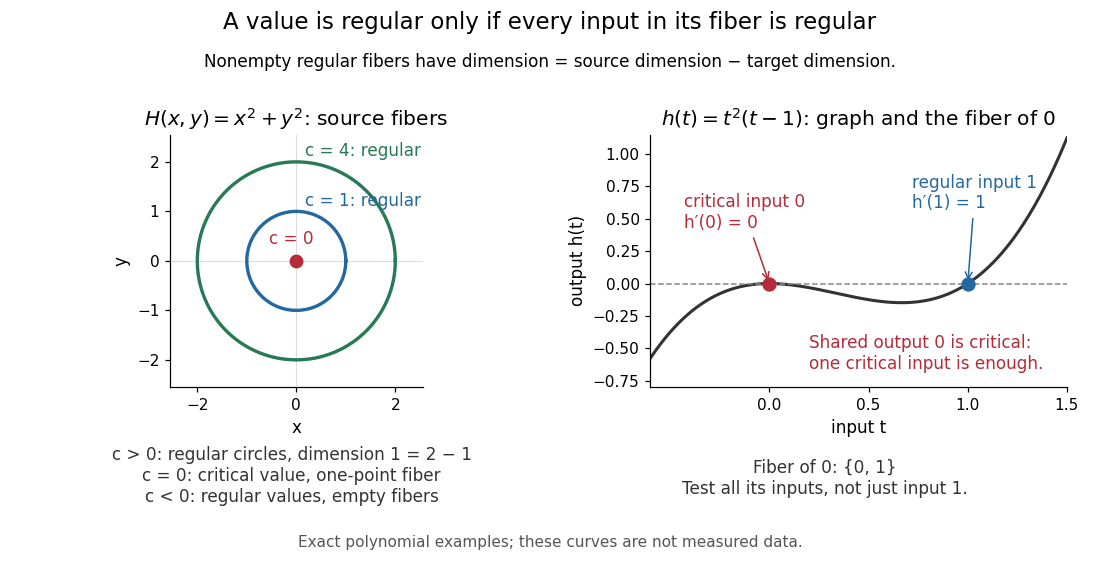
Regular circular fibers and a critical value reached from both critical and regular inputs
. Details. The distinction is useful when solving equations. For a smooth map between smooth manifolds without boundary and a regular value with nonempty fiber of a function, the regular level set theorem makes an embedded submanifold of dimension , with tangent spaceThe implicit function theorem explains the freedom count: locally, independent equations fix coordinates and leave free. The rank-nullity theorem gives the same count for the displayed kernel of a linear map. See Eckhard Meinrenken, Differentiable Manifolds, Theorems 1.11 and 1.15 for the local projection description and its consequence for level sets.
For example, , , has gradient and just one critical point, the origin, with critical value zero. For , its fiber of a function is the circle of radius , a one-dimensional embedded submanifold; negative are regular values with empty fibers. At , the fiber of a function is a single point instead of a circle. A critical value does not force its fiber of a function to be nonsmooth: that singleton is itself a zero-dimensional embedded submanifold, but the regular dimension conclusion does not apply.
Nor does a single regular input certify a regular value. The scalar smooth function has and derivative . The input zero is a critical point, while the input one is regular because . Their shared output zero is nevertheless a critical value. Conversely, different critical points of a smooth map can share one critical value: sends both critical inputs and to zero. Counting inputs and counting critical outputs are different tasks.
Finally, for , every output on the parabola is a critical value, and every output off it is a regular value with empty fiber of a function. There is no nonempty regular fiber of a function here, so the negative expression never becomes a claimed manifold dimension. Both diagrams show exact mathematical examples, not measured data.


A critical value is a point in a statistical distribution that helps to determine the threshold for making decisions about null and alternative hypotheses in hypothesis testing. It essentially divides the distribution into regions where you would accept or reject the null hypothesis. Here's how it generally works: 1. **Hypothesis Testing**: In hypothesis testing, you typically have a null hypothesis (H0) that represents a default position, and an alternative hypothesis (H1) that represents a new claim you want to test.
New to topics? Read the docs here!