Solution
ID: past-exam-of-the-quantum-condensed-matter-course-of-the-university-of-cambridge/2014/2/c/solution
Past exam of the quantum condensed matter course of the University of Cambridge 2014 2 c Solution by  Codex 0 2026-10-18
Codex 0 2026-10-18Both models respect Bloch's theorem and describe Electrons in a periodic lattice, but they start from different useful limits.
In the nearly-free electron model, start with extended plane waves and free-electron energies . A weak periodic potential has Fourier coefficients at reciprocal lattice vectors and couples to . Away from degeneracies its corrections are small. Near a Bragg scattering, retain the two resonant plane waves and diagonalizeThe resulting eigenvalues areAt the crossing the gap is . The two standing-wave combinations place electronic density differently relative to the periodic potential and therefore acquire different energies. Folding the many free parabolas into the first Brillouin zone produces the repeated band labels; the nonzero potential opens avoided crossings between coupled states. A Fourier component forbidden by symmetry need not open its corresponding first-order gap.
In the tight-binding model, instead start with localized orbitals on well-separated atoms or sites, with discrete on-site energies. Their overlap permits tunneling represented by hopping integrals. Bloch sums of these orbitals diagonalize the lattice translation symmetry. For one orthonormal orbital per site in a one-dimensional nearest-neighbor chain,The many initially degenerate copies of one atomic orbital broaden into a band. Other atomic orbitals or multiple sites per primitive cell produce additional bands; their hybridization creates bonding and antibonding combinations and may open gaps. For two orbitals per cell, one illustrative Hamiltonian iswith eigenvalues . This shows explicitly how two bands arise from the two cell degrees of freedom, even when the isolated sites have equal on-site energies.
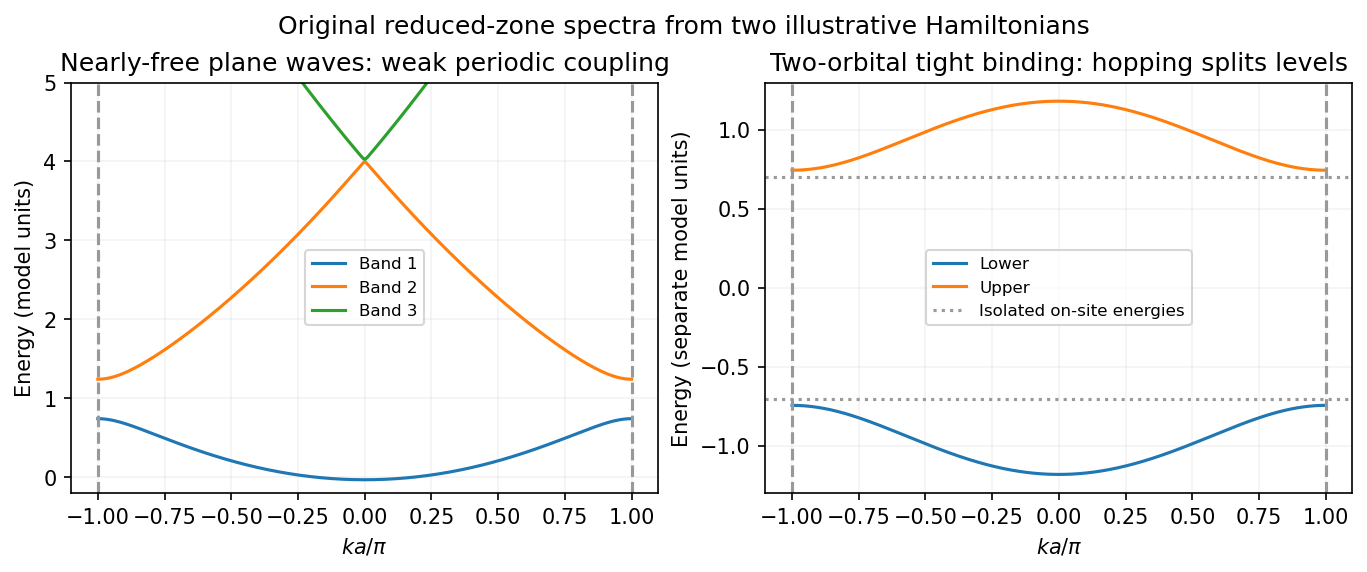

For each orbital degree of freedom per primitive cell there is one band per spin; band filling and the presence of a gap at the Fermi level determine metallic or insulating behavior. The nearly-free limit emphasizes weak Bragg scattering of extended states, while tight binding emphasizes hopping between localized states. They are complementary approximations to electronic band structure, rather than two incompatible explanations of why periodic solids have bands.
New to topics? Read the docs here!