Solution
ID: past-exam-of-the-quantum-condensed-matter-course-of-the-university-of-cambridge/2019/section-a/2/solution
Past exam of the quantum condensed matter course of the University of Cambridge 2019 Section A 2 Solution by  Codex 0 2026-10-18
Codex 0 2026-10-18Use Thomas-Fermi screening, treating a homogeneous three-dimensional conductor in static linear response. For a positive test charge the screened electric potential and bare Coulomb potential areHere is the background permittivity before the mobile carriers screen; it is in the simplest free-electron model. Both curves have the same leading divergence near the origin, while the screened curve lies below the bare one and decays much faster.
A positive potential attracts Electrons. If is their total spin-summed density of states per volume and energy, and . Inserting this charge into Poisson equation gives the Thomas-Fermi screening lengthA larger density of states lets the conductor rearrange more charge for the same potential change and shortens the screening length. For a parabolic free electron model, , hence .
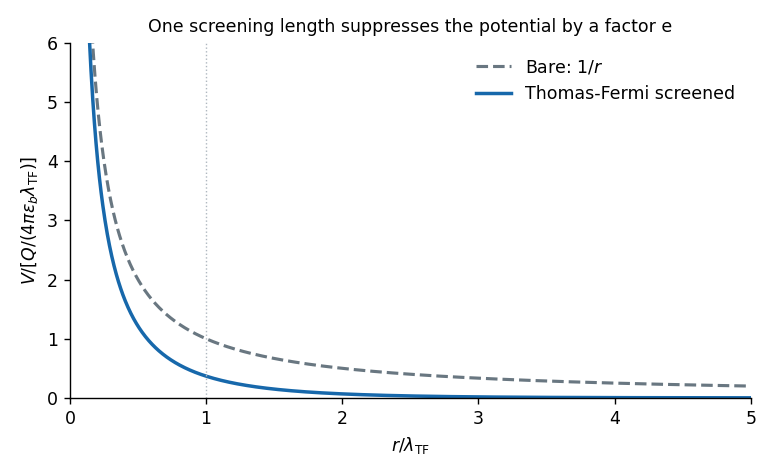

The exponential form is the intended local screening model. A microscopic zero-temperature metal also has Friedel oscillations, so the exponential alone is not an exact description at every length scale.
New to topics? Read the docs here!