Solution

ID: past-exam-of-the-short-options-paper-shared-by-prelims-and-parts-a-and-b-of-the-physics-course-of-the-university-of-oxford/2012/s26/2/3/i/solution

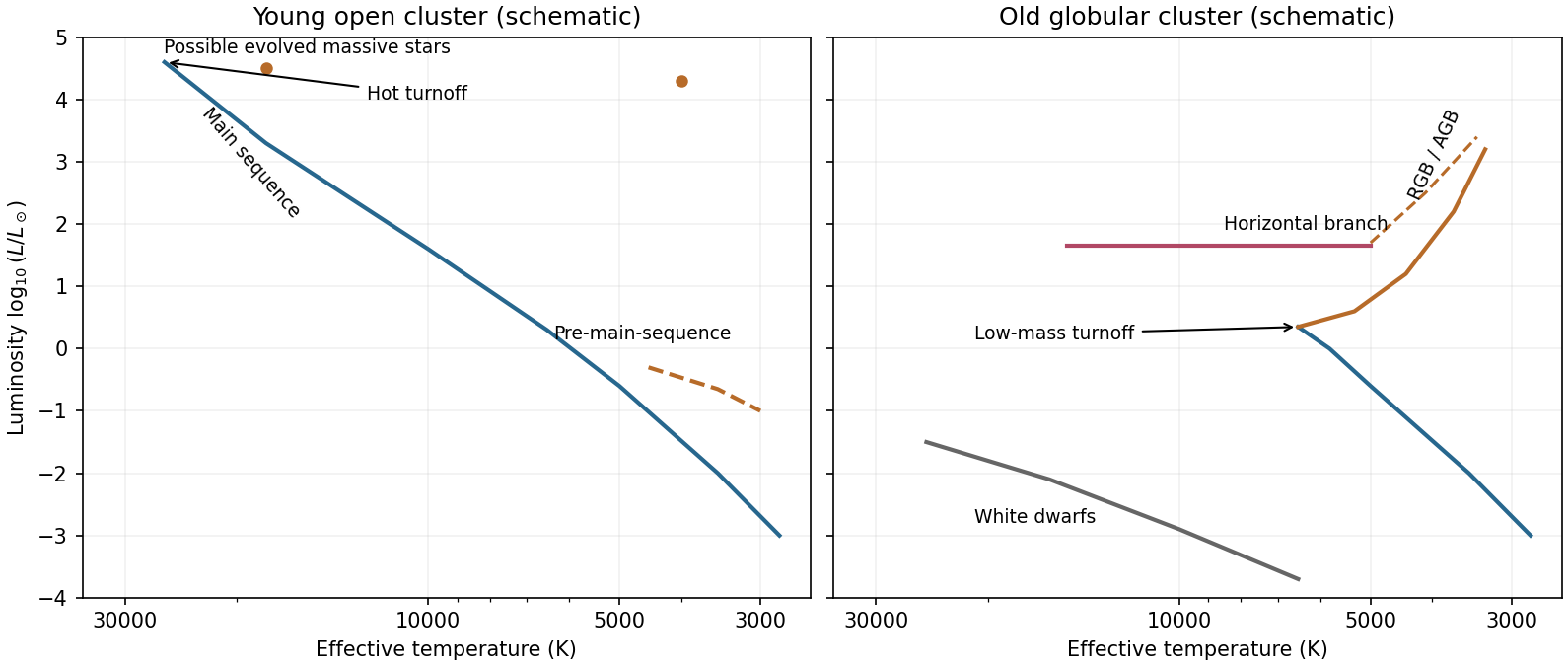
For a young open cluster, the Hertzsprung-Russell diagram contains a populated main sequence reaching hot, luminous, high-mass stars, with a high-mass main-sequence turnoff determined by its age. Cool low-mass members may still lie on tracks of pre-main-sequence stars above the lower main sequence. Depending on how young the cluster is, a few evolved blue or red supergiants may already be present; an extremely young cluster need not have any. It lacks the dominant old low-mass red-giant and horizontal-branch populations of an old globular cluster.
Figure 1.
Schematic temperature-luminosity diagrams of young and old star clusters
. Temperature decreases to the right. The young cluster reaches a hot luminous turnoff and contains possible pre-main-sequence stars; the old cluster has a cool low-mass turnoff, red giant and horizontal branches, and a white-dwarf sequence. Curves are illustrative population sketches, not fitted isochrones. Details.

New to topics? Read the docs here!