Solution

ID: past-exam-of-the-short-options-paper-shared-by-prelims-and-parts-a-and-b-of-the-physics-course-of-the-university-of-oxford/2015/s18/1/6/solution

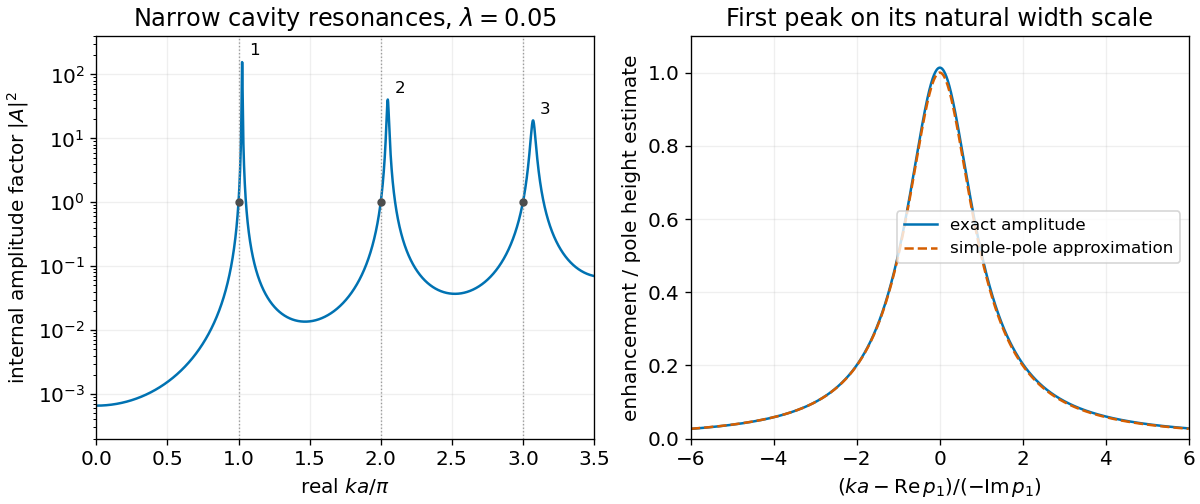
For real , taking the modulus squared of the amplitude gives the half-line delta-well amplitude enhancement
The supplied resonance poles have real parts and negative imaginary parts for fixed low at .[ref] Linearizing the denominator at a simple pole gives
Thus the sketch has narrow, tall peaks with a locally Lorentzian line shape, just above positive integer multiples of . Their half-widths are , and the leading peak heights are . In this fixed-low-mode approximation, increasing broadens and lowers the peaks. Exactly at , the value is one. At zero it has the finite limit for .
The peaks represent long-lived standing waves between the wall and the attractive delta potential. Despite the source's transmission-coefficient terminology, is an internal amplitude factor and can exceed one. The interior probability current is zero, and the reflected probability current equals the incident magnitude; the hard wall passes no transmitted flux.

New to topics? Read the docs here!