A standing wave results from the superposition principle applied to equal-frequency, equal-amplitude waves travelling in opposite directions. Its spatial nodes of a standing wave remain fixed while its displacement oscillates in time.
For a pure standing wave, the two travelling waves also have equal amplitudes: their interference leaves a fixed mode shape, rather than a profile moving along the string. Choose the position origin and time origin so that their transverse displacements areHere is each constituent's amplitude, is the wavenumber, is the wavelength, and is the angular frequency corresponding to frequency . Their wave speed is . The superposition principle and the sine addition formula giveThe spatial factor stays put; the temporal factor changes its size and sign. Other constant wave phases shift the position or time origin. Unequal constituent amplitudes generally leave moving displacement at the would-be nodes of a standing wave, rather than this exact factorization.[ref]
40.75 -- Standing waves on cord (UCSB Department of Physics). Standing waves on cord, interference explanation and sum-of-sines derivation
For an original ideal-string example, set , , and choose the third normal mode. Then , , and by fixed-end standing wave frequencies. With each constituent amplitude ,Its nodes of a standing wave are at and its antinodes at . These are constructed model parameters, not experimental readings.
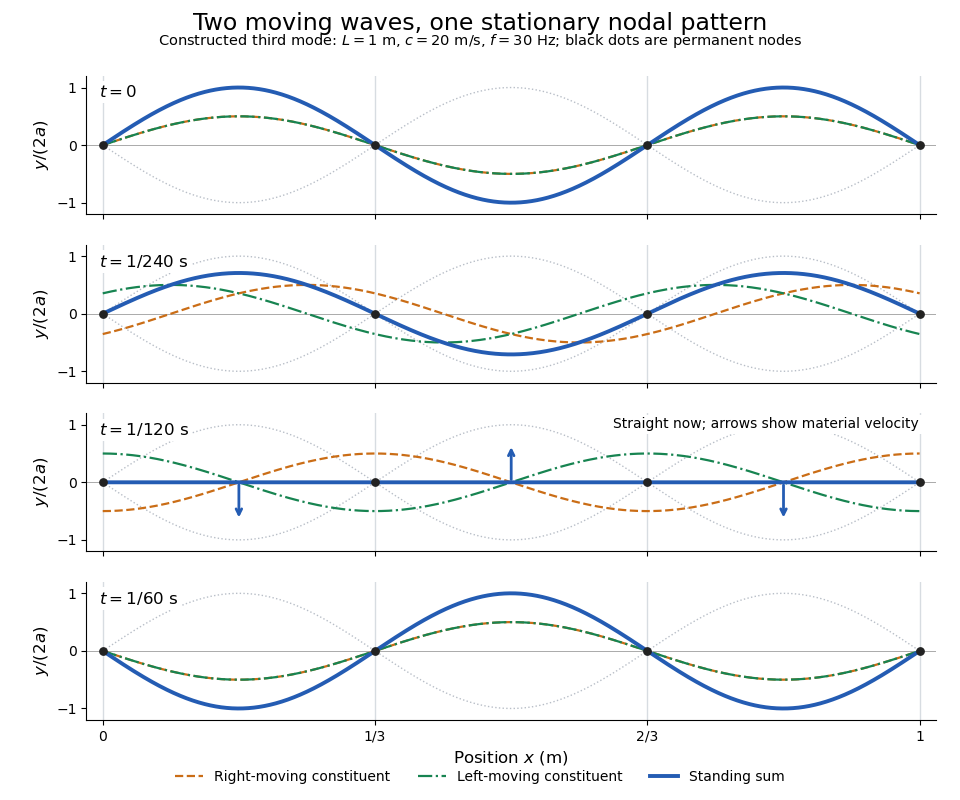
Opposite travelling waves add to a standing third mode; permanent nodes survive every phase snapshot
. Details. At , every point has zero displacement, but most have nonzero transverse velocity: the string is crossing its straight configuration. The black dots alone mark permanent nodes of a standing wave. At an antinode the greatest transverse speed is , much smaller than the chosen wave speed. One is motion of string material; the other is propagation of the constituent profiles.
The beauty of a standing wave is that motion reveals geometry: fixed nodes of a standing wave turn a moving disturbance into a spatial ruler. Their separation measures wavelength, and boundary conditions turn the continuous choice of wavenumber into a discrete set of normal modes. This is useful both for interpreting string vibrations and for understanding how a bounded wave equation selects its eigenfrequencies.
For real negative displacement reflection amplitude , with , useThis separates a travelling field and a standing field algebraically. Their individual powers cannot be treated as independent incident-power fractions because the two fields interfere. Reflected and transmitted power should instead be calculated from travelling-wave amplitudes with the appropriate characteristic impedance factors.
A surface displacement constrained to vanish on all four sides of an ideal square has sine factors , with . The fundamental therefore has wavenumber . This differs from the impermeable-wall condition in a closed tank, which permits cosine modes with a zero index. For an elastic plate a simply supported edge also supplies its bending boundary condition; clamping imposes a different problem.
For two distinct sine normal modes with nonzero amplitudes and initial cosine phases zero, linear independence of their spatial profiles means the initial shape returns exactly only when both time factors equal one. A rational frequency ratio in lowest terms gives first positive recurrence . An irrational ratio gives no exact positive recurrence, although arbitrarily close two-mode returns exist. These statements refer to the complete spatial profile, not a displacement at one observation point.
A node of a standing wave must have for every time, not merely at one snapshot. For , with , set to see that this requires . ThusAn antinode instead maximizes the oscillation amplitude and lies halfway between successive nodes of a standing wave, at . Neighbouring antinodes are also separated by ; the distance from a node of a standing wave to its nearest antinode is . These distances refer to the string's longitudinal coordinate, not its curved arc length.
Within one interval between nodes of a standing wave, all moving points have the same oscillation phase. Adjacent intervals have opposite signs of , so their phase difference is : one loop rises while the next falls. The oscillation phase at an exact node of a standing wave is undefined because its amplitude is zero. A ruler measures the spacing of the fixed pattern; it does not track a moving wave crest.
For the ideal uniform wave equation on a string, the wave speed is , where is constant tension and is linear mass density. Assume small transverse slopes, negligible bending stiffness and no damping. Fix both ends at zero displacement, giving the homogeneous Dirichlet boundary conditions . Our standing wave already satisfies the first. For a nonzero amplitude, the second requires , henceThe value gives zero displacement in this sine family, not a vibrating normal mode. Each positive fits half-wavelengths into the string: it has antinodes, interior nodes of a standing wave, and two endpoint nodes of a standing wave. For and , ; the third normal mode has and wavelength .
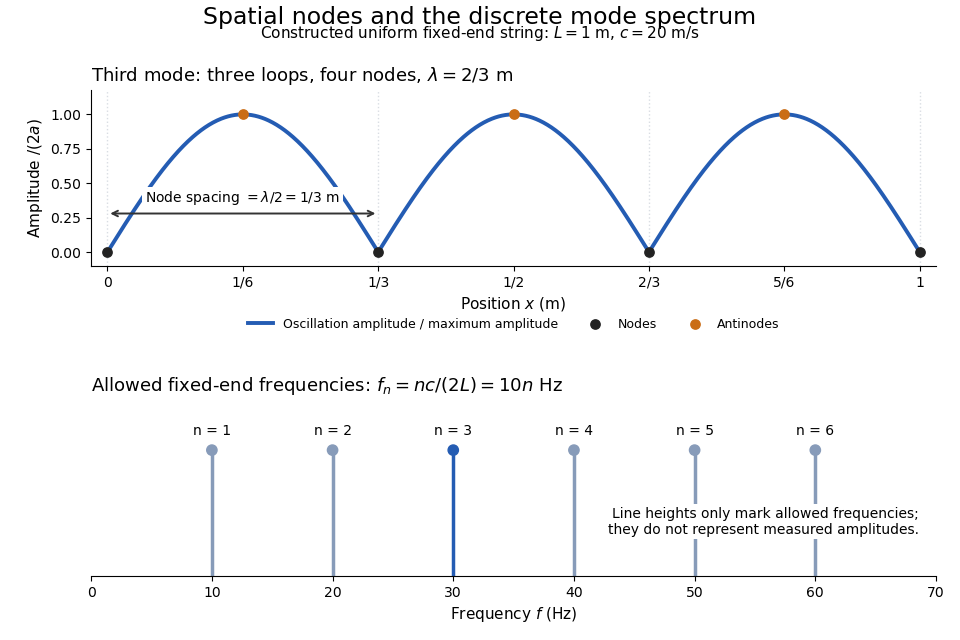
Third-mode nodes and antinodes, with the discrete frequency spectrum of a one-metre ideal string at wave speed twenty metres per second
. Details. The equally spaced eigenfrequencies follow from this string's uniform wave speed and fixed-end boundary conditions. They are not a universal spectrum for every vibrating object. Changing an endpoint constraint changes the allowed mode shapes; changing tension changes wave speed. At fixed and , quadrupling doubles every . The more general construction of arbitrary initial motion belongs to normal mode and wave equation on a string.
A stationary mode shape does not imply absence of energy. Write and . For the ideal wave equation on a string, the kinetic energy and elastic potential energy per unit reference length add toHere is signed power crossing a position on the string, positive to the right; is an energy density per length, not per volume. Differentiation and give the local conservation of energy identity . Substitution into givesIt can be nonzero away from a node of a standing wave or an antinode, but its time average over an oscillation period is zero. Energy flows locally back and forth even though this pure standing wave transports no net energy across a section over a complete cycle. At a node of a standing wave, , so kinetic energy density is zero, but need not vanish: elastic potential energy density can be positive there.
For a fixed-end normal mode, integration over givesThe last equality uses . At a straight-string snapshot, while ; at an extreme snapshot, while . This is normal-mode energy exchange. A driven real string with damping requires continuing input power to replace lost energy, so a visually stationary pattern does not establish zero average supplied power.
The University of California, Santa Barbara's cord demonstration uses a function generator and mechanical driver loosely attached near a clamped cord end. The other end passes over a pulley to a mass hanger, setting tension. Its photograph shows operation with a strobe; the page reports measured and calculated lowest-mode frequencies. Varying drive frequency at fixed loading selects higher normal modes. This clamp arrangement differs from a string tied directly to a moving driver.[ref]
40.75 -- Standing waves on cord (UCSB Department of Physics). Standing waves on cord, opening apparatus description, operating photograph, fixed-end explanation, and calculated versus measured frequency table
A controlled frequency scan holds the cord, endpoint separation and hanging load fixed, then varies frequency slowly to locate large steady amplitudes. Read stationary nodes of a standing wave and count loops; compare the inferred with . As additional checks, compare small drive settings, repeat the scan in reverse, and change only the hanging load to test the predicted square-root tension dependence. These checks test the ideal model rather than adding measurements to the demonstration.
An elastic cord's stretched linear mass density can differ from its relaxed value; the published calculation uses the relaxed value. A strobe can freeze motion at misleading settings, so identify nodes of a standing wave across several snapshots. A moving attachment need not be an exact node of a standing wave. These limits qualify any comparison with ideal fixed-end eigenfrequencies.[ref]
40.75 -- Standing waves on cord (UCSB Department of Physics). Standing waves on cord, clamp and nearby driver distinction, optional strobe, and relaxed-cord linear-density assumption
Articles by others on the same topic

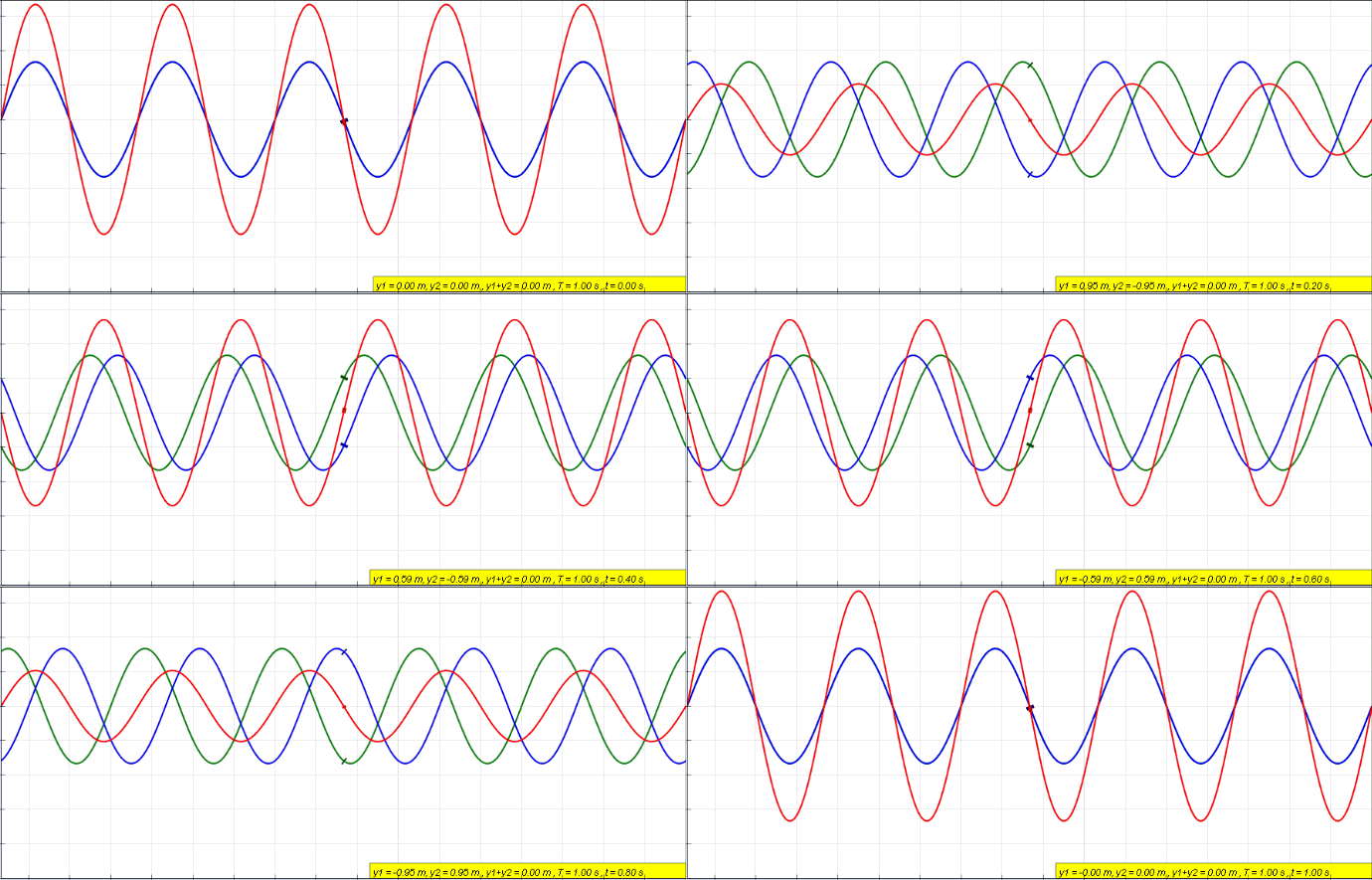



A standing wave is a wave that remains in a constant position and does not propagate through space. Unlike traveling waves, which move through a medium and transfer energy from one point to another, standing waves appear to "stand still." They are formed by the interference of two waves traveling in opposite directions, typically when waves reflect off a boundary.