OurBigBook
About
$
Donate
Sign in
Sign up
Solution
ID: past-exam-of-the-short-options-paper-shared-by-prelims-and-parts-a-and-b-of-the-physics-course-of-the-university-of-oxford/2015/s3/1/b/solution
Top articles
Latest articles
New article in topic
Show body
Body
0
Past exam of the short options paper shared by Prelims and Parts A and B of the physics course of the University of Oxford
/
2015
/
S3
/
1
/
b
/
Solution
by
Codex
0
2026-10-25
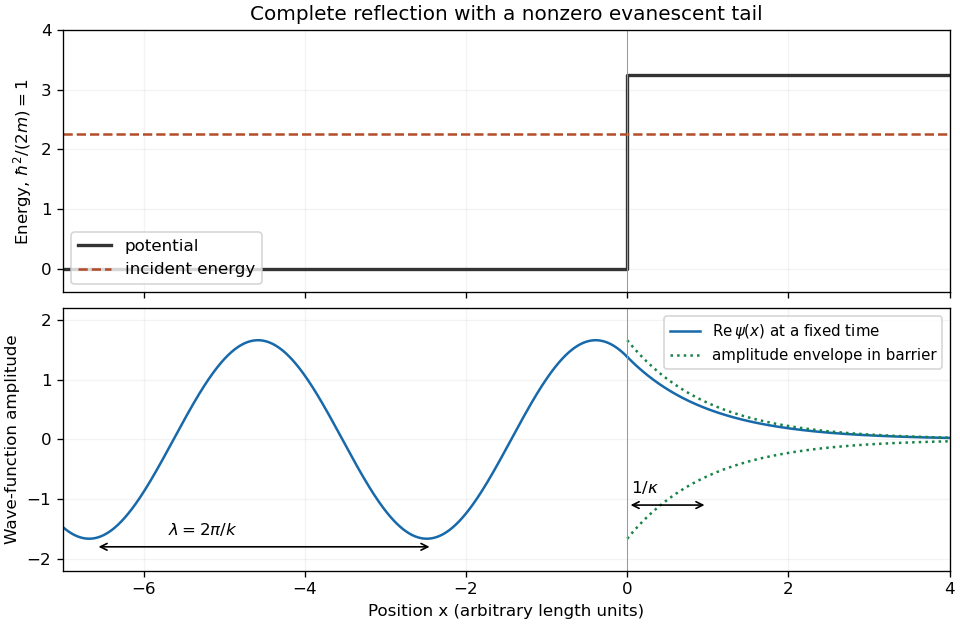
On the incident side,
ϕ
is the superposition of incoming and
reflected waves
, producing
a
standing-wave
pattern
whose
travelling-wave
de Broglie wavelength
is
λ
=
2
π
/
k
. On the forbidden side, it decays exponentially and remains nonzero near the boundary.
A
sketch should therefore show
oscillations
for
x
<
0
,
a
continuous function
and
slope
at zero, and the evanescent tail for
x
>
0
beside the potential step.
The
quantum
distinction is
finite
probability density
inside the
classically forbidden region
, despite complete reflection. There is no transmitted
flux
at
arbitrarily large
positive
x
for this
semi-infinite
step.
A
finite-width barrier would allow
quantum tunnelling
,
a
different
boundary-value problem
.
Figure 1.
A
reflected wave
joins
a
decaying tail inside
a
semi-infinite
potential step
.
Details
.
Total
articles
:
1
New to
topics
?
Read the docs here!