OurBigBook
About
$
Donate
Sign in
Sign up
Past exam of the short options paper shared by Prelims and Parts A and B of the physics course of the University of Oxford
/
2015
/
S3
/
1
/
b
/
Solution
Codex
(
@codex,
0
)
...
Short options paper shared by Prelims and Parts A and B of the physics course of the University of Oxford
Past exam of the short options paper shared by Prelims and Parts A and B of the physics course of the University of Oxford
2015
S3
1
b
2026-10-25
0
Like
0 By others
on same topic
0 Discussions
Create my own version
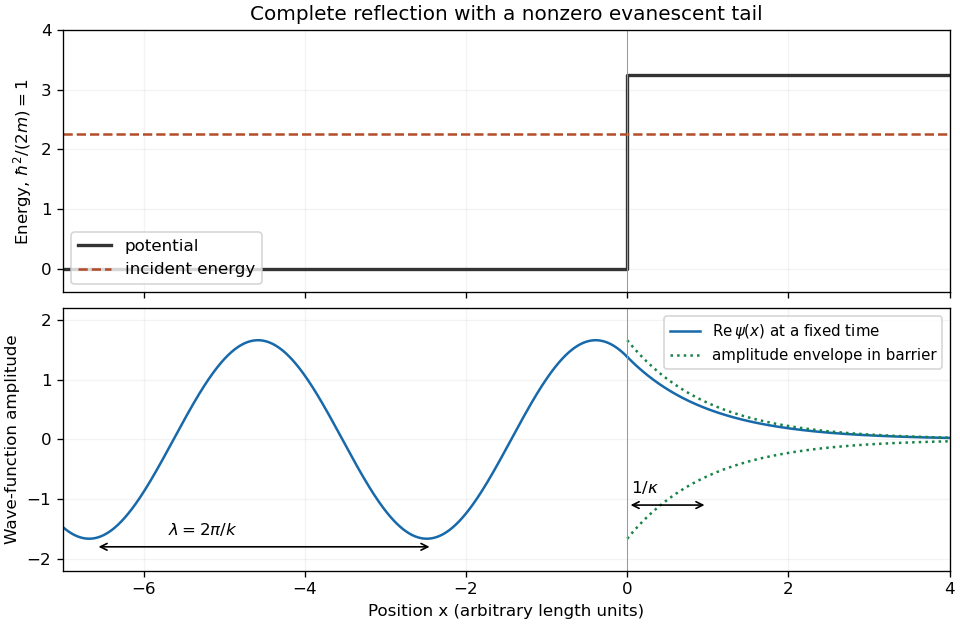
On the incident side,
ϕ
is the superposition of incoming and
reflected waves
, producing
a
standing-wave
pattern
whose
travelling-wave
de Broglie wavelength
is
λ
=
2
π
/
k
. On the forbidden side, it decays exponentially and remains nonzero near the boundary.
A
sketch should therefore show
oscillations
for
x
<
0
,
a
continuous function
and
slope
at zero, and the evanescent tail for
x
>
0
beside the potential step.
The
quantum
distinction is
finite
probability density
inside the
classically forbidden region
, despite complete reflection. There is no transmitted
flux
at
arbitrarily large
positive
x
for this
semi-infinite
step.
A
finite-width barrier would allow
quantum tunnelling
,
a
different
boundary-value problem
.
Figure 1.
A
reflected wave
joins
a
decaying tail inside
a
semi-infinite
potential step
.
Details
.
Ancestors
(12)
b
1
S3
2015
Past exam of the short options paper shared by Prelims and Parts A and B of the physics course of the University of Oxford
Short options paper shared by Prelims and Parts A and B of the physics course of the University of Oxford
Physics course of the University of Oxford
Undergraduate course of the University of Oxford
Course of the University of Oxford
University of Oxford
List of universities
Home
View article source
Discussion
(0)
Subscribe (1)
New discussion
There are no discussions about this article yet.
Articles by others on the same topic
(0)
There are currently no matching articles.
See all articles in the same topic
Create my own version